Jimmy Connor
Founder & Managing Partner | Bloor Street Capital | Uranium-focused mining interviewer and host
"Multi-day Virtual Uranium Conferences and long-form CEO interviews on the Bloor Street Capital YouTube channel."
Biography
Jimmy Connor is the founder and Managing Partner of Bloor Street Capital, a Toronto-based financial media and capital-markets advisory firm that has become one of the most-watched channels for retail investors following the uranium and broader resource sectors. He is the principal host of the Bloor Street Capital YouTube channel and the "Growing and Protecting My Wealth" podcast, where he has built a library of nearly 500 long-form interviews with mining executives, fund managers, and commodity strategists.
Before launching Bloor Street Capital, Connor spent more than a decade in capital markets at multinational firms including CIBC, working in trading and institutional coverage. That institutional background shows in his interview style: he presses guests on production guidance, offtake terms, balance-sheet runway, and the small print of regulatory filings rather than chasing promotional narratives, and the resulting catalog is regularly used by self-directed resource investors as primary research on individual companies and on commodity-cycle calls.
Connor is best known in commodity circles for his deep focus on the uranium thesis. He hosts the recurring Bloor Street Capital Virtual Uranium Conference, a multi-day event that has run at least four editions and has featured leadership from Kazatomprom, Cameco, enCore Energy, Denison Mines, UEC, Ur-Energy, Premier American Uranium, Verdera Energy, and Sprott Asset Management. The conferences have been promoted by the World Nuclear Association and have become a regular fixture in the uranium calendar alongside his one-off CEO interviews.
For a resource investor, the value of following Connor is a steady, executive-level view of the uranium supply-demand picture, layered with adjacent coverage of gold, silver, copper, lithium, and critical minerals. His interviews emphasize what management is actually doing — drilling, permitting, financing, and building offtake — over the macro narrative of the week, which is why both juniors and majors keep coming back to his channel.
Videos (69)
No Stopping Oil Price Shock | Rory Johnston and Jimmy Connor
About 13 million barrels a day remain shut in, yet WTI (the US crude benchmark) sits near $100 because inventories have not yet confirmed scarcity. Repeated White House posts knock $10-15 per barrel off crude within minutes, stopping traders from accumulating upside length while the deficit builds. Chinese refining data is the most bearish signal in the market: throughput has slumped while mobility stays strong, pointing to hidden strategic stockpile draws. The UAE left OPEC after absorbing over half of Iran's attacks and chafing at caps on its expanded capacity, leaving a more Saudi-led group. If the shut-in volumes stay offline past June, the guest expects Brent (the global crude benchmark) above $150 en route to $200.

Optimistic on the U.S. Economy | Claudia Sahm and Jimmy Connor
- Top takeaway The host argues higher oil is squeezing consumers, citing Delta's extra $2 billion fuel cost for Q2, new surcharges at Amazon, FedEx and UPS, and his own Toronto pump price rising to roughly US$5 per gallon equivalent by the time of the interview.
- The host keeps pointing to the resilience of the US economy and stock market, noting the S&P and NASDAQ keep grinding higher despite policy uncertainty.

Finding Value in Small Cap Stocks | Philippe Hynes and Jimmy Connor
- Top takeaway The host says, as a consumer, the free ad-supported Stingray in-car model sounds more favorable than paying for Sirius XM.
- The host remarks that he only goes to theaters for blockbusters like Mission Impossible and otherwise watches films at home.
Quality small caps trading at wide valuation gaps to large caps offer asymmetric upside, Hynes argues. The guest avoids mining and pure-play AI but likes AI infrastructure picks in data centers and electrical grids. Hynes is buying Cineplex, IMAX, and Stingray as earnings streams less exposed to AI disruption. Software heavyweights Microsoft and Oracle have sold off materially on AI fears, opening fresh research interest.

Bullish on the S&P and the U.S. Economy | Brian Belski and Jimmy Connor
- Top takeaway As host, Connor frames 2026 as 'one hell of a year' — flags private credit, AI valuations, the software-stock collapse, and the Middle East conflict since February 28 as the dominant themes of the year to date.
- Expresses concern that 'educated' Canadians are leaving the country at scale, pointing to 2025 marking Canada's first population decline since Confederation (down 102,000 people).
Belski argues the S&P 500 will reach 7300-7500 on an earnings-driven regime, which historically delivers half the returns and more corrections than a momentum-driven one. Gold at four standard deviations above its long-term average signals a multi-year underperformance window — Belski owns only Agnico Eagle (AEM) as a result. Belski flags asset-class stress as Ontario Teachers, Blue Owl, KKR, and Blackstone report private credit and private equity write-downs — but not systemic risk yet. Underweight the Mag7, overweight U.S. financials: Belski favors big diversified banks plus small community lenders with clean balance sheets. Belski prefers Canadian energy pipelines (Enbridge, TC Energy, Suncor) over U.S. drillers because U.S. producers need higher oil prices to break even.

Andean Precious Metals: Gold & Silver Producer in the Americas | JC Sandoval and Jimmy Connor
Andean's two-asset model pairs a 100% third-party ore processing plant in Bolivia with a producing gold mine in California, balancing silver and gold exposure. Blending fixed-price contracts with spot purchases at San Bartolome creates a natural price hedge, keeping margins intact through metal price swings. Golden Queen's AISC sits near $2,000, elevated by heavy equipment reinvestment that should taper as the operation matures. With over $160 million in cash and $30 million of debt, Andean is actively hunting a third Americas-based acquisition, preferring gold, silver, or copper. The near-term catalyst is a year-end 2026 43-101 technical report expected to extend Golden Queen's mine life beyond the current two-year estimate.
U.S. Based Uranium Company | Colin Healey and Jimmy Connor
Premier American Uranium stands out as one of the largest U.S.-focused uranium explorers, with both ISR (Wyoming) and heap leach (New Mexico) assets. Cebieta's PEA shows robust economics: 1.4M lbs/year production over 13 years at $90/lb uranium, with $115M capex and $84M after-tax NPV at 80% recovery. Heap leach recovery is the key swing variable: lifting it from 80% to 90% could add roughly $75M to Cebieta's after-tax NPV. Wyoming ISR drilling extended an 8-mile mineralized trend at KC and delivered a project-record 15.5 ft hole grading 0.09% U3O8 at Cyclone. A $15M bought-deal financing was anchored by existing institutional shareholders, with management focusing on scale to re-enter major uranium ETFs.

NexGen Energy Update | Leigh Curyer and Jimmy Connor
NexGen is fully permitted and has begun construction at Rook I in Saskatchewan, targeting first production in 2030 after a roughly 48-month build. Rook I economics look sharp: $1.5B US capex, $800M already funded, sub-12-month payback at spot, and up to 30M lbs/year (~20% of global supply). NexGen's Patterson Corridor East (PCE) discovery 3.5 km from Arrow has four rigs active and could 'completely change the economics' as Phase 2. Management expects uranium prices to push well past $100/lb as major-producer incentive prices approach $70/lb and supply stays tight. Saskatchewan provincial bodies are co-running training programs in local communities and Saskatoon, drawing 400+ applicants for 16-20 recent roles.
Paladin Energy Update | Paul Hemburrow and Jimmy Connor
- Top takeaway The host frames the conversation as a broad investor update on Paladin Energy, steering the discussion through operations, contracts, balance sheet, permitting, and news flow.
Langer Heinrich is in the final phase of ramp-up, targeting ~91% recoveries and full year guidance of 4.4M lbs at $44-$48/lb. Athabasca PLS adds about 93M lbs of reserves, a 10-year mine life, and three active drill rigs with further resource growth drilling planned. Contract book covers 23M lbs through 2030 across 14 utilities spanning Europe, Asia, and North America; ~47% of contracts are base-escalated for downside protection. Balance sheet: $278M cash plus a $70M undrawn debt facility, with capital mainly earmarked for PLS engineering and exploration. No US listing planned; ~43% of the shareholder base sits in North America and just over 20% in Australia.

Time to Buy Gold & Silver? | Jason Shapiro and Jimmy Connor
Silver offers the best risk-reward because COT data shows speculators historically short; the guest stays neutral on the S&P, oil, copper, and Bitcoin. Wait for a 'news failure' day when bad news can't push prices lower; buy at the day's low and exit when positioning turns neutral. A 35-40% win rate with 4:1 winners-to-losers works mathematically; missing turns is fine if stops and sizing are disciplined. He watches bonds most — government, AI, and private-credit borrowing drain liquidity — and expects the next QE round to be rejected. No-brainer trades like 'copper-as-AI' tend to undo themselves once the crowd piles in; markets usually need shakeouts before a thesis can resume.

Uranium Flows in Q1 2026 | John Ciampaglia and Jimmy Connor
- Top takeaway Argues the U.S. government is going all-in on nuclear power — four executive orders last year, a goal of starting construction on 10 reactors before 2030, and uranium added to the critical materials list — yet uranium prices and equities have not responded, leaving many retail investors frustrated.
- Notes India runs only 25 reactors and gets 3% of its grid from nuclear energy, which he calls enormous room for upside as its large population gains wealth and appliances like air conditioning.
Guest John Ciampaglia argues uranium's slide from $100 to the mid-$80s after the Iran war reflects investor de-risking, not damaged fundamentals. The uranium term price — the base reference price for future delivery — sits at $90 per pound, its highest level since 2008. A carry trade — buying spot weakness and selling uranium forward — keeps spot and term prices tethered, cushioning market downdrafts. India's state-owned energy company is signing multi-billion-dollar uranium contracts with Kazatomprom and Cameco, joining China in locking down long-term supply. He expects a tight market: no meaningful new mine supply until roughly 2030, when utilities' uncovered requirements grow and price caps reach $150.

Kazatomprom: The World's Largest Uranium Producer | Dastan Kosherbayev and Jimmy Connor
- Top takeaway Through his questioning he argues official contracting data is understated - challenging the UXC figure of 116 million pounds contracted in 2025 as unreliable because reporting is voluntary - and frames sulfuric acid access, cost inflation, and Middle East and Russia-Ukraine risks as the key supply issues.
- He pushes the view that fuel buyers betting on falling prices are 'waking up to the new reality' that prices will not drop, and closes by pointing investors to upcoming Kazatomprom IR events and his possible attendance at the Bank of America conference in Miami.
Kazatomprom's 2026 guidance of 71–75 million pounds looks attainable: sulfuric acid (its key input) is secured, with a third in-house plant due in early 2027. C1 cash cost (direct production cost per pound) guidance of $23.50–$25.00 and AISC (all-in sustaining cost) of $35.00–$36.50 reflect inflation and higher Kazakh mining taxes. The guest argues uranium's structurally strong fundamentals are being obscured by policy uncertainty: Eastern fuel buyers contract decades out while Western utilities hesitate. US reactors need roughly 50–60 million pounds of uranium a year against about 1 million pounds of 2024 domestic output, forcing reliance on external supply. An India contract comparable to Cameco's signals Eastern demand, while Middle East turmoil has lifted uranium prices without disrupting Kazatomprom's operations.
IsoEnergy Update | Phil Williams and James Connor
- Top takeaway Connor frames the update around the Toro acquisition and the well-received capital raise, then argues most of IsoEnergy's roughly C$900 million market cap reflects only Hurricane and Tony M — a view Williams fully endorses.
- He stresses the US mismatch, noting the country consumes 45-50 million pounds of uranium a year while producing very little domestically.
IsoEnergy's Tony M mine in Utah is on track for a production restart decision before year-end, backed by a bulk sample and updated technical study. Winter drilling at Hurricane — the world's highest-grade uranium deposit at 34.5% — expanded past plan, with results due in weeks. Management argues Hurricane plus the adjacent Cameco-Orano Dawn Lake project could replace the depleting Cigar Lake mine after full production ends in 2035. The pending Toro Energy acquisition adds scale toward 400 million pounds of uranium and a Western Australian project management believes policy changes will unlock. An oversubscribed $57.5 million equity raise from about 45 institutions funds the restart decision, exploration programs, and the Toro closing.

Denison Mines Update | David Cates and Geoff Smith
- Top takeaway Frames the interview around Denison's two-year transition from developer to producer, pressing on Phoenix construction timing, the $600 million capex increase, contracting, Griffin funding, and skilled labor.
- Argues the Athabasca Basin's size is underappreciated and much of it remains unexplored, drawing out Cates' case for running multiple exploration teams through Team Denison.
Denison started construction at Phoenix, its in-situ recovery (ISR — wells and solutions, no shafts) uranium mine, targeting first production by mid-2028. Post-FID capex for Phoenix is set at $600 million, up from the 2023 feasibility study, reflecting inflation; provincial grid power limits diesel exposure. The McLean joint venture with operator Orano delivered Denison's share of about 150,000 pounds in 2025, adding to its held physical uranium inventory. Management aims to fund the Griffin underground mine from Phoenix cash flow, targeting a combined 16-18 year mine life and over 100 million pounds. A 'Team Denison' portfolio of junior partners (Cosa, Foremost, Skyharbour) spreads exploration across the underexplored Athabasca Basin while construction stays the priority.

Virtual Nuclear Energy & Uranium Conference | Learn the Benefits of Nuclear Energy
- Top takeaway Connor opens the conference arguing uranium has the strongest fundamental setup of any sector — WNA demand of 170 million pounds a year against 140-150 million of supply and 74 reactors under construction — yet spot sits well below the 2007 peak of $136, and he asks guests whether the market is mispriced.
- He presses guests on why the price has not responded to producer discipline and government support, and how frustrated retail investors should think about the next catalysts.
Uranium's term price (the long-term reference price) holds near $90 per pound, its highest level since 2008, anchoring a firm spot market. Producers are holding output flat while utilities and state buyers like India return, signaling intensifying competition for future pounds. Denison Mines has started construction at Phoenix, the first new Canadian uranium mine approved in over 20 years, targeting production by mid-2028. NexGen says fully permitted Arrow will produce up to 30 million pounds annually — about 20% of world mine supply — with construction underway. Contract terms are shifting toward sellers: ceilings near $150 per pound, some deals with no cap at all, ending the $30 fixed-price era.
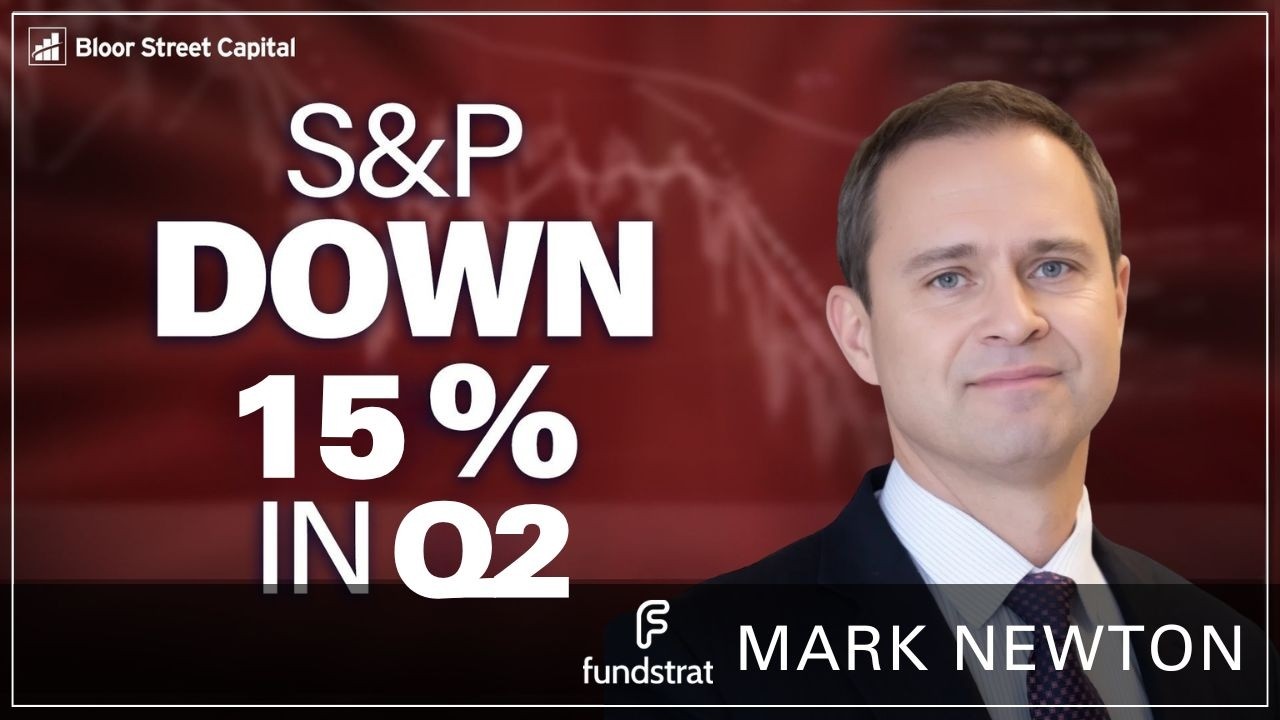
More Downside For S&P and Gold | Mark Newton and Jimmy Connor
- Top takeaway As host, Connor frames the episode around a month of extreme volatility in which Middle East tensions overshadowed AI and private-credit worries, and presses Newton for downside targets on every major asset.
- He closes by summarizing Newton's key calls, including S&P toward 6,200, gold toward 3,800, Bitcoin toward $50,000, and meaningfully lower oil in the second half of 2026.
Technical strategist Mark Newton expects an S&P 500 slide toward 6,200 — a 38% retracement of the move off last April's low — before a mid-April-to-mid-May bottom. Gold's three-year rally looks exhausted — the monthly RSI (a 0-100 momentum gauge) hit about 95 — and he sees 3,800 or lower into summer. Slowing central bank gold buying and ETF outflows confirm a peak; he would buy metals on summer weakness, favoring July-October seasonality. Bitcoin likely makes one more leg down toward $52,000-$50,000; a break under $65,000 would signal the capitulation that marks durable lows. Energy stocks lagging crude oil warns the war-driven rally is late; he would short crude at $110-$115 and expects lower Q4 prices.

Uranium Market Update | Justin Huhn and Jimmy Connor
- Top takeaway He frames the US supply deficit for the guest — the world's largest uranium consumer uses 45-50 million pounds a year against roughly a million pounds of domestic production, with 20% of its grid nuclear-powered.
- He raises the precedent of US government equity stakes in resource companies, citing Lithium Americas in Nevada and Trilogy Metals in Alaska, to ask whether Washington might take a stake in a uranium name.
- He argues jurisdiction deserves a premium, pointing to what he calls a Mexican company and the world's largest silver producer acquiring a Quebec gold developer in late 2025 for about $800 million, and asks whether a similar buyer could target a permitted uranium developer.
- He presses the M&A question on NexGen and Denison — fully permitted but still needing to build — and asks whether Cameco, BHP, or Rio might ultimately step in.
Strait of Hormuz disruption risks sulfur supply for uranium processing; Namibia's Husab and Rossing face output losses if imports stall for weeks. Kazatomprom's growth increasingly serves the east: almost half of 2025 sales went to China, and its new JV project's output goes entirely to Russia. Term uranium sits near $90 a pound with spot around $83; Sprott's physical trust has bought about 6 million pounds of its 2026 allotment. US executive orders target 10 large new reactors under construction by 2030, yet America consumes 45 to 50 million pounds yearly and produces far less. The guest argues NexGen's Arrow is the supply linchpin, but timeline slippage and Kazakh mine decline rates leave the 2030s supply gap unresolved.

$200 Oil and Impact on Global Economy | Rory Johnston and Jimmy Connor
- Top takeaway Frames the episode around the investing angle, pressing the guest on whether the setup means investors have to be long oil and natural gas.
- Supplies market color: oil started 2026 near $60 and ran to about $100, and every $10 crude move adds roughly 25 cents at US pumps.
The Strait of Hormuz closure removes roughly 20 million barrels a day — about a fifth of global oil supply — rivaling peak-COVID demand destruction. Rory Johnston argues oil near $100 is firmly too low and sees the inflation-adjusted record near $200 as reachable this year if the closure persists. Refined products are cracking first: Asian jet fuel spiked past $200 a barrel, and diesel cracks near $60 imply $150–$160 effective costs. The IEA's 400-million-barrel release, the largest ever at roughly 3 million barrels a day, is a band-aid against a 15–20 million barrel daily loss. Johnston is at his most bullish ever on near-term energy exposure, but warns energy stocks do poorly in the recession-or-worse conditions this crisis risks.

What's Next For Oil and How To Prepare | Josh Young and Jimmy Connor
- Top takeaway Frames the 1970s analogy — the 1973 embargo took oil from $3 to $12 and the 1979 revolution from $14 to $38 — and asks whether a double-or-triple move could repeat now.
- Highlights Canadian pump prices, noting the carbon-tax repeal cut 17 cents a litre while prices still jumped to about $1.50 a litre, roughly $4.20 a gallon, as oil surged.
- Presses on investor positioning for the volatility and puts the guest on the spot on where oil lands by December 2026.
- Flags the macro toll of high oil: a weak February non-farm number, rising unemployment, sticky inflation, and airline stocks down 20-40%.
Josh Young argues the Strait of Hormuz blockade removes 10-20 million barrels a day, and longer disruption points oil toward $150 or higher. He draws a 1970s analogy: an initial spike, a deep retracement, then a second supply-driven surge toward inflation-adjusted record prices. Iranian exports keep flowing to China through workarounds, and unenforced sanctions signal weakness that Young says sets up a larger price shock. Oil demand stays price-inelastic because fuel is a small share of ownership costs, and rising wealth keeps lifting per-capita consumption. The guest sees the biggest opportunity in smaller oil and gas producers whose transformed cash flows are not yet reflected in share prices.
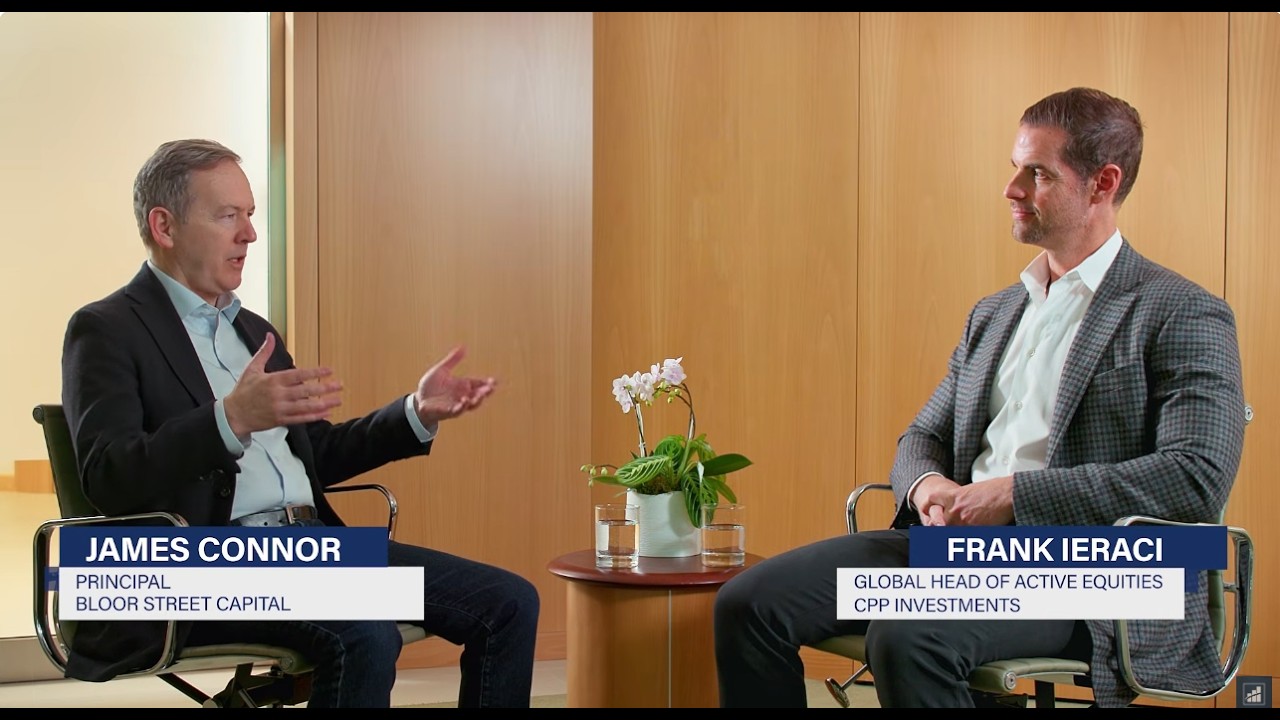
CPP Investments | Frank Ieraci and Jimmy Connor
- Top takeaway Jimmy Connor argues that after gold's run to or near $5,000 an ounce, producers trade at very rich valuations that no longer fit a bottom-up value approach.
- He presses on AI valuations, citing OpenAI's rise from a $20 billion valuation at ChatGPT's November 2022 release to $500 billion at its latest raise, and asks whether this recalls the early-2000s tech bubble.
- He challenges the idea that a pension fund must be conservative, saying he was surprised CPP Investments held Nvidia and is an early investor in Waymo.
- He describes riding a Waymo autonomous vehicle in Austin, operated in partnership with Uber, and says he was blown away by its capabilities.
- He frames a weak Canadian backdrop for the interview: declining GDP per capita, falling labor productivity, rising unemployment, and Canada-US trade-negotiation uncertainty.
CPP Investments targets a risk level rather than fixed asset allocations, flexing across sectors, geographies, and asset classes to find the best risk-reward. The fund owns no gold or gold miners today; management sees producers as richly valued after gold's run toward $5,000 an ounce. Central banks have lifted gold buying to as much as 30% of annual production since 2022, a key driver behind the metal's rally. On energy, CPP Investments would evaluate Canadian pipelines and infrastructure if shown a real economic case and durable assets. With a 3-5 year holding horizon and 20-25% annual turnover, the fund argues scale lets active management beat ETFs.

Skeena Gold + Silver | Walter Coles and Jimmy Connor
- Top takeaway His central argument is a valuation gap: mid-tier gold producers trade at about 7.5 times EBITDA, and Skeena is expected to produce $2.1 billion of EBITDA, which he says would imply roughly a $15 billion market cap against about $4 billion today.
- He points to Lundin Gold at roughly a $26 billion Canadian market cap and Artemis Gold at around $10 billion as the comparables a producer of Eskay Creek's size would command.
- He closes by inviting viewers into the final leg of the Lassonde curve, the stretch immediately before a mine starts generating cash flow.
- Connor notes Skeena was a new name for him before this interview and frames the whole discussion as introducing the stock to his audience.
Eskay Creek is fully permitted and half built, with Coles guiding to first cash flow in 2027 instead of 2028 or 2029. Silver supplies roughly 40% of the project's value, averaging 9.5 million ounces a year in the first five years. AISC (All-In Sustaining Cost — what it really costs to produce an ounce) runs $538 per gold-equivalent ounce in years one through five. Coles says the Blackstone-Orion package covers construction, and refinancing the 12.13% debt plus a two-thirds stream buyback come next. Management expects investors to front-run the first cash flow, and values Skeena between mid-tier gold producers on EBITDA multiples.
Key Works
Long-form interviews with mining executives and commodity strategists; nearly 500 videos focused on uranium, gold, silver, copper, and critical minerals.
Audio version of Bloor Street Capital interviews covering resource investing and wealth preservation.
Recurring multi-day virtual conference featuring leadership from Kazatomprom, Cameco, Denison Mines, enCore Energy, UEC, Ur-Energy, Sprott, and other uranium names; promoted by the World Nuclear Association.
Specializations
Disclaimer: Jimmy Connor has NOT endorsed this platform and is not affiliated with Pixys in any way.