Allan Barry Laboucan
Founder, Rocks And Stocks News | President & CEO, Advance Lithium Corp | Host of the Lab Report
"Daily junior-miner deep dives on the Lab Report and more than three decades in mining, from the Allan Barry Report to Smoke Signals Investing."
Biography
Allan Barry Laboucan is the founder of Rocks And Stocks News and host of its daily Lab Report, where he breaks down junior mining stocks the same day their news crosses the wire. A First Nations mining entrepreneur, he has worked in the sector since 1993 and covered it as a reporter and interviewer since 2005. He is also President, CEO and a director of Advance Lithium Corp (TSX-V: AALI, formerly Advance Gold), a small exploration company with lithium salars (salt flats whose brines can hold lithium) and gold projects in Mexico. That combination of operator and commentator is the draw: he reads press releases, economic studies and financing terms the way a company insider does.
He founded the Allan Barry Report in 2005, an online show of interviews with mining executives, and appeared frequently on business television and at investor conferences. In 2017 he published Smoke Signals Investing: An Insider's Guide to Finding Junior Mining Stocks Before They Take Off, which reached No. 1 on Amazon's Energy & Mining Industry bestseller list. On the executive side, he was appointed President and CEO of Alset Energy in October 2016 and has led the company through its renames to Advance Gold and, in December 2021, Advance Lithium. Under his tenure it acquired 13 lithium-potassium-boron salars in Mexico (2020), added the Sarape gold project (2022), and agreed in 2023 to buy Wolfden Resources' Bathurst Mining Camp projects in New Brunswick, while holding talks with LitioMx, Mexico's state lithium company, about a possible joint venture.
Each Lab Report episode pairs a market overview with deep dives on a handful of companies in the news, and the show is powered by the investor platform CEO.CA, where his videos also run on the official channel. Two tools anchor his analysis: the Lassonde Curve, a model describing the stages through which exploration juniors typically de-risk and revalue from discovery toward production, and sentiment readouts from CEO.CA users. When he weighs economic studies, he has said he favors IRR (internal rate of return, the annualized return a project is expected to generate) and payback period over headline NPV (net present value, what a project's future cash flows are worth today). His coverage spans precious and base metals juniors across Mexico, the United States, Canada and Brazil, set against a macro view built on monetary policy; in September 2026 he argued that renewed quantitative easing was "inevitable and closer than people think" and supportive of gold, silver and copper.
Laboucan works from Zacatecas, Mexico, and publishes daily on the Rocks And Stocks News Substack, with audio versions distributed as the Rocks And Stocks News podcast. He discloses that he often holds shares or warrants in companies he covers, and he tells readers he is "only an idea generator" whose work is a starting point for their own research. For a resource investor, the value is watching an experienced junior-market participant sort news flow in real time, with the skepticism of someone who has run a public company himself.
Videos (46)
Lab Report | Aug 20 Daily Market Overview & Deep Dive on Athena, Mackay, Orogen, Sirios
- Top takeaway He is bullish on gold and silver, arguing that fiat currency and the debt system are broken and that all roads lead to gold, with silver following the same path to a degree.
- He points to weak copper supply against strong demand from AI and other electricity-driven uses, and says copper has moved from the lower left to the upper right of his chart over roughly the past year.
- He notes the Dow, S&P 500 and Nasdaq were all lower on Aug 20 amid rate uncertainty, and argues bond yields at multi-year highs are the clearest signal that rate relief is not coming.
- On the stocks he covered he sees Athena sitting very early on the Lassonde curve despite its new Red Lake discovery and a roughly $16.5M valuation, while treating Mackay's roughly $257M valuation as rich but with room to run.
- His stated working method is to watch where companies drill relative to grade and mineralisation, the lens he applies to the fourth deep dive's high-grade shoots beneath the pit shell, and he moved the show's format to deep dives first with the market overview at the end.
Athena Gold's new Red Lake hit of 23.85 g/t (grams per tonne) over 5 metres, near surface, is the standout result. The host reads Sirios' 2.4 g/t over 48.5 metres at Cheech as high-grade shoots being tested beneath the open pit. Mackay Gold & Silver adds a core rig to test the historic Sutro tunnel intersection on the Comstock, Nevada, inside a 20,000-metre program. Orogen Royalties adds a 2% net smelter royalty on the Haldane silver project, and the host prefers its geologist-led model. With bond yields at multi-year highs and debt near $40 trillion, the host says all roads lead to gold, now above its 200-day average.

Lab Report | Aug 20 Deep Dive on Contango Silver & Gold
- Top takeaway His core thesis: Contango is a 'unicorn' - a junior producer with the platform to grow into a mid-tier - and he sees the elements of young Alamos and young Agnico Eagle in it, calling it 'Alamos 2.0.'
- Argues the mid-tier void is bullish for gold and for Contango: his three mid-tiers (Aris Mining, Alamos, and Equinox post-Orla) all become majors within about a year, leaving Contango as a rare name that can still grow into the category.
- His per-100,000-ounce valuation framework - typically $500 million up to a couple of billion per 100,000 oz of production depending on costs - shows Contango standing out as cheaply valued.
- His macro driver: a death spiral of debt and unsustainable debt-servicing costs is behind the gold and silver bull market, and he believes the fiat currency and debt system is broken, noting CNBC now discusses the debt problem.
- He picks for high grade and minimal permitting burden, and judges management by actions over words, pointing to Contango's drilling progress and ahead-of-schedule infrastructure work as proof the merged team delivers.
Contango eliminated its hedge book near $4,000 gold, restoring shareholders' complete exposure to gold price upside. High-grade projects using a direct shipping ore model — rock sent to existing mills — avoid tailings dams, big capital, and slow permitting. Moncho cash flow from the 70/30 joint venture operated by Kinross self-funds seven drill rigs and Johnson Track roadwork on a 33-million-share count. On the speaker's valuation yardstick of $500 million to $2 billion per 100,000 ounces produced, Contango screens cheap against its project portfolio. Decades of consolidation emptied the mid-tier ranks, leaving few growth producers positioned for the next stage of the gold bull market.
Lab Report | Aug 19 Daily Market Overview & Deep Dive on Strikepoint, Kirkland Lake, and Onyx Gold
- Top takeaway Maintains his start-of-2026 call for gold at $5,500-6,000; with gold up 2.7% to $4,540 on the day, he sees the correction over after a triple bottom and a forming cup-and-handle.
- Argues the Treasury joining the Fed in QE is a band-aid destined to fail against what he calls a death spiral of debt, and that all roads lead to gold.
- Believes official inflation understates the real rate by roughly half, so he would not lend to the US government below about 7-8% and sees no case for owning bonds.
- Pushes both Kirkland Lake Discoveries and Onyx Gold to concentrate on high-grade orogenic shoots rather than open-pit bulk tonnage, arguing that is where the value and re-rating lie.
- Sees Strikepoint's Northumberland acquisition as company-making for a firm valued at only C$10.29 million and expects the stock to ramp once trading resumes.
Treasury joining the Fed in QE (bond-buying to suppress yields) signals debt-market stress, and the host argues gold is the main beneficiary. StrikePoint Gold is buying Newmont's Northumberland deposit — 4.5 million combined ounces in Nevada — funded by a C$140 million bought-deal financing. Kirkland Lake Discoveries hit 4.4 metres of 20.29 g/t (grams per tonne) gold at Morado, and shallow high-grade points to underground potential. Onyx Gold's 73.4 g/t visible-gold intercept at shallow depth (341 metres) suggests an orogenic system worth chasing deeper, in the host's view. Orogenic gold (fault-channelled) systems are structurally controlled with deep roots; the host prefers chasing high-grade veins over low-margin bulk open-pit ounces.

Lab Report | Aug 18 Daily Market Overview & Deep Dive on Astra, Torr Metals, Westward, and Errington
- Top takeaway Argues the worldwide bond sell-off confirms his long-held view that the fiat currency and debt system is broken, and that gold - after triple-bottoming - is poised to break its 200-day moving average and run at $5,000 and higher in the very short term.
- Reads the pressured yen carry trade as a canary in the coal mine that only heals with a softer US dollar, which he says is another reason to be bullish on gold.
- Expects copper's record-high trend to continue on tight supply and strong demand, and sees Middle East supply-chain damage keeping oil elevated - possibly testing $100 rather than returning to $60-70 levels.
- Says he is buying Astra Exploration into its ~22% post-results drop and is constructive on Torr Metals, Westward Gold and Errington Metals, the four deep dives of the day.
- Frames picks through his Lassonde Curve 2.0, arguing metals are in a bull market while mining equities are not reflecting it - a contrast he says investors should pay attention to.
A worldwide bond sell-off and a strained yen carry trade have the host arguing the broken debt system is bullish for gold. Astra Exploration fell 22% despite 80.54 grams-per-tonne gold over 2 meters in Argentina — the host calls it oversold and is buying shares. Torr Metals jumped 50% after its first Bertha North holes hit copper sulfides and potassium alteration, vectors toward a porphyry center in British Columbia. Westward Gold hit 12 meters of 8.06 grams-per-tonne gold in Nevada, entering the sweet spot of the Lassonde curve (the typical junior miner value cycle). Errington Metals' Sudbury-area VMS (volcanogenic massive sulfide) drill hits run mining-grade copper with zinc, lead, and silver lifting copper equivalent grades sharply.

Lab Report | Aug 17 Daily Market Overview & Deep Dive on Banyan Gold, Contango, and Equinox Gold
- Top takeaway His central claim is that the market is machine-driven and therefore exploitable: "How the algorithmic or computer trading is trading on a daily narrative that I believe Creates some stellar opportunities." He is "80% sure that the Next move by the Fed is to be lowering rates, not raising rates", resting that on "$40 trillion in debt" with the 10-year at "a 4.72% Interest rate".
- The larger argument is sector structure, and it is his own: consolidation has "Really hollowed out that mid-tier category", and the sector needs "Those projects that are not big enough for a major, but they are company makers for mid-tiers". With the wider project pipeline thin, he expects "a long-term supply issue".
- He sorts companies into size buckets and along a stage progression of his own design, from exploration through resource definition, feasibility, development and production. Every placement he makes is opinion, not disclosure: Equinox "is on the verge of graduating from My mid-tier category into the majors category", Contango is expected to move from junior to mid-tier, and Banyan he rates a takeover candidate.
- On Banyan his thesis is the grade plus the access, not the valuation: a 13.03 gram intercept that he calls "a miner's dream", and road access he says is "very unique. In the Yukon", which is what he believes makes the project something "a lot of major mining companies that would need".
- He hedges his own market calls rather than asserting them — the Equinox intraday read is "my guesstimate would be that it Will give back some of these gains", closed with "So who knows? Where it'll go today" — and he defers the Contango substance to the interview he says is scheduled for the following day, Aug 18, 2026.
Debt-service math points to rate cuts rather than the September hike markets price, which is why the host stays bullish gold, silver and copper. A discovery-to-production pipeline he calls broken leaves gold, silver and copper with weak supply chains against strong demand. Banyan Gold rose 6.3% on a 13.03 grams-per-tonne gold intercept over 14.2 metres at a road-accessible Yukon project. Contango Silver and Gold is a preview: the host expects the junior to graduate into a well-run mid-tier with a cash-rich balance sheet. Equinox Gold’s South Railroad permit milestone adds 800,000 ounces a year and, on the host’s view, moves it from mid-tier toward major.

Lab Report | Aug 13 Daily Market Overview & Deep Dive on AMEX, Pan American, Arizona, WRLG
- Top takeaway His core argument is that markets trade on the day's narrative rather than on reality: a CPI print of 3.4% against 3.5% expected was read as cooling, which he links to the NASDAQ being up 1.12% and bond yields falling on Aug 13, 2026.
- He says investors can beat the algorithms by looking beyond the day-to-day, and warns that AI-related moves rest on circular financing between large companies, their suppliers and the debt markets rather than on the durability of the earnings behind them.
- He is structurally bullish on gold, silver and copper because 20 to 30 years of under-exploration has left supply chains unable to respond to higher prices, which he argues runs against the standard economic response that rising prices lift output.
- He reads gold and silver as having formed triple bottoms and breaking above their moving averages, and expects gold to reach $4,800 or better within four weeks, even after gold fell about 1% and silver 1.42% on the day of the report.
- His bullish gold case is a debt argument: he believes the cost of servicing debt shows the fiat currency and debt system is unsustainable, with the US and Japan linked through the yen carry trade, and he argues the dollar needs to soften because intervention to support the yen never lasts.
Laboucan argues algorithmic trading keys off the day's headline narrative, not longer-term reality, which creates an opening for investors who look past daily swings. Turning a discovery into a mine takes 20 to 30 years, so gold, silver and copper supply cannot respond quickly to rising prices. Free cash flow - the cash that actually reaches the bank - is Laboucan's preferred measure, ahead of accounting earnings, at producers large and small. Mapping each name on the Lassonde Curve, he finds all four priced earlier than their actual development stage, a gap he frames as the opportunity. His gold case leans on debt stress: the yen carry trade - cheap Japanese borrowing funding US debt - keeps needing intervention that never lasts.

Lab Report | Aug 12 Daily Market Overview & Deep Dive on Nine Mile, Generation Mining, Algo Grande
- Top takeaway The host argues the failed yen intervention and multi-year-high 10-year yields expose a broken fiat currency and debt system, and he is sticking with his start-of-year gold call of $5,500-6,000, expecting the year to finish closer to $6,000.
- He is bullish gold, silver and copper on multi-year supply deficits - silver short about 25% of annual production going on six years, copper in a deficit year with a strained supply chain - against rising demand from AI data centers, EVs and grid upgrades.
- He contends metals miners, developers and explorers are still priced as if the metals were in a bear market when they are in long-term bull markets, a contrast he calls a wonderful opportunity.
- On the show's names, he calls Nine Mile's $18.43 million valuation very cheap, sees Generation Mining valued like the bottom of the feasibility stage of the Lassonde curve, and plans a small flyer position in Algo Grande ahead of assays.
- He expects crude oil to trend from $80 to over $100 once the war ends because of lasting supply-chain damage, and says bond-vigilante yield pressure keeps the Dow, S&P 500 and Nasdaq stretched and risk-off.
A failing yen intervention and a stressed debt system are the host's core evidence that gold, silver, and copper stay in long-term bull markets. Gold triple-bottomed near $4,000 and broke out toward the host's $5,500-$6,000 year-end target; silver is breaking out after correcting to about $59. Copper entered a supply deficit as Chilean output struggles and AI data centers, grid upgrades, and electrification keep building demand. Nine Mile Metals intersected 3.49% copper equivalent (copper, zinc, gold, silver combined) over 24.55 meters in New Brunswick's Bathurst mining camp. Generation Mining's Marathon capital costs are bidding at or below feasibility estimates; visible bornite in Algo Grande's Sonora core flags assays due in weeks.

Lab Report | August 11 Daily Market Overview & Deep Dive on Goliath, Sterling, Decade, Northisle
- Top takeaway His central thesis: gold, silver and copper are in bull markets while mining stocks are priced as if in a bear or neutral market, a gap he calls a 'fabulous opportunity' using his Lassonde Curve 2.0 framing.
- He argues the fiat currency and debt system is broken, citing Fed-Bank of Japan yen support, multi-year-high bond yields and $80-$100 oil ahead, all of which he finds very bullish for gold.
- He calls Goliath's Surebet a unique project and one of his highest-conviction gold exploration companies, with potential to be a world-class discovery.
- On Sterling, he is impressed that strong copper grades hold far from a porphyry core, saying that 'speaks volumes about the core of the system,' while still rating it early-stage on his curve.
- He says Decade's Ed Krakowski is 'on to a banger' at Bonaparte ahead of Phase 1 drilling, and that Northisle's easy-access 10-billion-pound copper-equivalent resource is shaping into a tier-one project.
The host argues gold's breakout reflects a broken fiat-debt system: tight supply, central-bank buying, and Japan-US debt stress keep monetary metals bid. Goliath's Golden Gate step-outs keep hitting high-grade, visible-gold mineralization across a huge footprint, making it the host's highest-conviction exploration company. Sterling hit 203 metres of near-surface copper-equivalent mineralization (all metals converted to one copper grade) far from the porphyry core the host expects. Decade's Bonaparte project near Kamloops shows porphyry and epithermal indicators at a C$21 million valuation, with phase one drilling now mobilized. Northisle's integrated resource growth and jump straight to pre-feasibility support tier-one potential, with the host arguing the shares still have room on the Lassonde Curve.
Lab Report | July 28 Deep Dive on Banyan Gold
- Top takeaway Laboucan's central call is that the July 28 holes represent a genuine new find rather than more of a known zone: he calls Roaring Fork 'one hole into a brand new discovery' hitting visible gold, while noting the company still needs a lot more drilling to learn what it means relative to Ormac.
- He interprets the core's veinlet texture as a reduced intrusion related gold system, explicitly borrowing Snowline as the comparable deposit style, and labels it as his own guess: 'My guess was right, reduced intrusion related gold system.'
- On the economics he argues the 0.30 g/t cut-off in the Ormac estimate is a rough stand-in for what it will cost to move the rock, and that Banyan's average grade sits close to double that, which he reads as a strong open-pit return; he stresses the numbers are rough and that a preliminary economic assessment is still needed.
- He calls Banyan an outlier in a broadly bearish 2026 gold-equity tape, crediting the team's work and Ormac's proximity to a town and a road, and describes the sector move as just a 'Short-term pullback inside of a long-term bull market'.
- On valuation he plots Banyan on the Lassonde curve, seeing either further upside from the discovery or entry into a development discount window, and argues a large open-pit resource beside a road leaves Banyan 'on the radar screen of many potential M&A type acquirers', since 'There's not Many of those around these days'.
Roaring Fork's first drill holes hit visible gold and 1.62 g/t over five metres, 25 km west of the Ormac resource. Ormac's estimate shows 3.6 Moz indicated and 4.9 Moz inferred gold, with a May 15, 2026 effective date and drilling since. A 0.30 g/t cut-off (the grade threshold deciding what gets mined) sits well below the ~0.5 g/t most open pits now mine. The host calls Banyan a takeover candidate: a large open-pit-mineable gold resource beside a road, where a buyout could lift valuation. A 55 million share placement unlocking in 41 days at $1.69 is not automatically bearish; watch whether unlock holders sell.
Lab Report | July 28 Deep Dive on Decade Resources
- Top takeaway Top point - his stance: he has done "significant amount of homework on this project" but places Decade at the very early end of his framework, "I would put decade way back" and "even before they've hit the sweet spot that I look at", and says he is "awaiting their drill results".
- His near-term call: he reads the flat share price as a "significant multi-month basing period" created by the drill permit, the archaeological study and the drilling getting underway, and expects that on "good results, I think we could see a significant breakout".
- On the drill start: he expects "about 10 days they expect to have the drill rig on the property", subject to the drill pads and the local forest-fire conditions he flags as a Kamloops seasonal risk.
- His geological read: the property appears to hold "the entire preserved system of a porphyry epithermal system", with one heat engine able to drive both the reduced intrusion related gold targets and the epithermal veins; he cites "Hishikari Sleeper" as a world example of a gold-rich epithermal vein, the kind of system he says he wants them hunting for.
- He adds a standing segment to his deep dives: a white paper he calls the "Lassonde Curve 2.0", used to place companies in his "sweet spots" - "companies either getting ready to go up the left side of the Lassonde Curve or bringing a project into production" - which he frames as "my homage to Pierre Lassonde" and as a record of his 30 some years in mining.
Decade Resources received a drill permit for its Bonaparte property near Kamloops; holes start after pads are built and wildfire conditions allow. The target is a preserved porphyry-epithermal system across 4,149 hectares, pairing a buried copper-gold porphyry with high-grade gold-copper veins. Historic bulk samples, not a resource estimate: the 2010 open-cut average was 25.4 g/t gold, yielding 3,160 ounces. A prior operator's 10,000-tonne extraction permit implies 0.37 oz/t (9.86 g/t) across a 20-metre zone, a documented 43-101 result. At a $17.22 million valuation the stock is flat and basing, with the host placing Decade early on his Lassonde Curve.

Lab Report | July 28 Deep Dive on Pacifica Silver
- Top takeaway Laboucan's own market stance is bullish and framework-based, not disclosure-based: on the Lassonde curve 2.0 he revised after writing a white paper on the changes, he places Pacifica about midway into a mid-curve sweet spot, "This is where I try to pick a lot of companies", with a chance to go up the left side of the curve. He calls it "a wide-open exploration story", says the shares have been "going sideways for a few months", and thinks "they're ready for a breakout".
- His central claim is that the July 28 reaction was company-specific rather than a metals move: with gold and silver down, the shares rose 6%, and he says the release sentence about the historical Aguilarina shaft, which "housed the highest gold and silver grades over Some of the widest intervals drilled on the property today", is the one that "speaks volumes".
- His method is to distrust a silver-equivalent headline and compute the metal split himself. On the first hole: "I kind of question companies that that's really a gold hit. It's not a silver hit. There's only 65 grams." He applies the same test in reverse where silver dominates, calling that case "almost a kilogram per ton of gold, a silver equivalent".
- His geological argument for why a new shoot matters is blind epithermal veins — "These are called blind veins, and they can be spectacular" — illustrated with MagSilver and Onosipio as a real-world example of a deposit built that way. That is a comparison, not a description of Pacifica's assets, and he never says who owns them. He reads the narrower structures in the hanging wall and foot wall as "They may represent bifurcations, parallel structures, or new veins that may potentially intersect" the Aguilarina vein.
- He is explicit about his position and his limits: "I'm quite a fan of this project and this company", and he has been for several months, yet he cannot confirm the claim boundary from the company's own map, saying "I'm not quite sure how much of those claims that they own". He also contradicts himself on the day itself, after seeing the stock quoted as "up 6%" and then "flat on the day".
Gold, not silver, drives the headline grade at Pacifica Silver's new Aguilarina shoot on its 100%-owned Claudia project in Durango. The host reads silver-equivalent assays to find which metal actually carries each hole, and gold carries the top intercept here. Epithermal veins can sit below surface, so angled holes can intersect new blind veins that never reached outcrop. He places Pacifica midway into a sweet spot on his Lassonde curve, the framework he uses to track a mine's value. Shares rose 6% while gold and silver fell, which he reads as company-specific news rather than a sector move.

Lab Report | July 27 Deep Dive on Barksdale Resources
- Top takeaway The host's most pointed reading is of the sell-off rather than the results: on a thin bid beneath one large posted offer, "it's an indication to me that maybe somebody's throwing In the towel, and they want to move their money elsewhere" - a seller repositioning, not informed selling.
- He holds drill releases to a unit standard: "Now bear in mind that this is in feet. And they kind of mixed Feet and meters that always annoys me." He converts the intercept himself to "about 200 meters of depth, they get 1.93% copper."
- His method tolerates a wide first phase only if the next round is targeted: having learned from the program, "they can target drilling. More effectively."
- On value he is explicitly early-stage: "I think that they're in the early stages of making an important discovery." and "And therefore the valuation is way back here." He expects the next targeted round, not the concept alone, to be what moves the stock.
Barksdale met its phase two earn-in drilling threshold and must pay $550,000 cash plus nearly $5 million in shares to reach 67.5% of Sunnyside. The headline hole grades 1.93% copper over 7.6 metres; the silver line reads 'nearly 2 grams per 100', garbled. The host objects that the release mixes feet and metres, converting the result himself to roughly 200 metres of depth at 1.93% copper. Shares fell 7% to 20 cents, which he attributes to a thin depth of market and a large posted offer rather than the drilling itself. He places Barksdale near the discovery stage of his own Lassonde curve, seeing the next targeted drilling round as the potential trigger.

Lab Report | July 27 Deep Dive on Newmont
- Top takeaway The host is very bullish on gold, expecting lower interest rates, renewed quantitative easing and the scale of global debt to push prices higher.
- He argues Newmont has moved back onto a bullish path on his Lassonde Curve framework after selling tier-2 assets and concentrating on its best-margin tier-1 assets.
- He would rather see Newmont pay down its significant debt than fund buybacks and dividends, though he thinks the company is moving in the right direction.
- He observes the stock barely improved in the two trading days after the strong Q2 report, which he attributes more to the gold price than to the results themselves.
Newmont produced 1.3 million attributable gold ounces in Q2 2026 and generated record quarterly free cash flow of $2.2 billion. AISC (all-in sustaining cost — what it really costs to produce an ounce) sits at $1,620 per ounce on a gold-equivalent basis, tracking below guidance. The host argues Newmont's sale of tier-2 assets and focus on tier-1 margins point to a more bullish Lassonde Curve trajectory ahead. Newmont returned $1.9 billion to shareholders, but the host would prioritize retiring significant debt over buybacks and dividends. Regulatory approval for a key block cave project adds a future driver as the host expects lower rates and renewed QE to lift gold.

Lab Report | July 27 Daily Market Overview
Laboucan's core call: constrained supply meets strong demand across gold, silver and copper, and mining equities still reflect neither. Silver's run from roughly $35 to over $100 an ounce, with production below demand for six straight years, underpins the bullish silver-miner case. Copper demand from AI data centers, EVs and grid rebuilds keeps outrunning new mine supply, with few projects reaching production in one to three years. Bond prices sit at a yearly low after a death cross while yields hit yearly highs, and balance-sheet easing is running past its stated term. Algorithm-driven trading chases the daily news cycle and misses structural supply changes, such as Middle East conflict damage to oil output.

Lab Report | July 23 Deep Dive on McEwen
- Top takeaway He argues McEwen is being punished and looks cheap relative to the quality of its assets, pairing a world-class undeveloped mine moving toward production with a gold producer that is growing output.
- He treats the company's copper project as the main driver of the equity, calling it one of the top 10 undeveloped copper projects in the world and expecting it to come into production over the next couple of years.
- On the Gray Fox study he highlights the $4,500 per ounce gold case, with a 5% NPV of $841 million, a 55% IRR and 2.3-year payback, and says he thinks that gold price is very doable by the time the project reaches production.
- On Las Azules he points to a feasibility life-of-mine all-in sustaining cost of $2.11 per pound against copper trading well over $6 per pound as of the July 23, 2026 broadcast, and says the project is needed because the world needs more copper projects.
- He notes the shares trade thinly, around 50,000 shares a day on the Canadian listing and roughly $1.2 million of average daily dollar volume on the US listing, and argues that liquidity shapes how the name gets valued.
McEwen's Gray Fox study models 15 years of Ontario gold, 1 million reserved ounces, and $2,212 per ounce AISC — the all-in cost of an ounce. At $4,500 gold the same study lifts Gray Fox to a 55% return and 2.3-year payback, against 25% and 4.6 years at $3,000. Nevada's Lookout Mountain and Windfall ounces sit in oxide mineralization that heap leaching recovers cheaply, with estimates still limited to the open pit. Las Azulis copper targets $2.11 per pound life-of-mine costs against copper above $6, and McEwen, Stellantis, Rio Tinto and Rob McEwen hold about 96%. Thin US-listing volume near $1.2 million a day leaves the stock cheap on the host's view of a 2030 goal of 250,000-300,000 gold-equivalent ounces.

Lab Report | July 23 Deep Dive on Kirkland Lake Discoveries
- Top takeaway Laboucan states he is very bullish on the drill results and a happy shareholder, and that the one-cent share move on July 23 tells him more about gold's action than about the news itself.
- His core thesis is that the drilling is exposing the plumbing: orogenic veins carry gold upward into a sponge-like permeable rock unit, and that shatter-and-fill setting implies potential for multiple high-grade feeder veins in a powerful mineralizing system.
- He says the structural work shows the deep cracks are the path of least resistance for the metal-bearing fluids, and that he is most excited about depth potential for high-grade veins below the roughly 500,000 oz footprint that still need to be modelled.
- He reads the recent decline as mostly gold-driven rather than company-driven, notes bids were heavier than offers at the time of the episode, and sees the chart building a base that could trade higher if gold improves.
- He praises the company's own news-release video as a useful complement to the written release for understanding the new geological model.
Kirkland Lake Discoveries' Marado gold system now reads as two targets: wide near-surface open-pit material plus high-grade underground vein potential. The 18.99 grams per tonne hit over 6.7 metres is orogenic (structurally controlled vein) gold, the grade profile underground mines chase. Near-surface runs of 0.5-1 grams per tonne beat the open-pit industry average, which sits just under half a gram per tonne. The host reads the deposit as plumbing: cracks channel gold-bearing fluids up into sponge-like permeable rock, which spreads mineralization wide. Catalysts stack up fast - 16 hole results pending, a regional drill permit secured, and untested ground 500 metres west.
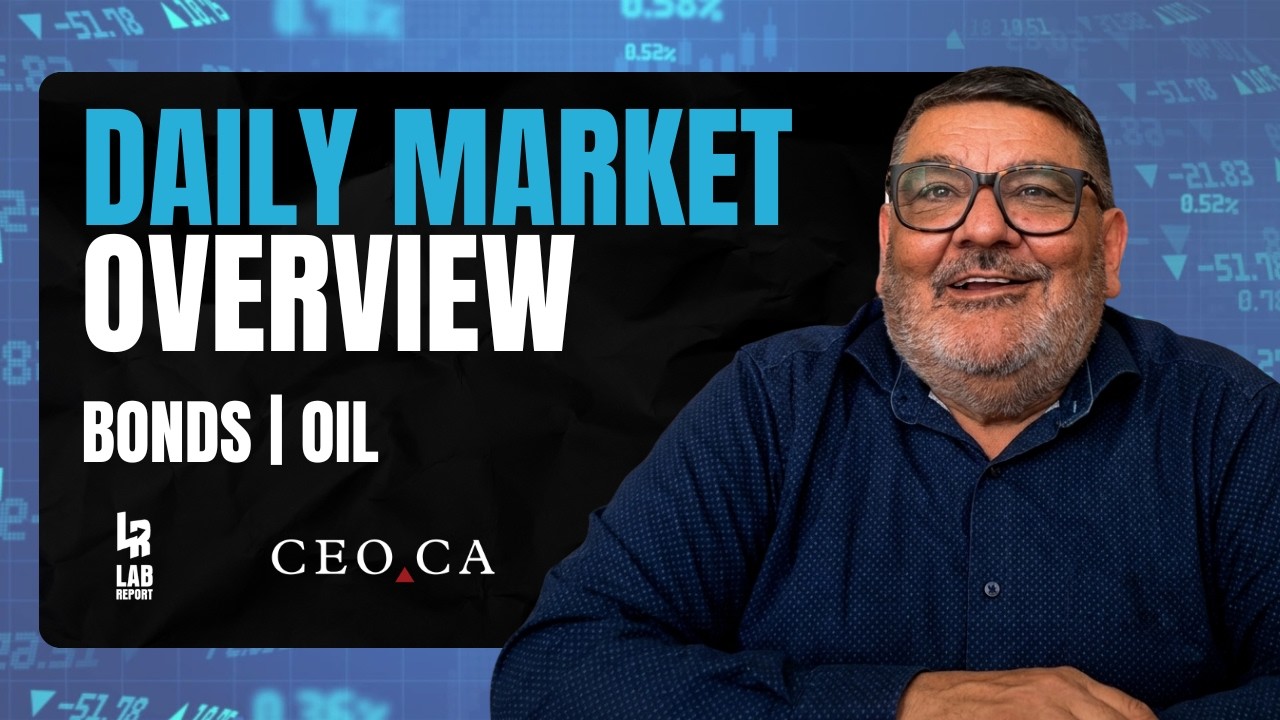
Lab Report | July 23 Daily Market Overview
- Top takeaway The host argues the bond market, not the day's price action, is the signal worth watching, and that what is happening there is ultimately extremely bearish for gold and for gold stocks.
- He uses the 10-year, as a proxy for the bond market, saying it is well into all-time lows while yields move the other way, which he reads as bond vigilantes being nervous about inflation and therefore as a bullish factor for gold.
- He attributes gold's 2.4% decline on 23 July 2026 to algorithmic, narrative-driven trading that ignores those longer-term bullish factors.
- He estimates the cost of servicing debt is running toward $1.5 trillion and possibly $2 trillion within a year, and calls that debt spiral the main long-term driver of gold.
- He says the Fed's short-term bond buying has been extended from four to seven months into 2026 and still is not enough to keep yields down, and expects more aggressive quantitative easing.
Bond prices at yearly lows are pushing yields up, and the host reads that as a strong bearish driver for gold and gold stocks. Gold fell 2.4% and the VanEck Junior Gold Miners ETF dropped 3.1%, while crude jumped 5.4% on Middle East supply risk. The host argues computers now trade the day's narrative, ignoring the slower inflation and debt signals that favor gold. He puts US debt service costs on a path toward $2 trillion within a year, framing that as the core long-term case for gold. Kirkland Lake Discoveries and McEwen Mining are teased for separate deep dives, with no company fundamentals covered here.

Lab Report | July 22 Deep Dive on New Found Gold
- Top takeaway The guest argues channel samples from exposed veins matter more than small surface samples, because they test the rock a mine would actually process, which is why he reads the Queensway result as an economic signal rather than a curiosity.
- He benchmarks the reported grade against open pits being mined at roughly half a gram of gold per tonne today, calls that gap a cash machine, and says he sees a lot of blue sky in the company's economics as Queensway moves toward production.
- He says the 18 to 20 month path to mining is right around the corner in mining terms, and argues the market is not yet giving credit to how shallow the system sits and how many pits sit along the Appleton Fault.
- He treats the 39 million shares coming free trading in 37 days as a sentiment test rather than a certain overhang, arguing that if the shares do not get sold it tells you who bought the April financing and how committed they are.
- He links the stock closely to the gold price, arguing a strong recovery in gold could let the shares match or outperform given the current news flow, and notes he is still getting familiar with the drill-hole database the channel launched the previous day.
New Found Gold's Queensway channel samples ran 23 grams per tonne over 15 metres; open-pit gold mines today average about 0.5 grams per tonne. Lotto infill drilling returned 43.5 g/t over 4.75 metres, more than an ounce per tonne while gold trades above $4,000. Channel samples taken from exposed veins that will be mined carry more weight than narrow surface samples, in the host's view. Orogenic systems like Queensway often grow richer with depth, and an underground zone sits a few hundred metres below the pit. Mining starts in roughly 18 to 20 months, while 39 million shares become free-trading 37 days after the release.

Lab Report | July 22 Deep Dive on Kingsmen
- Top takeaway He chose the Kingsmen Soledad depth result as the first deep dive of his 22 July 2026 lab report, saying it was among the most interesting news releases that day.
- His stated framework is that grade is king but continuity is a close second, and he argues the 135 m of vertical depth with a continuous zone of alteration and mineralization across the three-hole fence is exactly the continuity he wants to see as a system deepens.
- He says he gets most interested in blind discoveries — new targets found while drilling for a different one — which is why he highlights the newly identified structural target to the southeast and northwest of the system.
- He argues that alteration halos and pathfinder minerals (pyrite, sphalerite, galena, arsenopyrite, with sericite and muscovite alteration) mark where metal-bearing fluids have travelled and where gold and silver mineralization will be, and that investors underrate that evidence, citing his 30-plus years of exploration experience.
- He cautions viewers that part of the news release restates a hole and results reported last year, pointing them back to those earlier releases rather than treating all of it as new.
Kingsmen's deepest hole returned 641 g/t silver equivalent over 1.4 metres, the highest-grade intercept reported at Soledad. Grade is king, but continuity along strike and at depth is a close second, and investors should judge both. Alteration halos around a vein are what most investors overlook, yet they mark where the ore-bearing fluids travelled. Flexure and dilatancy simply mean rock opening up, which gives metal-bearing fluids a path of least resistance. Shares rose 9.8% to C$1.12 on the release, leaving market value at roughly C$38.7 million.

Lab Report | July 22 Daily Market Overview
- Top takeaway The host argues gold equities are the strongest trade of the day, pointing to the VanEck Junior Gold Miners ETF up 4.8% against gold futures up 2.1% on 22 July 2026, and reads that spread as pent-up demand after equities were punished harder than bullion during the war-driven selloff.
- He calls the new Fed chairman a hawk in dove's clothing, noting the balance sheet has grown by roughly $500 billion since quantitative easing began despite hawkish talk, and expects the dove to show through with rate cuts not far off.
- He views oil rising 3.2% on a possible Middle East ceasefire as an oversold bounce, since damage to Iranian fields, refineries and shipping still constrains global supply.
- He sees copper as a long-term winner, up from about $4.40 a year earlier to roughly $6.50 on 22 July 2026, with supply unable to react to demand from power grids, electric vehicles, cloud computing, AI and robotics.
- He expects silver to resume its bullish trend after recovering toward $60 from a speculative run to $120 pulled back by retreating hot money.
Junior gold miners jumped 4.8% against gold's 2.1%, and the host reads that spread as pent-up demand after a punishing selloff. The Fed's balance sheet has grown roughly $500 billion, which is why the host calls the new chairman a hawk in dove clothing. Oil rose 3.2% on ceasefire headlines, which the host calls an oversold bounce while war damage to Iranian fields and shipping persists. Silver stabilized near $60 after a speculative run to $120 sent hot money out, and the host expects the bullish trend to resume. Copper's rise to $6.50 from $4.40 a year ago reflects demand from grids, vehicles, and AI outpacing a supply chain that cannot react.
Key Quotes
"only an idea generator"
— His standing disclaimer on the Lab Report (Rocks And Stocks News, September 24, 2026), where he urges readers to do their own homework
"inevitable and closer than people think"
— Lab Report market commentary on renewed quantitative easing lifting gold, silver and copper, September 24, 2026
"to help investors become their own best stock pickers"
— Smoke Signals Investing: An Insider's Guide to Finding Junior Mining Stocks Before They Take Off (2017)
"Alset Energy has some high quality assets and I'm excited to join the team."
— Statement on his appointment as President and CEO of Alset Energy Corp (GlobeNewswire, October 27, 2016)
Key Works
Beginner-focused guide to evaluating junior mining stocks; reached No. 1 on Amazon's Energy & Mining Industry bestseller list in February 2017 (Prominence Publishing).
His mining news service on Substack, with daily Lab Report deep dives, executive interviews and weekly shows, also distributed as a podcast.
Online mining interview show he founded in 2005; more than 130 episodes with over 500,000 minutes watched by 2017.
Specializations
Disclaimer: Allan Barry Laboucan has NOT endorsed this platform and is not affiliated with Pixys in any way.