Jesse Day
Producer & Host | Commodity Culture | Conversations with mining CEOs, fund managers, and macro thinkers
"Host of Commodity Culture — long-form interviews with mining CEOs, fund managers, and macro guests on gold, copper, and critical minerals."
Biography
Jesse Day is the producer and host of Commodity Culture, a Canadian interview-format channel covering the metals, mining, and energy sectors. He sits down with prominent fund managers, economists, geopolitical experts, and resource company CEOs, with a recurring emphasis on precious metals, copper, critical minerals, and the macro backdrop that drives resource prices.
Day got his start in commodities content by producing documentaries on metals, mining, and energy, and that production background shows up in how he runs interviews — leaning on the fundamentals a resource investor actually cares about, such as mine supply, project economics, jurisdictional risk, and capital structure, rather than surface-level price commentary. Episodes like his copper-supply conversation with Ian Harris ("'There's No Deposits Anywhere' — Why $7 Copper is Only the Beginning") and his critical-metals interview with Daniel Major ("THESE Critical Metals Set to FLY as Supply Squeeze Accelerates") lean directly into deposit-quality, capex, and supply-deficit arguments that drive mining-stock selection.
His gold coverage is where Commodity Culture has built its core audience. The recurring "Buy the Best Gold Companies Instead of Juniors" theme — and his framing of gold as the real monetary barometer rather than a CPI-adjusted inflation hedge — reflects a producer-and-developer bias common among serious resource allocators. Conversations with GATA's Ed Steer on precious-metals market structure, and recurring interviews with publicly listed explorers and developers, have given the channel credibility with self-directed mining investors who want operator-level discussion.
For a mining-stock investor, Commodity Culture is most useful as a curated filter on who is saying what about copper supply, gold-equity selection, and critical-minerals policy. Day's editorial line — favor well-funded developers and producers over speculative juniors, watch jurisdictional and permitting risk, and treat gold as a monetary asset first — is consistent enough that subscribers know roughly what view they are signing up to hear argued out.
The public record on Day himself is thin: he has not (as of available sources) published a personal investing track record, fund returns, or formal mining credentials, and his value to commodity investors is as a host and curator rather than as a position-taking analyst.
Videos (28)

Is Iron Ore the Next Metal to Go Ballistic? 'Price Increase is Inevitable'
- Top takeaway Endorses Oceanic's decision to focus spending on Hopes Advance rather than advancing Morgan Lake and Roberts Lake now, calling it a smart strategy.
- Hosts this Commodity Culture interview, which the video discloses was compensated by Oceanic Iron Ore; he says he is not a shareholder of the company.
Steelmaking's shift to higher-grade feedstock is creating a structural premium for high-purity iron ore, which few jurisdictions can supply at scale. New supply such as the Simandou project mainly offsets depletion at existing mines, so the guest expects only a short-term price dip. Buyers increasingly favor minerals from allied jurisdictions, and Oceanic's tidewater access in Quebec lets it skip costly rail and compete on cost. Oceanic Iron Ore has restarted Hopes Advance after 12 years, with a $50 million raise funding a PFS (Pre-Feasibility Study) due in the fourth quarter. Management argues the stock is undervalued at a 0.1 multiple to NAV (net asset value), with roughly 60% insider ownership backing the restart.

SILVER Back to Triple Digits THIS Year? 'Dramatic' Move Coming
- Top takeaway The host frames the interview around the disconnect between six consecutive years of silver supply deficits, per the Silver Institute, and the price pullback, and says he agrees with McDonald's read that the macro backdrop is unchanged.
- He lays out governments treating silver as strategic — roughly $12B for US critical-mineral stockpiling under Project Vault, Russian central-bank silver purchases, a Saudi central-bank position of close to a million SLV shares, and China's export controls — and presses on Mexico jurisdiction risk, citing Vizsla Silver's cartel-related issues.
The guest argues silver's 50% slide from January's $120-plus peak is consolidation inside a bull market, with triple digits possible this year. Six consecutive deficit years and a 10-to-20-year mine development timeline mean silver supply cannot quickly respond to rising demand, the guest notes. Governments now treat silver as strategic: US stockpiling, Russian central-bank buying, Saudi ETF purchases, and Chinese export controls tighten available supply. A first PEA (Preliminary Economic Assessment — early-stage mine economics) gives Kootenay's La Seguera a $763M after-tax NPV and 41% IRR at $50 silver. High-grade Columba drill results, including 98 metres at 200 g/t (grams per tonne) silver, feed a 60,000-metre program and a year-end resource update.

Global Food Security Under Threat: THIS Commodity to Benefit BIG TIME
- Top takeaway Frames the Iran war and Strait of Hormuz closure as exposing fragility in global supply chains and uses that to question how a domestic potash source could strengthen supply chains.
- Observes lithium is up around 170% year over year as of the interview and asks the guest what catalysts could push prices higher.
The US uses about 7 million tons of potash (a potassium fertilizer) a year but produces only 5% domestically, the guest says. Potash prices have climbed on the Russia-Ukraine war, Middle East shipping disruption, and supply contracts India and China signed earlier this year. Lithium is up roughly 170% year over year; the guest cites mine curtailments, Chinese restocking, and energy storage demand as signs of a new cycle. American Critical Minerals controls about 32,000 acres in Utah's Paradox Basin, targeting potash, lithium, and bromine about 20 miles from Intrepid Potash's Moab mine. Permitted for up to 7 wells with about C$5.4 million on hand, it plans one drill hole from late July, with results around October.

Start of 2026 Was 'Opportunity of a Lifetime' to SELL Your Gold & Silver: Mike McGlone
- Top takeaway The host says he takes a very different view from his guest, arguing that geopolitical instability, global conflict, inflation, and central bank money printing will make natural resources the winners in the years ahead.
- He presses the guest on downside buy levels for gold and silver, the 2008-style commodity decline, the rotation-to-hard-assets narrative, the treasury bull case, and how severe a market correction could get.
Mike McGlone argues gold and silver's early-2026 all-time highs were the moment to sell, with prices potentially range-bound for a decade. He says record gold-to-S&P 500 correlation and elevated gold volatility make metals a speculative 'sock puppet' of the stock market. Silver, now mostly an industrial metal rather than a monetary one, and the wider commodity complex look set for years of range trading. The guest expects a long-overdue US stock correction to be deflationary, with capital destroyed rather than rotated into commodities. His preferred 2026 position is US Treasury long bonds near 5% yields, which he expects to rally when stocks fall.
LITHIUM is About to Wake Up - Massive Upside for Prices & Stocks in 2026
- Top takeaway As host, Jesse Day frames the discussion, noting grid storage has become a dominant lithium demand driver alongside EVs and that lithium carbonate prices are up around 170% year over year.
- He raises the resource-nationalism theme, pointing to the US stake in Lithium Americas, Project Vault stockpiling, and Premier Danielle Smith's comments tying lithium to Alberta's trade future under CUSMA.
Lithium carbonate prices up around 170% year over year, with battery energy storage systems overtaking EVs as the main demand driver. Global lithium demand (LCE — lithium carbonate equivalent) is about 1.5 million tons and projected to double by 2030, while North America supplies under 1%. Government support is accelerating: the US is stockpiling critical minerals and Canada is championing lithium in CUSMA trade talks. LithiumBank's Boardwalk brine project in Alberta pairs an 8-million-ton resource with grid power, highway access, and fast provincial permitting. A development agreement with SLB (Schlumberger) covers the full direct lithium extraction flow sheet, reducing execution risk for a modular 10,000-ton start.

'Where's the Fuel Coming From?' - The Race to Secure URANIUM as Big Tech ALL IN
- Top takeaway He notes the uranium equity sector has been volatile, with the URA-proxy ETF slightly down year to date as of June 2026 but bouncing back after the US-Iran peace announcement.
- He frames the gap between speculative enthusiasm (the SpaceX IPO, a company with a $4 billion-plus quarterly net loss) and the neglect of uranium as a big opportunity for investors who see what is coming.
US nuclear fuel is roughly 95% import-dependent while defense law requires domestic uranium, making US extraction a national security priority. Big tech power deals like the Three Mile Island restart serve data centers but ignore upstream mining, the next likely investment focus. New Mexico holds about one billion pounds of known and historic uranium resources, which the guest argues makes it essential to any nuclear renaissance. Verdera's West Largo 43-101, due by year-end, may lift resources through lower cut-off grades and drilling beyond historic confined boundaries. Verdera claims about 88 million pounds of historic resources plus roughly 90% of New Mexico's private uranium data at a $50 million market cap.

Market Data a 'Non-Stop PSYOP' - Real Economy 'On Life Support': Melody Wright
The guest argues official economic data is fabricated, and the bond market — not headlines — reveals what is really happening. She watches the 10-year Treasury yield fight near 4-5% and expects levels above 5% to break the system. Rising delinquencies in prime mortgage books — not just subprime — are the signal she watches for a credit event. Housing data understates reality: she cites restated home-price series and growing inventory as the narrative cracks. Oil has fallen on Iran peace headlines, yet gas field damage and force majeure keep energy supply risks in place.

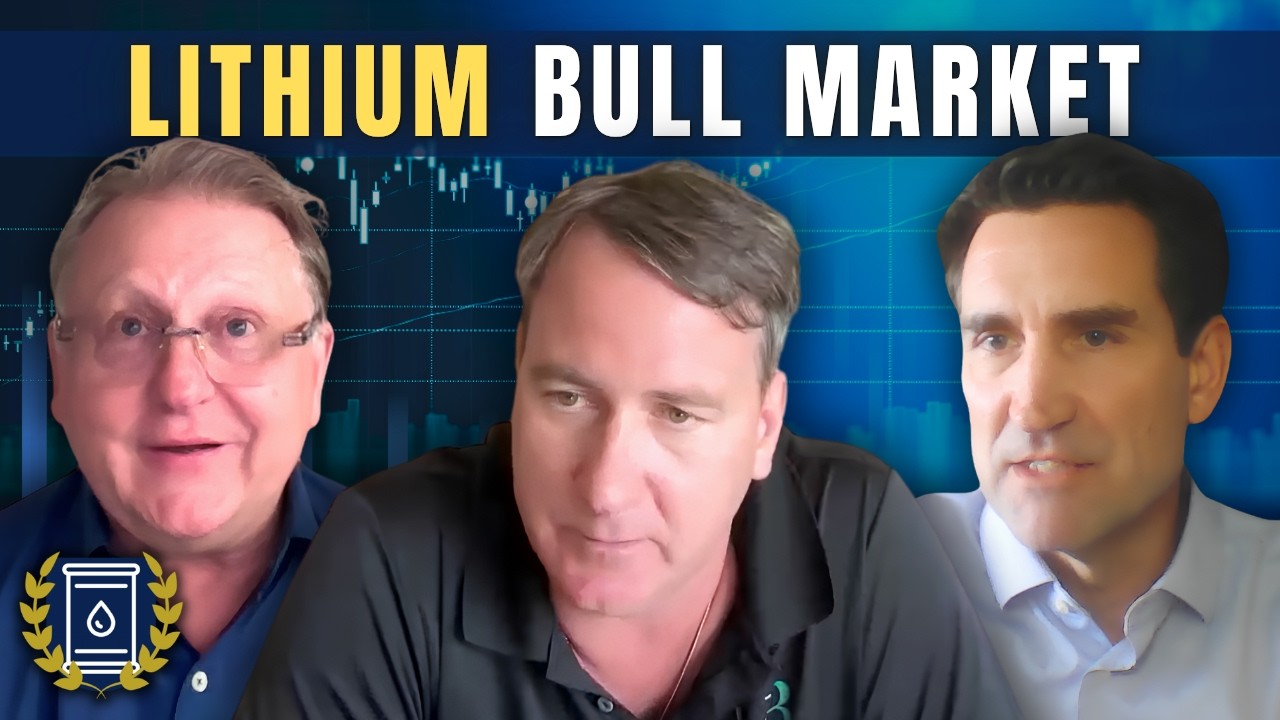
Is LITHIUM the Next Major Bull Market? Supply 'Just NOT There' as Prices FLY
- Top takeaway As host he frames the segment around lithium carbonate's roughly 170% year-over-year price run as of June 2026 and cites an Oregon Group view that grid-scale storage is now lithium's fastest-growing demand sector.
Lithium carbonate prices have risen roughly 170% year over year, and the guests expect a durable floor near $20,000 per ton. Grid-scale battery storage built with lithium iron phosphate batteries has become lithium's fastest-growing demand sector, alongside EVs. EMP Metals advances its Saskatchewan brine project through a demo plant using DLE (direct lithium extraction — recovering lithium from brines chemically rather than by evaporation). A hub-and-spoke model of smaller commercial facilities targets cash flow at far lower capex than the two-billion-dollar mega-projects proposed elsewhere. Canadian federal and provincial critical-minerals programs provide EMP with non-dilutive funding supporting its demonstration facility and future scale-up.
Key Quotes
"Buy the best gold companies instead of juniors."
— Commodity Culture episode 'Buy the Best Gold Companies Instead of Juniors'
"Gold is the real monetary barometer."
— Commodity Culture episode 'Gold Is the Real Monetary Barometer'
"There's not enough mines — demand for copper is soaring."
— Commodity Culture episode "'Extremely Bullish' on COPPER — 'There's Not Enough Mines' as Demand SOARS"
Key Works
Long-form interview channel featuring fund managers, economists, geopolitical experts, and mining CEOs discussing gold, copper, critical minerals, and macro.
Episode arguing that resource investors should focus on well-capitalized producers and developers over speculative junior explorers.
Episode framing gold as a monetary asset and the cleanest read on real rates and central-bank policy, rather than a CPI-inflation hedge.
Interview with mining commentator Ian Harris on copper supply scarcity and the structural case for higher long-run copper prices.
Interview with industry executive Daniel Major on supply-side pressure in critical and battery-metals markets.
Disclaimer: Jesse Day has NOT endorsed this platform and is not affiliated with Pixys in any way.