Barry O'Shea
President & CEO | Highland Copper Company Inc. | Leading the fully permitted Copperwood copper project in Michigan toward U.S. production in 2029
"Leading Highland Copper's fully permitted Copperwood project — one of the most advanced U.S. copper developments — toward a 2029 production start."
Biography
Barry O'Shea is a Canadian Chartered Professional Accountant (CPA) and the President & CEO of Highland Copper Company Inc. (TSXV: HI — the TSX Venture Exchange, the Canadian junior mining listing venue), the company advancing the Copperwood copper project in Michigan's Upper Peninsula. For investors tracking the United States' push to rebuild domestic copper supply, Copperwood is one of the few advanced, fully permitted U.S. copper projects with first production targeted for 2029, and O'Shea is the finance executive charged with getting it built.
O'Shea has spent more than 20 years in finance roles across diverse industries and countries. He was Chief Financial Officer of Nevada gold producer Fiore Gold from May 2018 until Calibre Mining acquired the company in January 2022 in a deal reported at a 46% premium. He joined Highland Copper as CFO in February 2022, was named interim CEO in October 2023, and was confirmed as permanent CEO in February 2024. He also serves on the board of Group Eleven Resources, a zinc-silver exploration company focused on Ireland.
His approach at Copperwood is financing-first. As a CFO-turned-CEO, he has sequenced the project toward a final investment decision (FID — the board's formal commitment to build) using state support and project debt: final approval of a US$50 million grant from the State of Michigan in August 2026, and a letter of intent for up to US$250 million in project financing. The 2023 feasibility study (a detailed engineering and economics study) by G Mining Services outlined a mine producing roughly 65 million pounds of copper and about 107,000 ounces of silver per year at a 17.6% after-tax IRR (internal rate of return — the annualized return the project is expected to generate), and an updated study is targeted for early 2027.
Copperwood's progress has put O'Shea inside the U.S. critical-minerals conversation: the project was cited in a White House publication in April 2026 on expanding domestic mining. Following him offers a working education in U.S. copper project economics, permitting, and mine financing, presented in plain terms in interviews including on the Bloor Street Capital channel. His public record is closely tied to Copperwood and his prior CFO roles, so his record as a CEO is still being written; what is known so far is documented in Highland Copper's news releases and filings.
Videos (4)
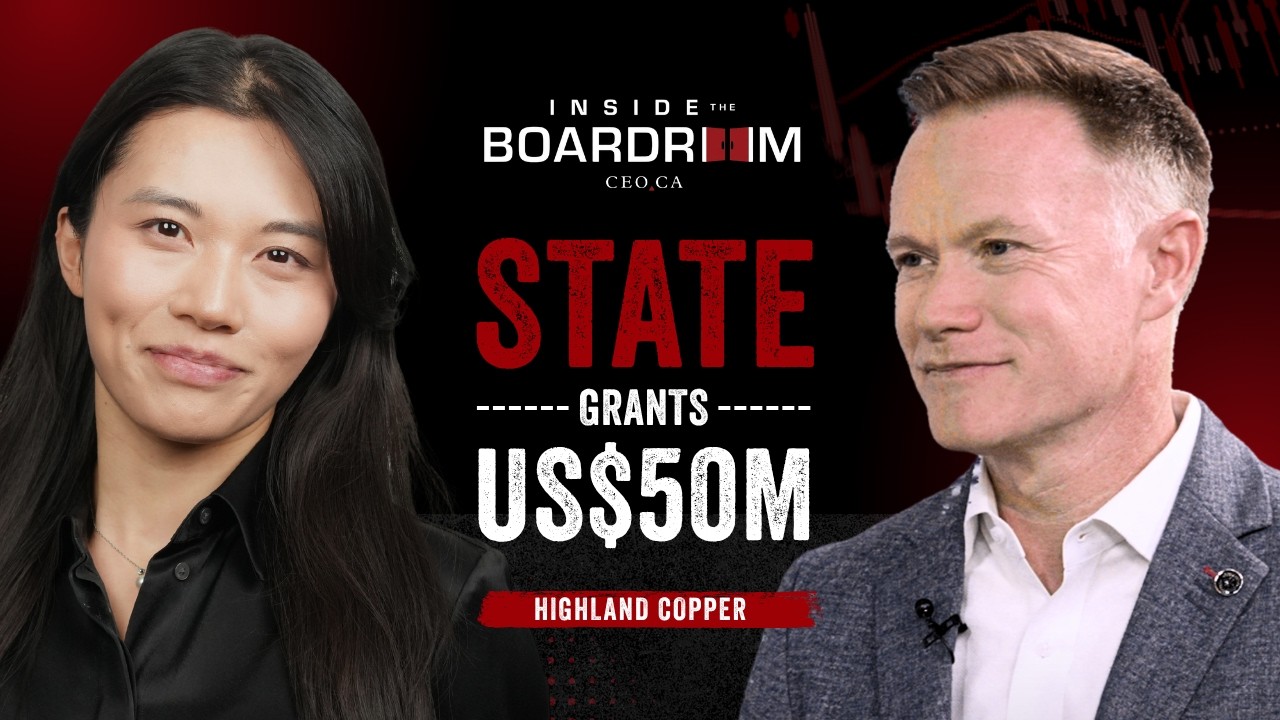
“The Path Has Never Been More Clear”: Highland Copper Lands State Grant
- Top takeaway O'Shea argues the $50 million non-dilutive Michigan grant is the largest de-risking step to date because it combines state endorsement with permits already in hand, cutting the execution risk lenders assess — and he concedes it is the answer to past shareholder scepticism about the company's ability to finance and build.
- His position is that social licence to operate matters more than permits alone, citing 22 resolutions of support from local units of government covering Wakefield, Ironwood and Gogebic County, plus support from Governor Whitmer, the Upper Peninsula legislative delegation, and federal advocates Senator Slotkin and Congressman Bergman.
- He claims a smaller company can now viably finance and construct this project, using the $250 million US Ex-Im Bank letter of interest as the anchor while running it competitively against private lenders to protect terms.
- He expects the first-half 2027 updated feasibility study to come in strong, pointing to a lower cut-off grade, mine-height and pillar optimisation, and roughly two extra percentage points of recovery from the ultrafine flotation incorporated into the plant.
- He sets out the sequence he wants investors to underwrite: engineering and the debt process over the balance of 2026, debt concluded and a construction decision by mid-2027, construction initiated in the first half of 2028, and first copper in the second half of 2030 after a roughly 27-month build.
Highland Copper locked in a US$50 million Michigan state grant — non-dilutive capital, underwritten, with no further government approvals needed. The grant obliges Highland to show US$150 million of other financing by 2028; a US$250 million Ex-Im Bank letter of interest is in hand. At US$5 per pound copper, net present value — the discounted value of future mine cash flows — triples to US$507 million from US$170 million. A lower cutoff grade, the minimum ore grade worth mining, should convert more measured and indicated resource into reserves without new drilling. An updated feasibility study lands in early 2027, a construction decision follows by mid-2027, and first copper is targeted for late 2030.

The White House Explicitly Named This Fully Permitted Copperwood Project
- Top takeaway Argues the US copper supply-demand imbalance is already stark and growing, with weak new-mine supply against rising demand from electrification, grid upgrades, and data centres.
- Contends that permits plus political support make a build likely and that smaller US developers should receive financing help, especially low-cost debt, moving them toward producer-style valuations.
- Lays out his timeline: grant conclusions within 3-6 months, an integrated mine review within 6-9 months, an updated feasibility study at about $5 copper in Q1 2027, then construction and operations within two to three years.
- Frames the recent executive hires — a Capstone founding executive as CFO and a Resolution Copper execution director — as evidence of the company's commitment to build the project.
- Positions Copperwood as roughly 15-16 years into the roughly 20-year US path from first drill hole to production, calling it the right place and right time.
Highland Copper's fully permitted Copperwood project in Michigan won explicit White House recognition, twice, plus a $250 million US Export-Import Bank letter of interest. A shrinking US mine supply meets robust demand from electrification, grid upgrades, and data centres, widening an already stark copper supply-demand imbalance. Fully permitted, near-construction US copper projects are scarce, and jurisdiction strength increasingly drives institutional confidence that a project actually gets built. The company eliminated all debt by selling a non-core asset for $30 million and hired a new CFO and execution director to drive construction. Upcoming catalysts: state and federal grant decisions, an expanded mine-life review, and a feasibility study (a full economic check) due Q1 2027 at $5 copper.

Highland Copper: U.S. Copper Production in 2029 | Barry O’Shea and Jimmy Connor
- Top takeaway The guest argues Highland Copper's Copperwood is one of the rare fully permitted, advanced-stage US copper projects positioned to address near-term domestic supply shortfalls, with construction targeted for 2027 to early 2028 and best-case production by H2 2029.
- The guest emphasizes strong federal backing — a $250 million letter of interest from the US Export-Import Bank covering roughly 60% of the $400 million capex, plus White House recognition alongside other key US copper producers — with a target of 75% federal and state funding.
- The guest projects meaningful NPV leverage to copper prices: roughly $170 million at $4/lb, $507 million at $5/lb, $850 million at $6/lb, and over $1 billion at spot prices as of mid-2026, supported by 30,000 tons of annual production at a $2 per pound cash cost.
- The guest attributes the company's discount-to-comps valuation to capital flowing to unloved sectors, expressing confidence in re-rating as the team demonstrates financing capacity and execution through recent key hires — Peter Hemstad (ex-Capstone Copper founding executive) as CFO and Trace Arlo (ex-Rio Tinto Resolution Copper execution director) as project director.
- The guest stresses a cleaned-up balance sheet with $22 million in treasury and all debt eliminated via a non-core asset sale, supported by long-term patient shareholders Orion Mine Finance (28%) and Condair (roughly 20%) to carry the company through development and into production.
Copperwood is a fully permitted, near-dated US copper project: 3.7B pounds defined, $400M capex, and a 2029 production target. AISC (All-In Sustaining Cost — what it truly costs to produce) sits at $250-275/lb; annual output of 30,000 tons addresses 5-10% of the US shortfall. NPV scales steeply with copper: $170M at $4/lb, $507M at $5/lb, and $850M at $6/lb, the guest argues. Federal capital is central: a $250M US Export-Import Bank LOI plus grant visibility could fund up to 75% of capex; equity need is ~$75M. An updated feasibility study at near-$5 copper is due early 2027; construction is targeted for 2027-2028 with first production H2 2029.

FREE Master Class on Investing in Copper and Copper Stocks | Jimmy Connor
- Top takeaway Barry O'Shea argues Copperwood is among the most near-dated corporate copper developers in the US, with the best-case production timeline of second-half 2029.
- He describes the US EXIM letter of interest for $250 million as roughly 60% of the project's $400 million capex.
- Barry notes that at $4 copper the project's NPV is $170 million, but at $6 copper the NPV rises to $850 million, showing significant leverage to copper prices.
- He argues that the US currently prioritizes permitted, near-term-ready projects rather than early-stage exploration assets, putting Copperwood in a strong position.
- Barry highlights that the company recently hired Peter Hengstad (formerly of Capstone Copper) as CFO and Trace Arlo (formerly of Resolution Copper) as Project Director, demonstrating commitment to construction.
UBS projects a 520,000-ton copper deficit by 2027 and a $15,000/ton price, framing the supply-demand squeeze that drove this conference. Chile produces roughly a quarter of global copper but output peaked in 2018, as falling ore grades and longer development timelines pressure new supply. AI data centers, EVs (150 lbs vs 50 lbs in gas cars), and renewable build-out are reshaping demand — together already making up 32% of copper use. Major supply disruptions at Cobre Panama, Grasberg, and Kamoa Kakula hit at the same time as demand acceleration, exposing the fragility of the supply base. Eight copper-focused company conversations cover developers (ATEX, Faraday, Highland, Lumina), a tailings processor (Amerigo), a royalty platform (Evolve), and Sprott's physical and ETF vehicles.
Key Quotes
"Copperwood, at the end of the day, is one of the most advanced copper projects in the US, and it's time to build it."
— myUPnow radio interview, October 2025, during the debate over Michigan's US$50 million Copperwood grant
Key Works
Feasibility study for the fully permitted Copperwood project: roughly 65 million lb of copper and 107,000 oz of silver per year at a 17.6% after-tax IRR.
Interview on Copperwood's financing, permitting, and path to U.S. copper production in 2029 on Jimmy Connor's Bloor Street Capital channel.
Specializations
Disclaimer: Barry O'Shea has NOT endorsed this platform and is not affiliated with Pixys in any way.