
Wesdome Gold Mines Ltd
WDOWesdome Gold Mines Ltd. engages in the exploration, extraction, processing, and reclamation of gold in Canada. It principally produces gold in the form of doré bars, as well as silver as a by-product. The company's properties include the Eagle River Complex that consists of the Eagle River Mine, the Mishi Mine, and the Eagle River Mill located in Wawa, Ontario; and the Kiena Mine Complex, which includes the Kiena Mine concession and Kiena Mill situated in Val-d'Or, Québec. Wesdome Gold Mines Ltd. is based in Toronto, Canada.
Score
—Data Quality
Market Cap
N/A
Total valuation
Stock Price
N/A
Latest close
Free Cash Flow
N/A
Annual
Financial Position
N/A
Cash position
PEG Ratio
ⓘN/A
P/E ÷ growth
Analysis
Subscribe to see the AI Analysis
Score breakdown, criteria, red flags, bull/base/bear scenarios.
SubscribeFinancials
Asset Pipeline
Subscribe to see the Asset Pipeline
Jurisdiction exposure, project portfolio, cost structure.
SubscribeInformation
Key Information
Legal Entity
Wesdome Gold Mines Ltd
Sector
Precious Metal
Founded
August 13, 1996
Employees
301
Reporting Currency
CAD
Contact Phone
416 360 3743
Website
www.wesdome.comHeadquarters Address
220 Bay Street , Toronto , ON M5J 2W4 , CA
Identifiers
ISIN
CA95083R1001CUSIP
95083R100
Commodity Portfolio
Stock Exchanges
Organization
Chart
Interactive chart powered by TradingView. Use the chart tools to analyze price trends.
Videos

They Explored ONLY 6% and Found a Gold Mine | Sean Roosen - Osisko Gold Group
Key Highlights
brief- Roosen describes Wesdome as a steady-state producer of about 200,000 ounces a year with a market cap a little over $5 billion, trading at about $2.9 billion per 100,000 ounces of annual production.
- He says that if Osisko built Caribou and stopped there, Wesdome would be the benchmark the company could expect to trade against.
Osisko Gold Group's Cariboo mine is 22% built and over-financed — $1.7 billion available against C$990 million of remaining capex, first production targeted Q1 2029. Conversion drilling targets 3.6 million ounces already accessed by mine infrastructure, setting up a doubling from 200,000 to 400,000 annual ounces. Only 6% of the 86-kilometre Cariboo trend has been drilled; a $160 million, 30-drill program over two years pushes the resource deeper. Roosen flags two overlooked assets: Sirios' open-pit-scale James Bay discovery and the revenue-producing Tintic project in top-ranked Utah. Roosen expects gold higher on declining US dollar confidence and argues energy suppliers, not tech firms, will win the AI buildout.
Building a 500,000-Ounce-a-Year Gold Producer | Patrick Downey - Orezone Gold
Key Highlights
brief- Downey lists Wesdome Gold Mines among the neighboring operators around Orezone's Hava-Hosco project in the Cadillac-Larder break.
Orezone CEO Patrick Downey calls the past 12 months the best mining sentiment of his 40-year career, with good projects finally getting financed. Downey maps a path from about 230,000 ounces of annual gold production to roughly 500,000 ounces, pointing to Bomboré, Casa Berardi and the development pipeline. He argues the market gives zero value to Heva-Hosco in Quebec, where a 2012 feasibility study showed roughly 105,000 ounces a year over 14 years. The year ahead looks catalyst-rich: a Heva-Hosco study, drill results at Casa Berardi and Bomboré, and a life-of-mine study (a whole-mine plan). Downey says Orezone holds over $100 million in cash with little or no debt and would buy back stock if the discount persists.

West Red Lake Gold Mines – Q2 Financials, H2 Development & Production Ramp Up, Exploration Update
Key Highlights
brief- The CEO uses Wesdome as WRLG's benchmark peer: two high-grade mines in the Abitibi producing about 160,000-180,000 ounces a year, Canadian, tier-1 jurisdiction, permitted - with 'a lot of similarities' to WRLG's Red Lake setup.
- The speakers contrast Wesdome's market cap, cited at roughly $3-5 billion, with WRLG's around $300-plus million, framing a large valuation gap for WRLG to close.
Madsen's Q2 showed the ramp-up is delivering: production up 51% and AISC (all-in sustaining cost — full cost per ounce) down 30%. The CEO argues high fixed costs mean AISC falls mechanically as ounces rise, so quarterly snapshots mislead until the year-end run rate. Shaft hoisting costs about a quarter of truck hauling, and phase two could lift hoisting capacity to 700 tons per day in late 2027. Williams outlines a hub-and-spoke plan: multiple satellite deposits feeding the Madsen mill, aiming for 100,000-120,000 ounces with a study due soon. He points to a larger Canadian peer's multibillion-dollar market cap, arguing regional consolidation could lift output toward 200,000 ounces.
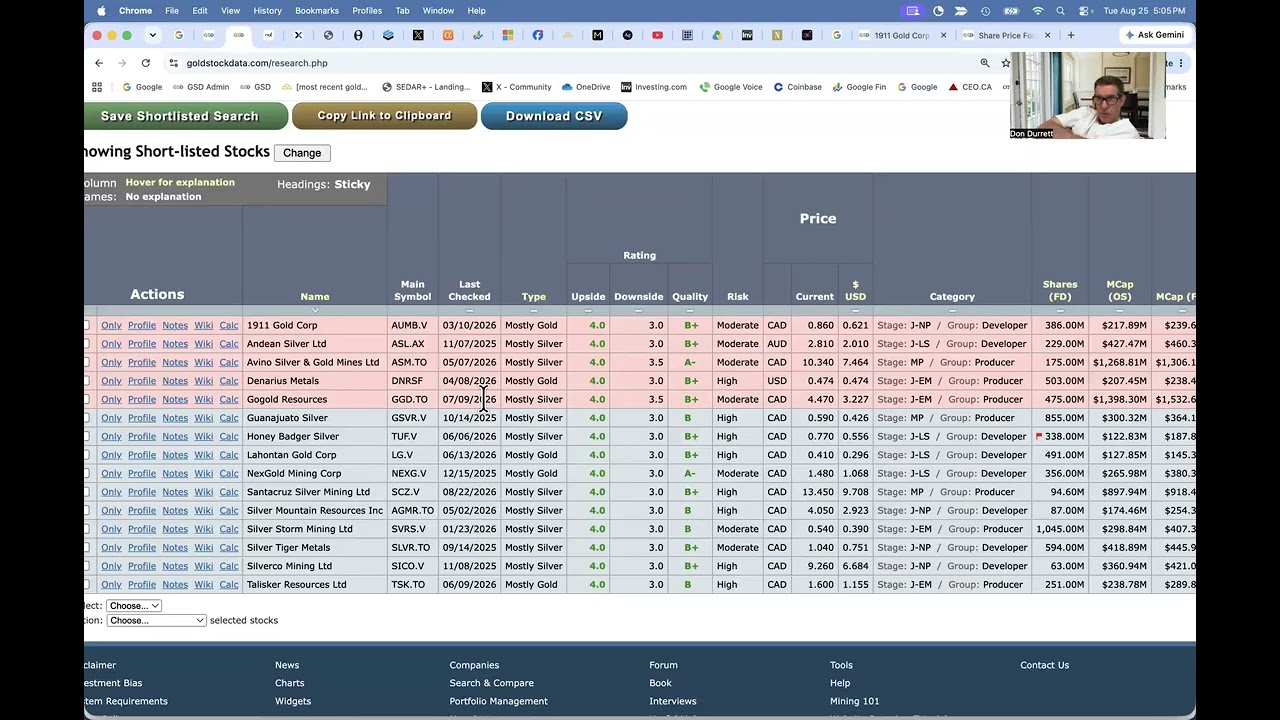
Gold/Silver Miners: Low Hanging Fruit (August 2026)
Don Durrett's 15 low-hanging-fruit names share a single thesis — execution on planned growth at $200 silver and $7,000 gold unlocks 5-20x upside across the list. Junior miners with low insider ownership become prime hostile takeover targets once their assets are de-risked, so a defensive merger often precedes the rerate. The market is still leaving the second-mine pipeline at NexGold and GoGold free, because the first project's standalone value already exceeds today's market cap. Canada's scarcity of new single-asset gold producers gives each one a permanent jurisdiction premium that U.S. peers cannot replicate. AISC (All-In Sustaining Cost — what it really costs to produce an ounce) is the single variable that decides whether each near-term producer on this list rerates or fades.
Mineros ($MSA | $MNSAF) CEO on Growth Story, Investments & 2030 Gold Production Goals
Key Highlights
brief- Don Durrett names Wesdome one of only three Canadian mid-tier gold producers to buy now, describing it as the longest-established of the three.
Mineros S.A. trades at 0.47 times net asset value (what its mines and cash are worth) despite a tenfold share-price re-rating under Sun Valley control. Sun Valley Investments deployed about $200 million to take control, then doubled silver recovery and lifted gold output 22% through operational fixes. Guidance rose to 240,000 ounces with costs tracking below plan, and the CEO targets 500,000 ounces by 2030 via the Porvenir project and acquisitions. An upsized $175 million buyback and $30 million dividend program return cash, while a strategic gold reserve keeps bullion in company vaults. Analyst Don Durrett argues quality mid-tier gold producers are the sweet spot, and Mineros still offers tenfold upside on his $7,000 gold assumption.

RPX Gold ($RPX | $RDEXF): A Staged Strategy Toward Gold Production in Ontario
Key Highlights
brief- Michaud notes Wesdome's Eagle River mine next door mines to about 1,500 vertical metres, showing how much deeper the district runs than RPX's 1.7-million-ounce resource, drilled only to roughly 300 m.
- He cites his time as a Wesdome senior VP - where he says the stock went from just under $2 toward $25 and he helped start the Kiena mine - as precedent for the value he aims to add at RPX.
RPX Gold's staged plan mines small starter pits and hauls ore to area toll mills (third-party processing plants), funding growth without heavy shareholder dilution. Startup capex sits under $50 million, with roughly $75 million in targeted annual free cash flow to fund drilling and the eventual underground decision. The consolidated property holds a 1.7-million-ounce resource drilled only to about 300 meters along a seven-kilometer gold structure. No on-site mill or tailings means no Environmental Assessment (EA) is required, with management hoping for permits in place by summer 2027. Both analysts frame the June metals break as a normal bull-market correction in which silver falls harder than gold, creating buying windows in juniors.

Osisko Development Update | Sean Roosen and Jimmy Connor
Key Highlights
brief- Roosen points out Wesdome produces a similar amount of gold to what Osisko Development is building toward, yet trades around $3.5 billion versus ODV's roughly $1.3 billion market cap.
- He uses Wesdome in his peer comparison at roughly $1.7 billion per 100,000 ounces of production.
Osisko Development is fully permitted and fully funded, building a 5,000-ton-per-day underground mine at Caribou targeting 220,000 ounces of gold a year. The optimized feasibility study outlines a 10-year mine life with AISC (all-in sustaining cost — the full cost per ounce) of $1,157. Roosen argues $4,600 gold could add 1.5 to 3 million ounces by lowering the cut-off grade, the minimum grade worth mining. He calls the stock cheap versus peers, citing about $700 million enterprise value net of cash against producers valued in billions per 100,000 ounces. Roosen assumes Osisko Development is in play daily and fears a takeover could arrive before drilling finishes the district's resource.

Gold X2 Moss Lake PEA | Leverage to $5000 Gold
Key Highlights
brief- The transcript notes Gold X2 acquired the Moss Gold project from West Dome Gold Mines in 2021.
Moss Gold could average 265,000 oz/year at $1,188/oz AISC over 13.2 years, but the $2B capex makes base-case economics only marginal. At $2,750 gold, NPV sits at $2.2B CAD with a 3.2-year payback; at $4,600 gold, NPV leaps to $6.6B CAD with a one-year payback. The PEA only counts open-pit ounces (2.1M oz indicated, 3.9M oz inferred), leaving underground material as future upside. Gold X2 trades at 0.23x EV/NPV — near the cheap end of the 0.05x to 2.2x range seen across Canadian developers. Moss is years from construction: feasibility study targeted within two years, permitting to begin in the second half of next year.
Articles
No articles available
Published articles for this company will appear here
Want the full picture on more companies?
Be one of the first.
A room for resource investors taking shape now — independent, spam-free, no hype.