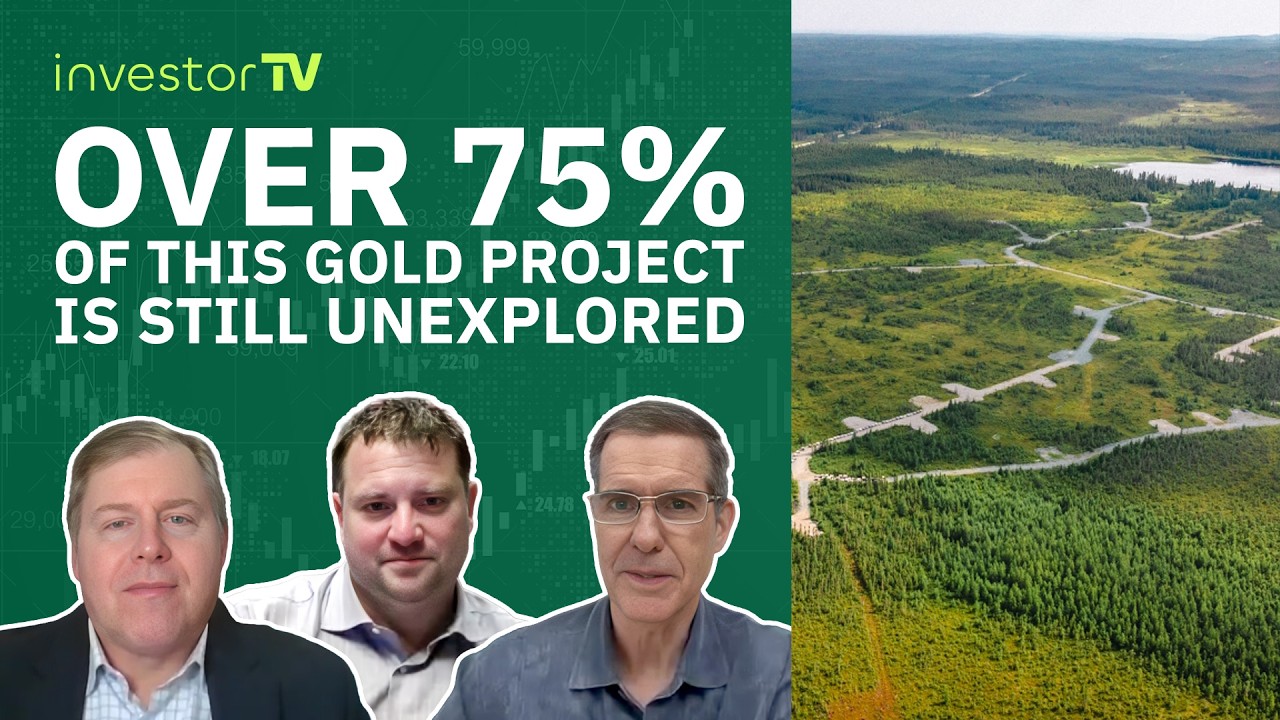
Mayfair Gold's Smaller-Mine Bet: A 4,800-Tonne-a-Day Starter Pit at Fenn-Gib Targets First Gold in 2030
On Investor TV, Mayfair Gold CEO Nicholas Campbell laid out a deliberately small start for the Fenn-Gib project in Ontario's Timmins district: a 4,800-tonne-per-day open pit producing roughly 70,000-75,000 ounces a year, permitted provincially in 2-3 years, with first gold targeted for 2030. Analysts Don Durrett and John Feneck see five-to-10-bagger potential but note the trade-off: most of the 4.3-million-ounce resource may wait until the late 2030s.
Investor angle
For investors, the core trade here is permitting speed versus embedded optionality. Mayfair is giving up a potential 200,000-ounce-per-year mine at Fenn-Gib in exchange for a 4,800-tonne-per-day starter pit that could be permitted provincially in two to three years and reach first gold in 2030 — a stated C$450 million build, sub-$1,200 AISC over the first six years, and management-projected free cash flow of $150-249 million a year depending on the gold price. The cost of that speed is that the bulk of the 4.3-million-ounce indicated resource likely waits until the late 2030s for a federal-permitting expansion, a point even the CEO half-conceded. Near-term markers named in the interview: entry into Ontario's streamlined permitting process this summer, a first look at exploration targets, a stepped-up marketing push, and opportunistic equity raises once management judges its cost of capital has improved. All figures are management and analyst claims made in a promotional interview, not verified results.
Mayfair Gold used the interview to make a focused case: the fastest way to turn its Fenn-Gib gold project in Ontario's Timmins district into a producing mine is to start smaller, permit provincially, and reach free cash flow years sooner than a large-scale build would allow.
CEO Nicholas Campbell, who took the role a little over a year ago after a proxy battle removed the previous management team, said the project was previously scoped at roughly 25,000 tonnes per day — close to a 200,000-ounce-per-year mine. In his telling, that version would cost over $1 billion to build, need 7 to 9 years of federal permitting before construction could start, plus about three more years of construction, putting first production more than a decade away.
## The smaller-mine plan
Instead, Mayfair published a pre-feasibility study (a detailed engineering and economics study one step before a final construction decision) in the first quarter of 2026 for a 4,800-tonne-per-day open pit. The size is deliberate: it stays under the 5,000-tonne-per-day threshold that would push the project into a federal assessment. Campbell said a project at this scale can be permitted provincially in 2 to 3 years, and he called Ontario the best jurisdiction in Canada for permitting.
## The asset and the numbers
Fenn-Gib holds 4.3 million ounces of gold in the indicated category — a resource confidence level detailed enough to support mine planning. Campbell said the project had never been a flagship asset before Mayfair took it over, and pointed to its infrastructure: the site sits on Highway 101, about 10 kilometers from a power substation.
The overall average grade is around 0.74 grams per tonne, but the plan targets a high-grade starter zone: 1.47 grams per tonne through the mill over the first six years, peaking near 1.65 to 1.67 in year two. With recovery around 90%, Campbell put output at roughly 70,000 to 75,000 ounces a year over that stretch.
The build is priced at about 450 million Canadian dollars. Campbell expects all-in sustaining costs (AISC — the full cost of producing an ounce, including sustaining capital) under $1,200 per ounce in the first six years and about $1,300 across the 14-year initial mine life. At $3,100 gold he sees about $150 million in annual free cash flow (cash left after operating and capital costs); at $4,450 gold, about $249 million. Over the first six years at roughly $4,500 gold, he projects about $1.4 billion in cumulative free cash flow. Against a market cap he put near $300 million, he argued that a 10% free-cash-flow yield — about a $2.5 billion valuation — is not an unreasonable way to value a producer of this profile.
## Financing and timeline
Campbell outlined roughly $300 million in debt plus about $250 million of equity in total over the next three years, a figure that includes the $35 million now on the balance sheet. Mayfair says it is funded into mid-2027 and does not need to raise today, though he was clear that a single-asset developer should never rule out opportunistic raises. "I don't think we're getting great cost of capital today," he said, so the company wants to build momentum in the stock before selling more equity.
On timing: Mayfair expects to enter Ontario's streamlined "1P/1P" process this summer — a pathway the province aims to complete in about 18 months. If admitted on that schedule, he sees permits in early 2028, construction of around 18 months, and first gold in 2030.
## Team and insider ownership
Campbell drew on his record at SilverCrest and Artemis Gold, where he said he was part of teams that took assets into production, and on new hires. COO Drew Anwell, he said, is one of the few people to get a federal environmental assessment approved in the past five years — at Generation Mining's Marathon project, under grandfathered rules — and helped build Detour Lake, Canada's largest open-pit gold mine. A new VP of capital markets, Zion LeCani, previously ran $4 billion at HSBC. A new CFO described as a former CFO of Barrick North America, with on-site experience at Ontario's Hemlo mines, put $250,000 of his own money into the company.
On alignment, Campbell cited $19 million of buying by company insiders since October 2024, including $2.2 million of his own, and insider ownership around 35% — a figure the hosts rounded up to roughly 40%.
## The growth question
Growth, in Campbell's plan, does not start with throughput. Mayfair recently acquired three properties from Plato Gold and intends to feed higher-grade material — including regional underground tonnes trucked along the highway from as far as 150 kilometers, at margins he put at 60-70% or better — into its mill to lift production without expanding it. Going past 5,000 tonnes per day would require federal permitting, a step he called undecided.
Durrett pressed the weak point: with federal environmental assessments now taking 5 to 7 years — both men noted no greenfield project has cleared one since Canada's 2019 impact-assessment law — the roughly 4 million ounces outside the starter pit sit effectively "orphaned" until 2038 or 2039. Campbell conceded, "that might be the truth," adding that federal and provincial processes cannot run in parallel.
## The analysts' verdict
Durrett said Mayfair checks his boxes — quality project, location, path to production, insider ownership — but flagged cost inflation: he thinks AISC closer to $1,500 is realistic, trimming free cash flow toward $200 million. Even so, at a 15-times multiple he sees a potential $3 billion valuation, which he placed in the five-to-10-bagger range. Feneck argued that 2030 first production is well timed if gold reaches the $6,000 to $6,500 range he expects, and he liked the 14-year mine life and sub-$1,200 AISC.
## Disclosure
The video description states the interview was disseminated on behalf of Mayfair Gold Corp., and that producer Global One Media may receive compensation from the featured company. The production outlook and valuation views above are the participants' claims, not independent verification.
Generated by Pixys from the source video below. Not investment advice.