Terry Harbert
President & CEO | Talisker Resources | Structural geologist leading the high-grade Bralorne Gold Project, British Columbia
"Geologist-CEO who doubled Bralorne's gold resource past 3.3 million ounces and brought the Mustang Mine into production in British Columbia."
Biography
Terry Harbort is President, Chief Executive Officer and a director of Talisker Resources (TSX: TSK), a junior gold company developing the Bralorne Gold Project in southern British Columbia. Resource investors should know him as the geologist in charge at one of the few Canadian juniors now actually mining: Talisker received its first gold sales from the Mustang Mine in August 2025, less than five months after initiating mining. He has led the company through the drilling, resource estimates and financings that moved Bralorne from an exploration story to an operating camp.
Harbort holds a PhD in structural geology and tectonics and has some 35 years in the industry. He was a senior member of the AngloGold Ashanti exploration team credited with the La Colosa and Gramalote gold discoveries in Colombia, and as Chief Geologist at Barkerville Gold Mines he redefined the deposit model in work the company credits with helping delineate 6.5 million ounces of gold. At Talisker, he led the inaugural Mineral Resource Estimate (MRE — a formal, NI 43-101-compliant tally of in-ground gold; NI 43-101 is Canada's disclosure standard for mineral projects) in January 2023, which outlined 33,000 indicated and 1.63 million inferred ounces (indicated and inferred are confidence tiers, with inferred ounces backed by the least drilling), and the May 2026 update that doubled the global resource to roughly 3.36 million ounces, including 3.15 million inferred ounces at 8.73 g/t (grams of gold per tonne).
His method is geological before it is financial. Harbort specializes in mapping ore geometries and ore controls — the structures that determine where gold actually sits — and applies them to target generation, target definition and project management. At Bralorne that means systematic drilling along a 33-kilometre, district-scale gold belt where mineralization is confirmed to two kilometres below surface: 141 veins feed the 2026 resource model, and the 105,000-metre program now underway is built to convert inferred ounces into the higher-confidence categories a mine plan requires.
For investors, following Harbort is a way to watch a junior move from exploration to production in real time. Near-term markers include the SGS Canada-led Preliminary Economic Assessment (an early study of whether the project makes money) and updated MRE, with a technical report expected in the second quarter of 2026; the ramp-up of the Mustang Mine and development of the new Olympus Mine; and 2026 intercepts such as 121.00 g/t gold over 1.00 metre. A $52.1 million private placement closed in 2026 funds the work, and the company finalized an ore purchase agreement with Ocean Partners.
Videos (3)
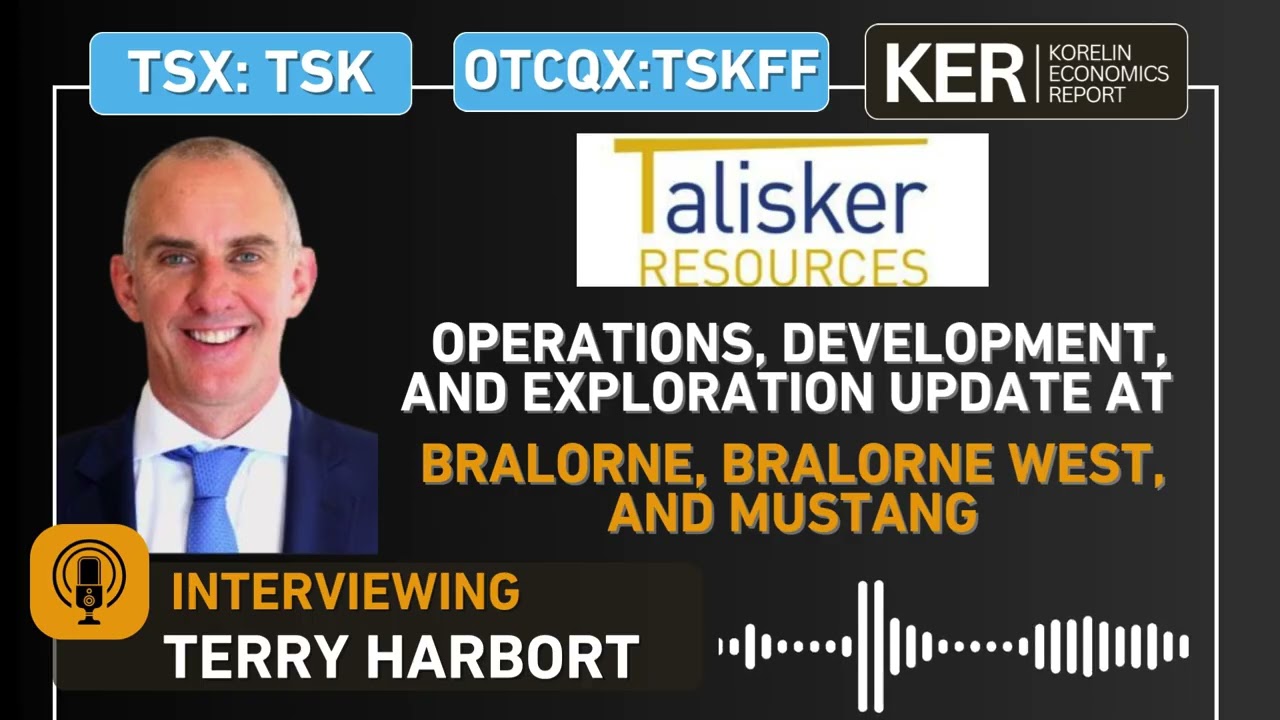
Talisker Resources – Operations, Development, & Exploration At Bralorne, Bralorne West, and Mustang
First direct-ship ore delivery from Bralorne to Ocean Partners on August 24 closed Talisker's logistics chain, with bulk shipments now every couple of months. Underground development at Bralorne, Bralorne West, and Mustang totaled 2,365 meters this year, including a first crosscut into the BK vein showing visible gold. A Q4 PEA is imminent, supported by a doubled Mineral Resource Estimate and real costs from current production, giving investors independent third-party validated economics. XRT ore sorter testing rejected 57-67% of waste, upgraded gold grade 2.0x to 2.5x, and recovered 84-87% of contained gold. Long-term vision targets 200,000 ounces annually from a district-scale operation spanning Mustang, Mustang West, Bralorne West, and Olympus.
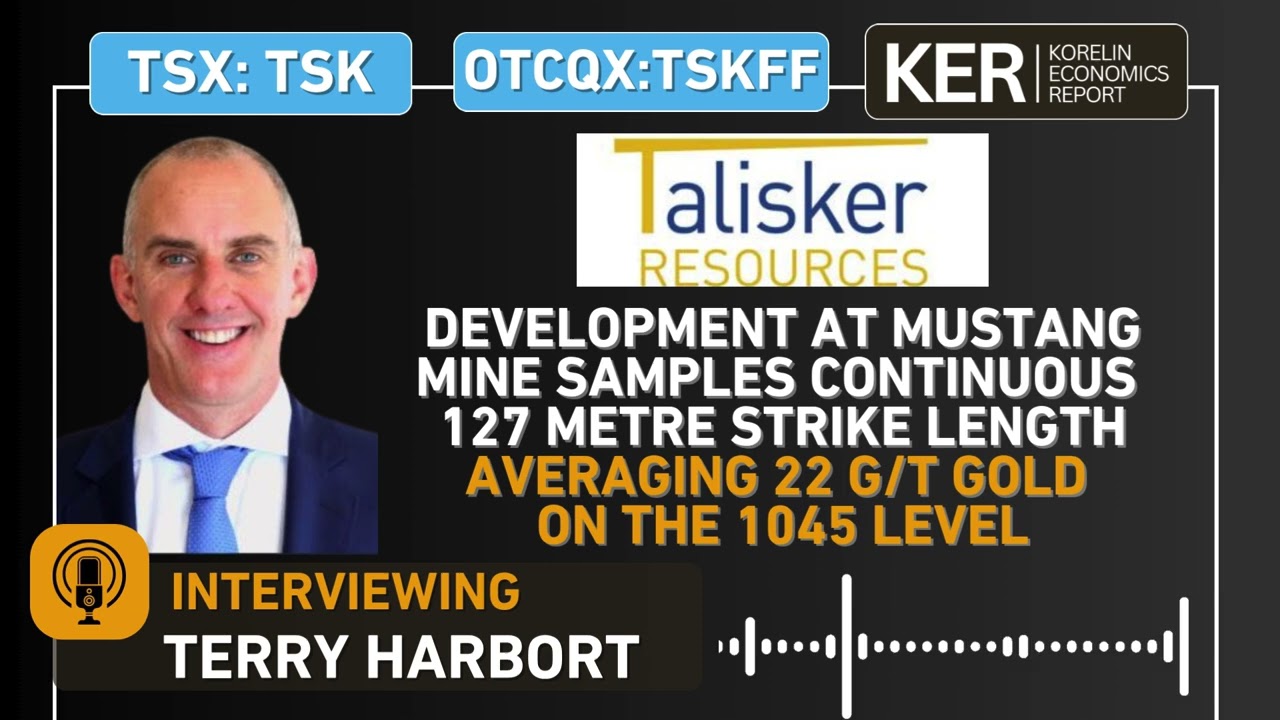
Talisker Resources – Continuous 127m Strike Length Averaging 22 g/t Gold on 1045 Level At Mustang
- Top takeaway He argues the 1045-level results on the BK9870 vein - nearly 130 metres at 21.5 g/t gold, about 30 metres from the earlier BK vein - have rewritten expectations after the prior 60-metre strike at 27 g/t, and stresses these are the first results from a level Talisker developed itself.
- He says the data validates the thesis Bralorne has always been famous for - high grade and structural, horseshoe-like continuity - and that his mining team does not chase veins, simply developing ahead as the structures keep giving high-grade face after face; stoping has started between the 1045 and 1060 levels.
- He frames sample-to-mill turn-around as a couple of months: finish a level's lateral development, then blast and stop it, with the 1045 being trucked now and the decline heading down toward the 1015 level.
- On ore sorting he is explicit that the goal is removing waste blended into narrow-vein material so the same tonnes carry higher grade and better recovery to partner Ocean Partners; he says the bulk sample tested with TOMRA at the University of Saskatchewan was very conducive to sorting, with results expected within about a week of the July 23, 2026 recording.
- His investment thesis is district-scale: with the July 13 Ben Nevis step the package is about 24,000 hectares and just over 40 km along strike, he points to potential for 5 to 8 million ounces at the centre of Bralorne plus half-million to one-million-ounce satellites trucked to a central facility, and asks investors to judge the company on a longer view than the assessment due in September and October.
Talisker's CEO says 127 metres averaging 21.5 g/t (grams per tonne) gold at Mustang confirms grade and continuity are improving with depth. Ore sorting equipment, funded by an $11 million loan, should cut blended waste rock and raise the grade of ore trucked from H1 2027. The Ben Nevis purchase extends Bralorne to 24,000 hectares along 40 km of strike, supporting a hub-and-spoke plan with a central processing facility. Roughly 85,000 metres of drilling is directed at converting known resource into mineable reserves rather than chasing new discovery. Management expects a significant increase in both revenue and gold production when second-quarter results are released.

Talisker Resources Updates Market with Doubled Gold Resource at Bralorne Project
- Top takeaway The CEO presents the doubled resource (about 3.4 million ounces) as proof Talisker executes on its promises, noting the company went from first drill hole to production within five years and exceeded its own 800,000 to 1,000,000 ounce growth guidance.
- He argues Bralorne is a world-class camp with potential to grow to 5 million ounces or beyond, calling the new resource a step toward that stated vision.
- His strategy is to stay in production and cashflow through ore sales (toll milling, direct shipping to Ocean Partners) until Talisker builds its own mill, then develop satellite deposits to truck into a central facility.
- He contends this fast-track model skips the 'Lassonde curve' value-losing quiet phase, building a cash pool during what is normally a no-revenue permitting and construction period.
- His near-term commitments: ore-sorting facility construction starting within about a month, an updated mine plan and PEA out by September 2026, and steady drill results from the 100,000-meter program.
Talisker's updated Bralorne mineral resource estimate (an inventory of in-ground gold) added 1.4 million ounces to reach 3.4 million, exceeding management's expectation. The larger resource feeds an updated mine plan and a preliminary economic assessment (early-stage project economics) due in September 2026. Direct ore sales (crushed ore sold unprocessed to trader Ocean Partners) generate early cash flow, avoiding the Lassonde curve's pre-production value dip. A 100,000 metre drill program mostly converts existing resources to support the mine plan, with new exploration at Congress and Pioneer Deeps. Management points to a five million ounce camp vision and a production-within-five-years track record as drills keep turning at Bralorne.
Key Quotes
"This updated MRE represents a step-change for the Bralorne Gold Project increasing our global resource by 100% and validates our long-held view of the quality and size of the Bralorne district."
— Talisker Resources press release, 2026 Mineral Resource Statement for the Bralorne Gold Project (May 14, 2026)
"We are very happy with our inaugural MRE and that it landed solidly within our expected range."
— Talisker Resources press release, inaugural Mineral Resource Estimate for the Bralorne Gold Project (January 24, 2023)
"The PEA will incorporate design and infrastructure criteria for the expansion of our Mustang Mine and the new Olympus Mine, providing an independent NI 43-101 compliant framework to support our current operations and future growth plans."
— Talisker Resources press release on engaging SGS Canada for the Bralorne MRE update and Preliminary Economic Assessment (2026)
Key Works
Press release doubling Bralorne's global resource to roughly 3.36 million ounces, with Harbort's statement on the district's size.
First NI 43-101 resource for Bralorne — 33,000 indicated and 1.63 million inferred ounces — including Harbort's assessment of exploration upside.
Announces the independent PEA and MRE update underpinning the Mustang Mine expansion and the new Olympus Mine.
Video interview with The KE Report on operations, development and exploration across the Bralorne, Bralorne West and Mustang assets.
Disclaimer: Terry Harbert has NOT endorsed this platform and is not affiliated with Pixys in any way.