Steve Hanke
Professor of Applied Economics | Johns Hopkins University | Monetary Policy & Inflation Expert
"Accurately predicting the 9% U.S. inflation peak using money supply analysis and his PPP-based hyperinflation tracking methodology"
Biography
Dr. Steve Hanke is a Professor of Applied Economics at Johns Hopkins University and one of the world's foremost authorities on inflation, monetary policy, and currency dynamics. His career spans academia, government advisory roles, and private sector consulting, giving him a rare ability to connect theoretical economics with real-world market implications. Hanke has advised multiple governments on currency reform and stabilization, and his purchasing power parity (PPP) methodology has become a benchmark for estimating inflation in countries experiencing hyperinflationary episodes.
Hanke's relevance to commodity investors stems from his rigorous application of the quantity theory of money to forecast inflation with striking accuracy. Along with John Greenwood, Hanke used money supply growth data to predict the 9% U.S. inflation peak—calling 9.1% when most economists and policymakers were blaming supply chain disruptions. This monetarist framework gives him a structural edge in forecasting the macroeconomic environment that drives gold, oil, and broader commodity prices. When Hanke speaks on inflation, resource investors should listen because his track record suggests he sees what others miss until it's already priced in.
In recent interviews on platforms like Metals & Miners, the David Lin Report, and Lena Petrova's channel, Hanke has addressed the commodity-market implications of geopolitical crises—particularly the Strait of Hormuz and oil supply shocks stemming from Middle East tensions. He has warned that markets are "totally complacent" about geopolitical risks that could send oil prices surging and reignite inflationary pressures. His analysis connects Federal Reserve policy, money supply dynamics, and commodity supply shocks into a cohesive framework that helps investors position ahead of major macro shifts.
For mining and resource investors, Hanke's work is particularly valuable because he treats gold as a monetary asset whose price is fundamentally driven by changes in the money supply and inflation expectations. His willingness to challenge consensus narratives—whether on transitory inflation, Fed credibility, or geopolitical risk pricing—makes him a contrarian voice worth tracking when constructing commodity-heavy portfolios.
Videos (5)

The Fed’s Inflation Model Is Broken
- Top takeaway Hanke's central claim is that the Fed's post-Keynesian macroeconomic models do not even measure the money supply and exclude the quantity theory of money, so the signal he considers most important for understanding inflation is absent from the framework.
- He frames policy as having already swung the other way: quantitative tightening ran until December 2025, and as of this video's July 2026 as-of date the Fed is in quantitative easing.
- Hanke rejects outright the Fed's stated view that there is no reliable relationship between the money supply and economic activity, calling that claim nonsense, and notes Jerome Powell has said it explicitly and repeatedly.
- He is pressing the incoming Fed leadership to put it on the record, hoping Warsh sees the light and keeps the quantity theory of money and money supply central to hitting the inflation target, while noting Warsh has not actually said this explicitly yet.
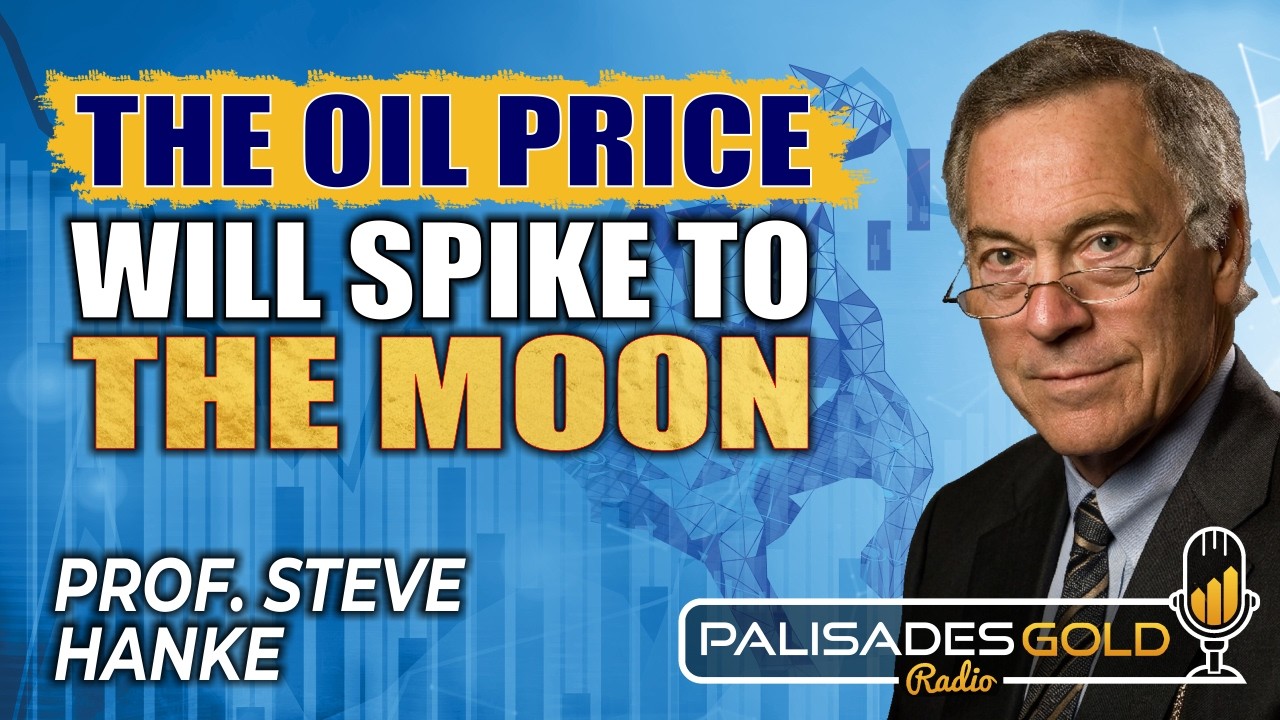
Steve Hanke: What Everyone Is Getting Wrong on Iran War, The Commodity Super Cycle & Gold
- Top takeaway Anticipates a sharp oil price spike later this summer (toward August 2026): as of the July 17 recording the Strait of Hormuz is effectively closed (only one tanker transited on July 16) with Iran controlling it, Russia has cut off diesel exports, and backwardation signals inventories are near depletion.
- Says the gold bull market is intact and should peak around $6,000/oz (about $6,600 using current-market math) — a level derived from past gold bull-market peaks relative to US real disposable income per capita — with central bank buying the main underlying driver.
- Recommends staying long oil into the spike: the plain-vanilla trade for average investors is buying the majors, which he says are trading at very low prices, while backwardation offers a built-in roll profit and very wide crack spreads favor refiners.
- Argues the war cycle has fueled a commodity supercycle that deglobalization will sustain, as balkanized trade forces larger precautionary inventories; he calls copper a "no-brainer" deficit and expects the tungsten deficit to be sustainable because byproduct supply responds slowly.
- Warns the inflation genie will stay out of the bottle: with about 35% of US individual income tax receipts going to debt service, the Fed faces pressure to monetize the deficit, which he expects to keep pushing bond yields up.
Backwardation (spot oil priced above futures) signals critically low inventories; Hanke expects a sharp price spike once physical stocks run dry later this summer. The Strait of Hormuz is effectively closed (one tanker transited July 16) and Russia has cut diesel exports, squeezing both oil inventories and flows. Hanke sees the gold bull market intact with a peak near $6,000 per ounce, driven mainly by central bank buying below reserve targets. Deglobalization forces firms to hold larger precautionary inventories, a structural demand boost that fuels the commodity supercycle alongside war-driven shortages. Copper and tungsten deficits look structural because most critical minerals are byproducts, so supply cannot respond quickly when demand rises.

Steve Hanke’s Plan to Expand the Dollar
- Top takeaway Hanke says he is advising the Trump administration on a dollar strategy to expand the use of the U.S. dollar worldwide, with dollar-based currency boards replacing local central banks as one mechanism.
- He advocates that most developing countries should replace their central banks, which run discretionary monetary policy, with currency boards.
- He points to Hong Kong's currency board, in place since 1983, saying its record is perfect.
- He argues currency boards never fail and always produce stability, low inflation, and low deficits because a currency board cannot create credit or lend to fiscal authorities or the government.
- He concludes that currency boards deliver lower inflation, lower deficits, and higher economic growth, calling it a win-win.
Steve Hanke is advising the Trump administration on a dollar strategy to expand worldwide use of the U.S. dollar. His proposed tool is dollar-based currency boards replacing the discretionary central banks most developing countries now run. Because a currency board cannot create credit or lend to government, Hanke says countries get lower inflation, lower deficits, and higher economic growth. Hong Kong's currency board, operating since 1983 with what Hanke calls a perfect record, anchors the argument.

Steve Hanke: Gold is Going to $6,000 as Inflation Comes Roaring Back
- Top takeaway Hanke argues gold's long-term secular bull market is intact and he expects it to peak around $6,000, calling the pullback to roughly $4,200 (as of July 7, 2026) a good buying time because central bank demand, with China buying heavily, puts a floor under the dollar price.
- He contends the inflation genie is out of the bottle: Divisia M4 money supply is growing about 6.7% year-over-year versus his 6% golden growth rate consistent with 2% inflation, with US CPI at 4.2% year-over-year (mid-2026) — more than double target.
- He predicts interest rates will rise further because the market-set 10-year yield (about 5.1% on July 7, 2026) follows inflation, so he is bearish on bonds: he would hold bills near 5% but completely avoid the long end, where rising yields mean capital losses.
- He argues a commodity price super cycle has begun and advises investors to pivot out of bonds and into commodities for the rest of 2026.
- He warns US interest expense now absorbs about 22% of tax revenue and exceeds defense spending — citing Ferguson's law as a historical red flag for governments — while advocating dollar-based currency boards to expand the dollar system, with Venezuela (inflation around 450% per year) as a key candidate.
Hanke argues gold's long bull market is intact with prices peaking near $6,000, and central bank buying makes the pullback a buying opportunity. Divisia M4 (broad money supply weighted by how spendable each component is) is growing 6.7% year over year — Hanke's signal inflation is re-accelerating. The 10-year Treasury yield (5.1% in early July) tracks inflation the market expects, so Hanke expects yields higher and avoids long bonds. Hanke sees a commodity price super cycle starting and advises pivoting portfolio weight out of bonds and into commodities. His forthcoming book argues currency boards — local money fully backed by an anchor currency — beat central banks on stability.

Steve Hanke: Massive Inflation Ahead & Markets 'Totally Complacent' On Iran War
Professor Hanke warns of massive inflation ahead driven by rapid US money supply acceleration and dangerous market complacency regarding geopolitical risks. A new commodity super cycle is emerging, fueled by severe supply disruptions, tariffs, and potential oil price shocks from Iran conflict scenarios. Gold serves as a critical geopolitical hedge as de-dollarization myths persist, while supply shocks and infrastructure bottlenecks create distinct investment winners and losers.
Key Quotes
"Markets are totally complacent on the risks of escalation in the Middle East and the potential for a massive supply-side shock to the world economy."
— Metals & Miners interview, March 2026
"We used the quantity theory of money to predict the 9% inflation peak when others were blaming supply chains—and we were right."
— Multiple interview appearances discussing his inflation forecasting track record
Key Works
A real-time inflation tracking methodology using purchasing power parity to estimate inflation rates in countries experiencing or approaching hyperinflation
In-depth discussion on Strait of Hormuz crisis, oil supply shocks, inflation risks, Fed policy, and implications for gold and commodity prices
Specializations
Disclaimer: Steve Hanke has NOT endorsed this platform and is not affiliated with Pixys in any way.