Rachel Tidball
Senior Manager, Global Family Office Group | Scotiabank Global Wealth Management | Wealth advisor to ultra-high-net-worth families
"Scotiabank Global Family Office Group manager; CIM®; founder of Corporates Connect"
Biography
Rachel Tidball is a Senior Manager in Scotiabank's Global Family Office Group within Global Wealth Management, working with ultra-high-net-worth (UHNW) families on the structure, governance, and long-term stewardship of their wealth. Her relevance to commodity and mining investors is indirect: she serves families whose portfolios often include direct resource holdings, royalties, and private mining equity, rather than producing buy/sell research on specific metals or individual miners.
Tidball holds the Chartered Investment Manager (CIM®) designation and an HBA from the Ivey Business School at Western University. She founded Corporates Connect, a platform she launched roughly three years ago to bridge corporate Canada with student talent. Earlier in her career she worked at Verizon, where she was selected to the Chairman's elite Finance Process Review team — an experience she frequently credits with grounding her in disciplined financial analysis.
Her work at Scotiabank focuses on multi-generational wealth planning for UHNW families, including those with significant resource-sector allocations. She emphasizes financial literacy and female representation in finance, regularly speaking to student and women-in-finance audiences about career paths in wealth management.
On March 8, 2026, Tidball appeared as a panelist on the "Women in Finance #IWD 2026" livestream alongside other senior Canadian finance voices. Resource investors tracking capital flows into commodities will encounter her primarily through family-office mandates with natural-resource exposure, rather than through commodity-specific research calls.
Videos (5)

Oregen Energy Increases Oil Discovery Potential Outside the Middle East
- Top takeaway Tidball pressed the guest for concrete catalysts, pointing out that he twice said 'if we've done our job right' and asking what would show investors the company had delivered.
- She asked why grabbing this specific acreage mattered now and how expanding to two blocks with 2D seismic improves the company's leverage in farm-out negotiations with supermajors.
Namibia's Orange Basin may be the last frontier where a junior explorer can still make a multi-billion-barrel oil discovery. Farm-out is the plan: a major partner should carry the roughly $100 million cost of drilling a deepwater well in extreme offshore depths. A local Indigenous partner, Petrovena, matters twice: Namibia favours local companies in block awards, and majors want in-country ties. Two-dimensional seismic data plus acreage beside TotalEnergies' Venus discovery is the leverage Oregen wants in data-room talks. Barrels from a basin outside chokepoints like the Strait of Hormuz should attract attention while Middle East conflict squeezes supply routes.

A2 Gold is Now a Multi-Asset Nevada Powerhouse with Gold, Silver, and Antimony
- Top takeaway Tidball frames the interview around whether the shift to a multi-asset Nevada company - gold, silver and antimony - reflects a real change in strategy since the company's prior appearance in January.
- She presses the CEO on the geological data that justified expanding to 30,000 metres of drilling outside the known resource, asking what moved the company from resource definition back into an aggressive exploration phase.
- She challenges the staleness of the Taylor silver estimate, noting it is over a decade old and was based on lower metal prices, and asks what process and timeline will bring it into a modern, compliant resource.
- She tests whether antimony, a critical mineral identified by the US government, changes exploration priorities, and whether the company would look for a separate partner to develop the critical-mineral side of the business.
- She requests a breakdown of the current cash position and how the burn rate will be managed if drilling results require further follow-up later in 2026, then raises the tension between proving up a multimillion-ounce resource and high drilling and permitting costs in a competitive Nevada market.
Only about 18% of the Eastside deposit has been drilled, so most of the expanded 30,000-metre program tests new ground. The CEO frames the drilling as a hunt for a third or fourth Eastside deposit, with two ore bodies defined today. Taylor's historical silver estimate dates to 2018 — 11 million ounces at $17 silver, about 20 million at $30, mostly measured and indicated. Antimony rides along with Taylor's gold zones, useful mainly as a route to U.S. government grants rather than a new business line. More than $15 million in cash plus roughly $3 million in warrants covers both programs into 2027, so no raise is needed yet.

Spartan Metals Now Has the Largest Tungsten Resource in the U.S.
- Top takeaway Tidball frames the discussion around U.S. critical-mineral independence: noting China controls over 80% of the world's tungsten, she presents the Victoria acquisition as giving the U.S. its largest tungsten resource and says that has made the company a focal point of the theme.
- She highlights the recent stock surge as the reason the company may now be able to move faster, and asks whether the schedule to earn 100% of Victoria, which carries up to $14 million of committed work over five years, can be compressed with drills turning earlier.
- She cites tungsten prices above $2,250 per unit, roughly a 100% increase from lows last marked in 2008, and asks how large the valuation gap is when today's record prices are applied to the historic study for this resource.
- She presses the CEO on whether the investment case is a pure-play tungsten story or a basket of strategic metals, naming beryllium, molybdenum and silver, with the CEO adding fluorspar at Victoria and rubidium.
- She asks whether the goal for Victoria is to move into a federal funding package on national-defense grounds, citing the CEO's earlier track record of developing projects and securing U.S. government grants.
Spartan Metals' Victorio acquisition in New Mexico hands it the largest tungsten resource in the United States. China controls over 80% of global tungsten supply, and Spartan is pitching Victorio as a domestic counterweight. Tungsten near $2,250 per unit, roughly double 2008 lows, sets up a 2026 PEA (Preliminary Economic Assessment, an early feasibility study) for Victorio. Federal support is management's key lever for speed, bringing capital, permitting help, and technical expertise. Spartan has committed up to $14 million of work over five years to earn full ownership of Victorio.
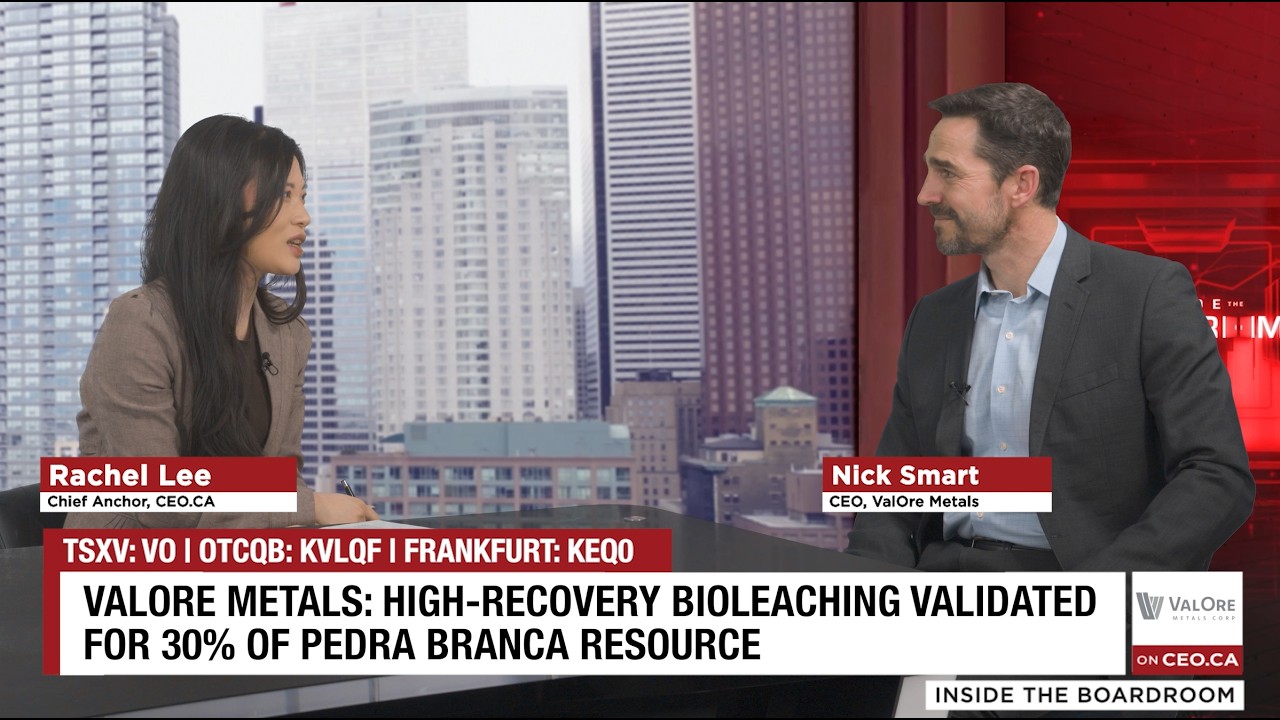
Inside the Boardroom: ValOre Metals — From Bioleaching Breakthrough to PGE Revaluation
- Top takeaway As interviewer, she presses on whether proven bioleaching lets ValOre bypass a traditional smelter and what that means for initial capital, plant footprint and economics at Pedro Branca.
- She argues safe, supportive jurisdictions matter more than ever and probes what ValOre's Brazil build-out and the end-of-2026 PEA mean for 2026.
ValOre's bioleaching tests (bacteria break down metal complexes to free metals) recovered over 70% of platinum and palladium in 22 days, versus 60 before. CEO Nick Smart argues a hydrometallurgical route (leaching on site rather than shipping concentrate to a smelter) enables low-cost processing. The top 130 meters of weathered near-surface ore — about 30% of the 2.2-million-ounce PGM (platinum group metals) resource — grades 6.5 to 8.5 grams per ton. A Preliminary Economic Assessment is due by end of 2026, with scale-up and column tests (heap leaching trials) set to feed its flow sheet. Smart sees Brazil becoming a regional PGE hub as buyers diversify away from supply concentrated in South Africa, Zimbabwe, and Russia.

Arizona Eagle Mining Hits the Public Market with High-Grade Past Producer
- Top takeaway Serves as the interviewer, pressing the CEO on the strategic logic of the reverse takeover, drill progress and geophysical targeting, permitting on private ground, and why he is hesitant to publish a formal resource estimate.
- Asks about the treasury position, insider ownership after the merger, and which news catalysts investors should watch over the following 90 days.
Newly listed Arizona Eagle Mining (TSXV: AZEM) offers a past-producing, high-grade gold mine where management sees kilometres of untested structure at depth. The CEO argues the McCabe mine's historic 11.7 g/t (grams per tonne) estimate already absorbs 15% mining dilution, so true head grade is higher. Management owns about 53% of 49 million shares under three-year escrow, and the team has invested $6 million without salaries, Reid says. Private ground lets permitting clear in 48 hours, and the fully funded 4,500-metre Phase 1 program is 40% done with results expected in April. Reid is in no rush to publish a resource estimate, warning early capping undersells a system that may reach a kilometre deep.
Disclaimer: Rachel Tidball has NOT endorsed this platform and is not affiliated with Pixys in any way.