Guy Bourassa
Director & Strategic Advisor | Scandium Canada (TSX-V: SCD) | Former CEO of Nemaska Lithium and Scandium Canada
"Founding Nemaska Lithium and leading Scandium Canada's Crater Lake scandium project toward an end-to-end aluminum-scandium supply chain."
Biography
Guy Bourassa is a Quebec mining executive who has spent nearly four decades building mineral development companies. He founded Nemaska Lithium and led it as president and CEO from 2008 to 2020, then served as president and CEO of Scandium Canada (TSX-V: SCD) from January 2024 to August 2026, guiding the Crater Lake scandium project in Nunavik, Quebec — which the company describes as one of the largest primary scandium projects in the world. He remains a director and strategic advisor to the company. For resource investors, his career is a case study in both the upside and the financing risk of critical-minerals development.
At Nemaska Lithium, Bourassa took the Whabouchi spodumene deposit (spodumene is the hard-rock ore of lithium) in Quebec's James Bay region through federal and provincial environmental approval in 2015 and raised successive financings, including a $69 million round in 2016, toward an integrated mine and lithium salts plant. The company filed for protection under the CCAA (Companies' Creditors Arrangement Act — Canada's court-supervised restructuring process) in December 2019 after project financing fell through, and Bourassa left in February 2020. The assets he assembled were later revived under Investissement Québec and Livent (now part of Rio Tinto), and Whabouchi remains central to Quebec's lithium plans. Earlier in his career he served as president of Radisson Mining Resources and Monarques Resources and as a director of graphite developer Nouveau Monde Graphite.
Appointed CEO of Imperial Mining Group in January 2024, he renamed the company Scandium Canada and rebuilt its strategy around the Crater Lake TG zone, which hosts a NI 43-101 resource (NI 43-101 is the Canadian rulebook for how mineral estimates are disclosed) of 11.8 million tonnes indicated and 15.9 million tonnes inferred. A 2022 PEA (Preliminary Economic Assessment — an early, approximate mine study) outlined a 25-year initial mine life with an after-tax NPV (Net Present Value — future cash flows discounted to today) of C$1.72 billion and an IRR (internal rate of return) of 32.8%. His approach is vertical: rather than stop at mining, the company filed a US patent in 2024, developed with McMaster University, for aluminum-scandium alloys and powders aimed at 3D printing of lighter aerospace, automotive and marine parts. He also brought in the Naskapi Nation of Kawawachikamach as an early shareholder in 2025.
In August 2026 he handed the CEO role to Simon Thibault, formerly General Motors' critical materials leader, and stayed on as director and strategic advisor. The near-term agenda was set under his watch: a C$5 million flow-through financing (a Canadian structure in which exploration spending becomes investor tax deductions) closed in August 2026 for Crater Lake drilling, and the 2026 program has since returned intercepts including 140.15 metres at 293 ppm scandium oxide. What follows — a pre-feasibility study and a 15-tonne metallurgical pilot — will test whether the end-to-end scandium supply chain he championed can be financed. His career offers investors a clear lesson: technical and permitting milestones can be won, but financing is the gate that decides outcomes.
Videos (3)
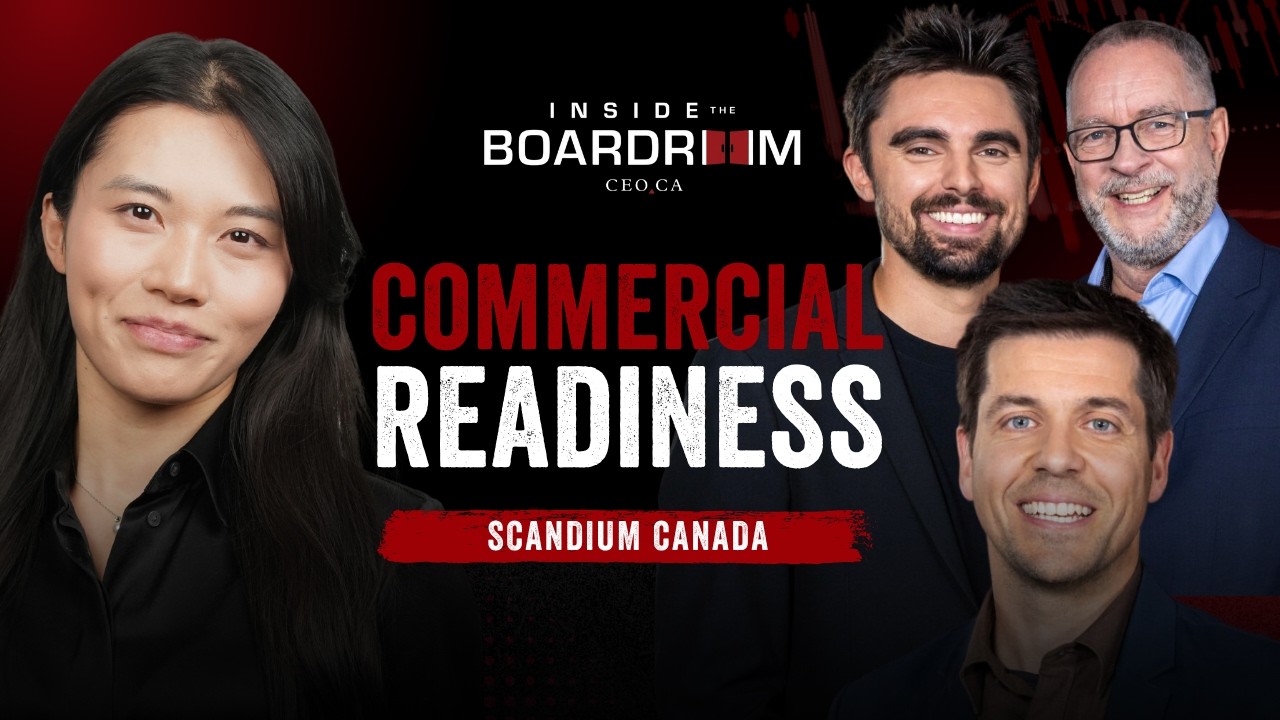
Why a Former GM Executive Left Automotive to Lead Scandium Canada
- Top takeaway Bourassa argues the handover timing is right because the recent acquisition of the commercial alloy unit confirms the mine-to-alloy-to-market direction the company set out on, and that leading that path calls for knowledge that was not his own.
- He says the project has now entered a long development phase, and that it was the best moment to hand it to a younger generation able to take it forward.
- In his new strategic advisory role he plans to make sure ongoing files do not fall through the cracks, keep the current pace, and make sure the new CEO has proper support.
- He notes the site is in the middle of a 10,000 m diamond drilling campaign, says the visual results look interesting but still need to be confirmed by certificates of analysis, and aims to finish the campaign by the end of October 2026.
- He sets out the campaign's three objectives: a mine representative sample across the deposit, already completed; at least 100 m of lateral extension north and south to add about 25% to the resource and enable a new resource estimate; and, funded by the $5 million financing completed in 2026, exploration targets to extend the T.G. zone roughly 3 km south toward the discovery area.
Bringing in a General Motors veteran signals a shift from building a mine to selling finished products downstream. Thibault says the edge is a product automakers (OEMs) can insert directly, not a concentrate needing several more refining stages. He argues buyers also need supply from an allied country, not just a competitive delivered price. A 10,000m diamond drill campaign, funded by a recent $5 million raise, targets core sampling and 3km of southern expansion, ending in October. Rolled aluminium-scandium coil is selling into this year's skis; aircraft and satellites remain the longer-term ambition.

Scandium Canada Expedited the Making of Its Own End-to-End Supply Chain
- Top takeaway He frames the Ferriol Technologies deal as de-risking and accelerating commercialization of the company's own alloys — bringing in a known team instead of building one with the time and risk of starting from scratch.
- He argues pre-mine alloy revenue is the path to financing the mine: as a junior, the company must demonstrate and confirm a market for aluminum-scandium alloys, including volumes and pricing.
- He argues a reliable primary scandium source in a good jurisdiction changes conversations with large OEMs, since byproduct supply tied to nickel prices and roughly 90% of output from China and Russia is geopolitically unsafe.
Scandium Canada (TSXV: SCD) closed its acquisition of Ferreol Technologies and rebranded it Scalium+, buying a ready alloy team and production line. The deal shortcuts the path to aluminum-scandium alloy revenue, with first sales already reaching the alpine ski industry. CEO Guy Bourassa says early alloy revenue will prove scandium demand and pricing, strengthening financing for the Crater Lake mine. Bourassa argues a primary scandium source (mined for itself, not a nickel byproduct) reassures buyers because roughly 90% of supply comes from China and Russia. Scalium+ CEO Félix Lapointe maps the roadmap: sports equipment now, aerospace projects within a year, space in about five years, aviation in ten.

Scandium Canada: Al-Sc Alloy Developments and the 2026 Drilling Campaign
- Top takeaway The guest argues the company's recent funding steps are the momentum investors should watch, saying the March 17 bond deal and the $7 million federal grant buy about two years of breathing room to move the pre-feasibility study forward and reach feasibility in about 18 months.
- He puts commercial scale far out, targeting a full feasibility study by end-2028, a 2028 investment decision to fix the construction start, and no initial production before roughly 2030, while calling the commercial step huge for any business.
- He argues the aluminum-scandium alloy work is strategically separate from the mining project, saying it will have a life by itself and is in qualification for laser-bed-fusion and 3D-printing powders and welding wires, which he expects to add momentum to the market cap and company development.
- He argues the Crater Lake program's main objective is representative material for a large piloting into metallurgy for the feasibility study, with the secondary aims of extending the open TG deposit to each side and testing continuity at depth of very high-value material.
- On supply-chain strategy he argues North American producers are not trying to knock China out but to hold their own reliable, long-term supply, saying the US ambassador's visit confirmed interest in financing critical minerals development and that Canada, already a large aluminum producer, should add scandium to its own metal.
Scandium Canada's aluminum-scandium alloy business runs separately from the mine, with powders and welding wires now in customer qualification. The guest says a $17.25 million bond deal closed March 17 plus a $7 million federal grant buys about two years of study time. Management targets a full feasibility study by end-2028, a final investment decision in 2028, and no first production before 2030. Crater Lake drilling serves three aims: bulk metallurgy samples, extending the still-open TG deposit, and testing high-grade material at depth. An Indigenous partner holding a 5% stake will lead the access road assessment, while a nearby processing plant trims transport costs.
Key Quotes
"Scandium is the future."
— InvestorNews interview, August 6, 2025
"Imagine, you can reduce the weight of anything that is moving … and be as strong."
— InvestorNews interview, August 6, 2025
"The 2024 drilling campaigns confirmed the strong scandium and rare earth potential of the TG zone"
— Scandium Canada news release, February 10, 2025
Key Works
Video interview on scandium demand, aluminum-scandium alloy powders for additive manufacturing, and plans for the Crater Lake project.
Company release detailing the Crater Lake TG zone resource, 2022 PEA economics (after-tax NPV C$1.72 billion, 32.8% IRR), the aluminum-scandium alloy patent with McMaster University, and pre-feasibility plans.
Specializations
Disclaimer: Guy Bourassa has NOT endorsed this platform and is not affiliated with Pixys in any way.