George Bennett
Chief Executive Officer | Rainbow Rare Earths (LSE: RBW) | Rare earths from phosphogypsum
"Leading Rainbow Rare Earths' low-capex route to magnet-metal NdPr from phosphogypsum at Phalaborwa, South Africa, backed by a proposed US$50 million US DFC investment."
Biography
George Bennett is chief executive officer of Rainbow Rare Earths (LSE: RBW), a London-listed developer building rare earth production outside China's supply chain. He is best known for championing an unusual source of the magnet metals neodymium and praseodymium (NdPr): phosphogypsum, the gypsum waste stacked beside phosphate fertilizer plants. For resource investors, his work is a live test of whether fertilizer byproducts can become a meaningful new supply of the materials that go into electric vehicle motors and wind turbines.
Bennett has spent more than 30 years in mining and capital markets. He founded engineering firm MDM Engineering in 2006, listed it on the London Stock Exchange in 2008, and sold it to Foster Wheeler in 2014. He led LSE-listed gold producer Shanta Gold and helped seed ASX-listed OreCorp as a non-executive director, after earlier roles at Fergusson Bros, Simpson McKie and HSBC Securities Africa. At Rainbow, the company's Gakara project in Burundi reached trial production in 2017 and, at run-of-mine grades near 10% TREO (total rare earth oxides), was the only African rare earth producer while it operated, before suspension in June 2021 at the Burundian government's request.
His focus now is the Phalaborwa project in South Africa, which targets recovering rare earths from roughly 35 million tonnes of phosphogypsum at 0.44% TREO, with NdPr making up about 29% of the contained oxides — a rich mix by industry standards. Rainbow's December 2024 interim study outlined around 1,850 tonnes a year of separated NdPr oxide for US$326 million of capital cost, a post-tax NPV (net present value — what future cash flows are worth today) of US$611 million and a 38% IRR (internal rate of return — the project's annualized return), with first production targeted from 2028. The US International Development Finance Corporation has proposed a US$50 million investment via TechMet, announced at COP28, and a second phosphogypsum opportunity at Uberaba, Brazil is being advanced with fertilizer producer Mosaic.
Bennett's method is to avoid building a new mine: the material is already mined and stacked, so capital goes into processing rather than excavation. That underpins his case for Phalaborwa — low capital intensity, a compact solvent extraction circuit (the chemical step that separates individual rare earths) designed with ANSTO, and a basket weighted toward the magnet metals markets outside China are short of. He argues supply will stay tight for years: "I believe that there's not going to be enough supply coming into the market in the next 15 years," he told Miningmx in October 2025. Investors who follow his interviews and conference master classes get a grounded read on magnet-metal supply economics, US government involvement in critical minerals, and the emerging phosphogypsum recycling sector.
Videos (2)
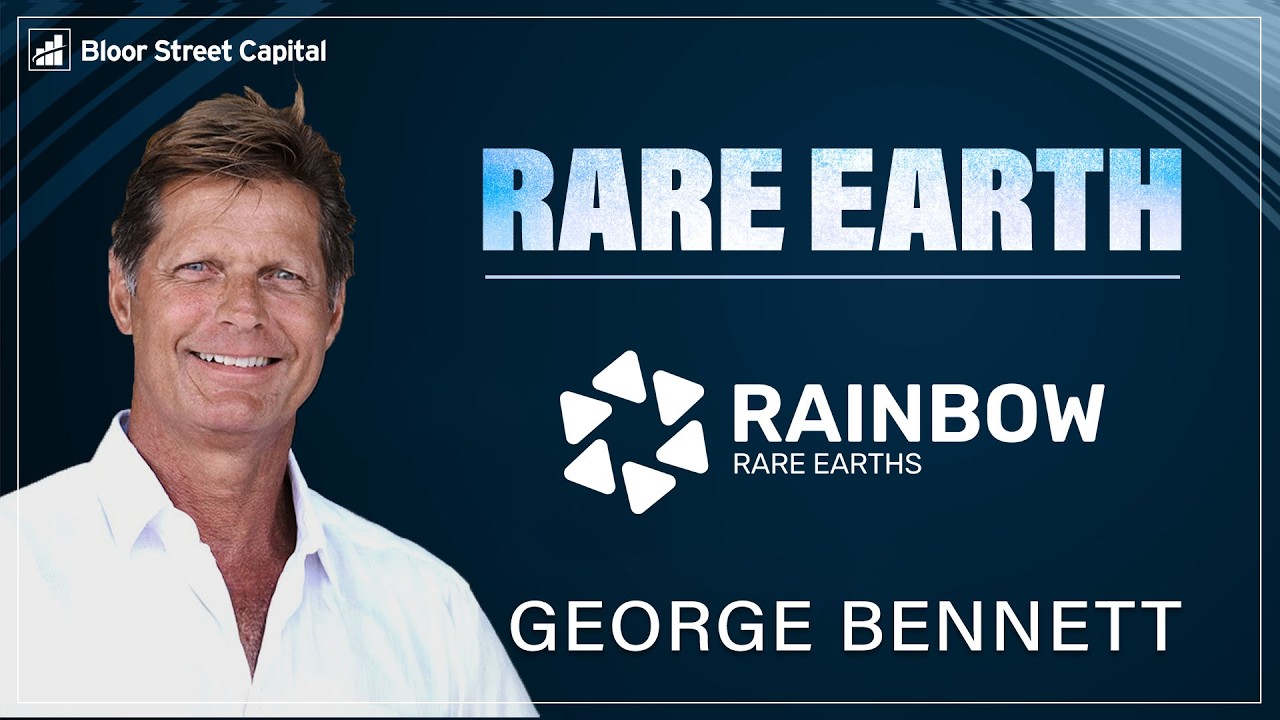
Rainbow Rare Earths - CEO George Bennett
- Top takeaway Bennett's central investment argument is that Rainbow is a chemical processor of existing phosphogypsum stockpiles, not a miner, which removes mining and geological risk and lets the company move from discovery (2021) to targeted production (2029) in roughly eight years versus a 15–20 year industry average.
- He argues rare-earth demand is entering a new phase beyond EVs and wind turbines, driven by humanoid robots (which he says require 3–5x more permanent magnets than an EV), eVTOL air taxis and commercial and defense drones — pointing to predictions of a billion humanoid robots by 2040 as a conservative demand base case.
- He highlights the dysprosium price move from about $100/kg to $1,200/kg, attributing the surge to Chinese export restrictions and framing it as a supply-driven move layered on top of a structural demand step-up rather than a purely cyclical spike.
- He makes a Western-alignment case for the equity: a $50M DFC equity commitment into Palabora on FID, a March 2026 raise of $14.6M that was over 90% US-sourced with Traxxas as a cornerstone investor, an ongoing evaluation of a US listing that he says should drive a re-rating, and US-Brazil cooperation that he suggests could eventually bring DFC support to Uberaba as well.
- He flags near-term catalysts investors should watch after the 2026-07-14 as-of date: a Palabora pilot-plant optimization and steady-state run-rate update, the kickoff of the Uberaba pre-feasibility study, new offtake announcements, and the final Palabora DFS numbers with capex held near $325M.
Rainbow Rare Earths recovers rare earths from phosphogypsum waste — a processing business that bypasses the mine entirely. Phalaborwa (South Africa) targets 2029 production: NPV ~$775M, IRR above 44%, and ~75% EBITDA margins at current rare earth prices. Uberaba (Brazil, JV with Mosaic) shows similar economics — NPV ~$920M and 2030 production — by reusing Phalaborwa's flow sheet. Humanoid robots could need 3-5x more permanent magnets per unit than EVs; rare earth demand is broadening into drones and defense. The US DFC pledged $50M at FID, Traxxas joined as a cornerstone investor, and Rainbow is evaluating a US listing.
Virtual Rare Earth Conference - Master Class on Investing in Rare Earth Sector
- Top takeaway George argues Rainbow's economics are 'unsurpassed' in mining because the rare earths come out of existing phosphate gypsum waste via chemical processing: Phalaborwa NPV about $775M, ~$220M/year EBITDA, ~75% EBITDA margin and a post-tax IRR above 44% at $300-325M capex with a 16-year stockpile life, no mining or geological risk.
- He positions Rainbow as a two-asset story: Phalaborwa in South Africa (35Mt stockpile, production targeted 2029 after DFS end-2026 and FID end-Q3 2027) and Uberaba in Brazil (Mosaic 51/49 JV, 30+ year stockpile, production targeted 2030).
- He highlights the US DFC's $50M project equity commitment to Phalaborwa at FID, alongside ~$200M of debt and only ~$50M of remaining equity, and notes the DFC has signaled interest in extending support to the Brazil project.
- He flags a March 2025 raise of $14.6M led 90%+ by US investors with Traxxas (a partner in the US government's $12B Project Vault) as a cornerstone, plus an ongoing evaluation of a US listing to drive a re-rating and improved liquidity.
- He ties demand to EVs, wind turbines, humanoid robots (3-5x the permanent magnets of an EV) and eVTOLs/drones, with dysprosium prices moving from $100/kg to $1,200/kg, and flags near-term news flow on pilot optimizations, the Uberaba pre-feasibility kickoff, off-take agreements and final DFS numbers.
China controls 60% of mining, 91% of refining, and 94% of magnet output, pushing Western governments to fund non-Chinese rare earth supply. Dysprosium is up 300% and terbium is up 400% on Chinese export restrictions, with Western buyers still struggling to secure heavy rare earths. Heavy rare earths are hardest to extract economically; China refines roughly 98% of heavy metal, the gap G7 nations are racing to close. Rainbow Rare Earths targets 2029 production by recovering rare earths from phosphate mining waste stockpiles, sidestepping traditional mining risk. Humanoid robots could use 3 to 5 times more permanent magnets per unit than an EV, opening a major new rare earth demand vector.
Key Quotes
"I believe that there's not going to be enough supply coming into the market in the next 15 years."
— Miningmx interview on rare earth supply deficits, October 2025
Key Works
December 2024 interim study for Rainbow's flagship: 35 Mt at 0.44% TREO, about 1,850 t/yr NdPr oxide, US$326m capex, US$611m post-tax NPV10, 38% IRR, first production targeted from 2028.
Miningmx interview in which Bennett sets out his case for a long rare earth supply deficit and Rainbow's low-cost phosphogypsum route.
Disclaimer: George Bennett has NOT endorsed this platform and is not affiliated with Pixys in any way.