Edward Dowd
Founder | Phinance Technologies | Macro Analyst & Gold Bull
"Predicting a debt supercycle breakdown and calling for gold to reach $10,000 by 2030"
Biography
Edward Dowd is a former Wall Street portfolio manager and the founder of Phinance Technologies, an investment research firm. He spent much of his career at BlackRock, where he managed billions in assets as a growth equity portfolio manager, giving him deep institutional credibility in financial markets. After leaving the traditional asset management world, Dowd built Phinance Technologies to provide independent macroeconomic research, with a particular focus on monetary policy, demographic trends, and their implications for asset prices.
Dowd has become one of the most vocal macro analysts warning of a systemic debt supercycle breakdown. His thesis centers on the convergence of unsustainable global debt, demographic decline, and the exhaustion of central bank stimulus tools. For commodity investors, his most consequential call is a long-term gold price target of $10,000 per ounce by 2030, driven by his expectation that the current fiat monetary system faces an inevitable reset. He argues that gold will serve as the primary store of value during this transition.
Beyond gold, Dowd's macro framework has direct implications for the broader mining sector. He has warned of a potential 40-50% stock market crash, which he believes will trigger a deflationary scare before a subsequent monetary response sends hard assets sharply higher. His outlook includes a bearish view on oil (potentially falling to $30 during the deflationary phase) and a constructive long-term stance on precious metals and critical minerals that will benefit from the eventual reflation and monetary regime change.
Dowd is a frequent guest on major financial media, including Kitco News, where his analysis of gold's trajectory in the context of the debt supercycle has garnered significant attention from the mining investment community. His ability to connect macroeconomic structural problems to specific commodity price outcomes makes him a relevant voice for investors trying to position portfolios ahead of what he describes as once-in-a-generation market dislocations.
Videos (2)
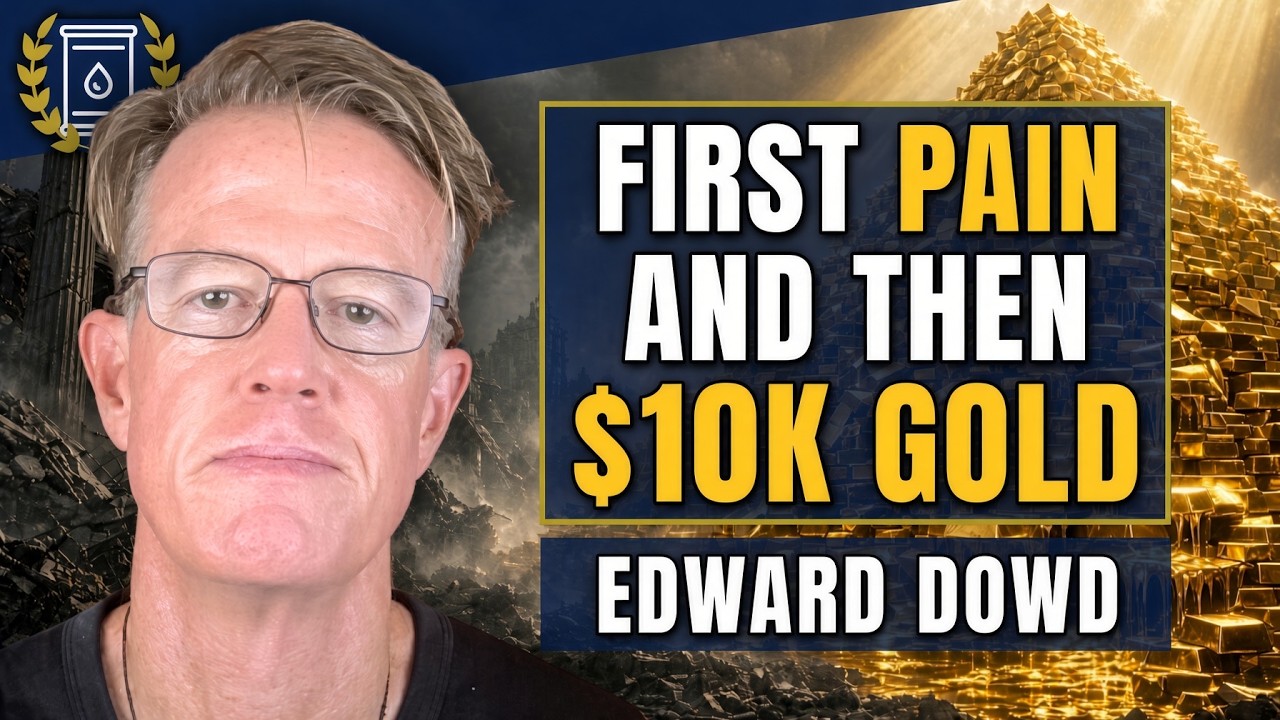
Gold's Drop 'Not a Concern' - Why Road to $10k Is Still Intact: Edward Dowd
- Top takeaway Dowd says gold's recent drop does not concern him: he has called for consolidation for roughly a year before a resumption of the march toward $10,000, and views rising yields as an excuse rather than the driver, noting gold is still in the $4,000 range as of late September 2026.
- He says the catalyst for gold is the next crisis, where slowing growth, credit problems and credit contraction force the Fed to print, and argues that when it happens it will happen fast and gold will benefit.
- He calls the Fed's 25 basis point hike a policy error made because the new chair needs credibility, expects yields to top out soon and the Fed to reverse course within roughly the next six months.
- He sees the AI trade as the only game in town and increasingly hard to finance, with private credit funding a shrinking share of the build-out, widening spreads at the neoclouds and a record junk-bond issuance, and says semiconductor stocks peaked in June and need to make new highs soon or the broader problem starts.
- He argues China's GDP in dollar terms has fallen from about 80% of US output to 60% since COVID with no dollar-denominated growth, and warns that a deep Chinese economic spiral would put Taiwan in the crosshairs.
Dowd calls gold's pullback a blip; the catalyst for $10,000 is money printing forced by the coming credit crunch. Rising bond yields are an excuse, in his view, because they choke off lending, top out soon, and force the Fed to reverse. AI's financing is cracking as private credit gates redemptions and CoreWeave bonds widen out to 13 percent. Once the bubble bursts, he expects commodities to lead while today's AI names underperform for five to ten years. He puts China's dollar GDP growth since COVID at zero, with that trouble spreading to partners in Japan and South Korea.

'Unstoppable' Market Crash To 'Break Everything' But GOLD - $10K Incoming: Edward Dowd
- Top takeaway The guest argues US equity valuations are historically extreme, with ten-year forward returns implied near 0% including dividends, and warns that the next leg down — when the AI trade finally breaks — will be fast and hard.
- He targets $10,000 gold by 2030 on the back of a global sovereign debt crisis, calling gold 'nobody else's liability' and positioning it as the honest unit of account amid ballooning deficits.
- He frames Nvidia's AI compute securitization push — MOUs, $500 billion headlines and the prospect of 'collateralized chip obligations' — as financial engineering built on circular earnings from unprofitable AI labs.
- He sees private credit as the next stress point, citing gated withdrawals, CEO exits at BlackRock and Blackstone funds, and PIMCO's call that a default cycle has begun, with insurance-company exposures as a tail risk.
- He advises typical investors to raise cash and wait, while a hedge-fund mandate would favor cash, gold and longer-duration treasuries to position for a fast Fed pivot once growth breaks.
The guest targets $10,000 gold by 2030, calling gold 'nobody else's liability' and the cleanest expression of the sovereign-debt unwind. Today's market hinges on one trade — about 19% of the S&P 500 is semiconductors, and the entire AI thesis depends on two unprofitable names. Private credit is finally being tested — gated redemptions, three CEO exits in eight weeks, and BlackRock marking a position to zero within a month. Japan is the release valve — a too-rapid yen appreciation could detonate the global carry trade and feed back into US equities. The portfolio play is cash, gold, and longer-duration Treasuries — patience, not market timing, is the real source of alpha.
Key Quotes
"Gold could surge toward $10,000 as global demographic collapse and spiraling debt mean a new monetary system is inevitable."
— Kitco News interview on debt supercycle breakdown
"By the end of 2026, it'll be cash and the 30-year bond. And my long term outlook for gold was $10,000 by 2030."
— The Real Story interview with Michelle Makori
"We call these types of moves ending moves."
— Commentary on AI stock parabolic advances and market tops
Key Works
Book co-authored with forensic financial analyst examining excess mortality data using Wall Street analytical frameworks
Independent macroeconomic research firm providing analysis on monetary policy, demographics, and market structure
Specializations
Disclaimer: Edward Dowd has NOT endorsed this platform and is not affiliated with Pixys in any way.