Dastan Kosherbayev
Chief Strategy & International Development Officer | Kazatomprom | Spokesperson on global uranium market discipline
"Explaining uranium production guidance and supply headwinds as a senior executive at Kazatomprom."
Biography
Dastan Kosherbayev is the Chief Strategy and International Development Officer at NAC Kazatomprom JSC, the world's largest uranium producer, accounting for roughly 25% of global mine output. For resource investors, he is a regular corporate voice explaining uranium market fundamentals, production guidance, and the operating constraints that shape Kazakh supply.
Kosherbayev joined Kazatomprom in 2016 as a manager in the Corporate Governance Department and rose through the company on the commercial side. He ran the M&A section in Business Development from 2017 to 2019, then led the Sales Department from mid-2021 before being appointed Chief Commercial Officer and Management Board member in June 2023. In April 2024 he moved into his current strategy role, broadening his remit to international development and government-level engagement. He is an economics graduate of Middle East Technical University (class of 2001).
His work sits at the intersection of commercial discipline and supply-chain reality. Kazatomprom's mines are predominantly ISR operations — in-situ recovery, a method that leaches uranium from sandstone using injected solutions rather than conventional open-pit mining. That technical profile means sulphuric acid availability, wellfield development, and contractor capacity are the binding constraints investors need to understand, and Kosherbayev has become a regular explainer of those levers in investor interviews and on stages like PDAC, the World Nuclear Symposium, and an IAEA "Digging Deeper" briefing.
For investors building a view on the uranium tape, his commentary is useful precisely because it comes from the largest physical supplier in the market: production guidance, cost discipline, and project economics are framed from the seat where the actual tonnes are produced.
Videos (2)
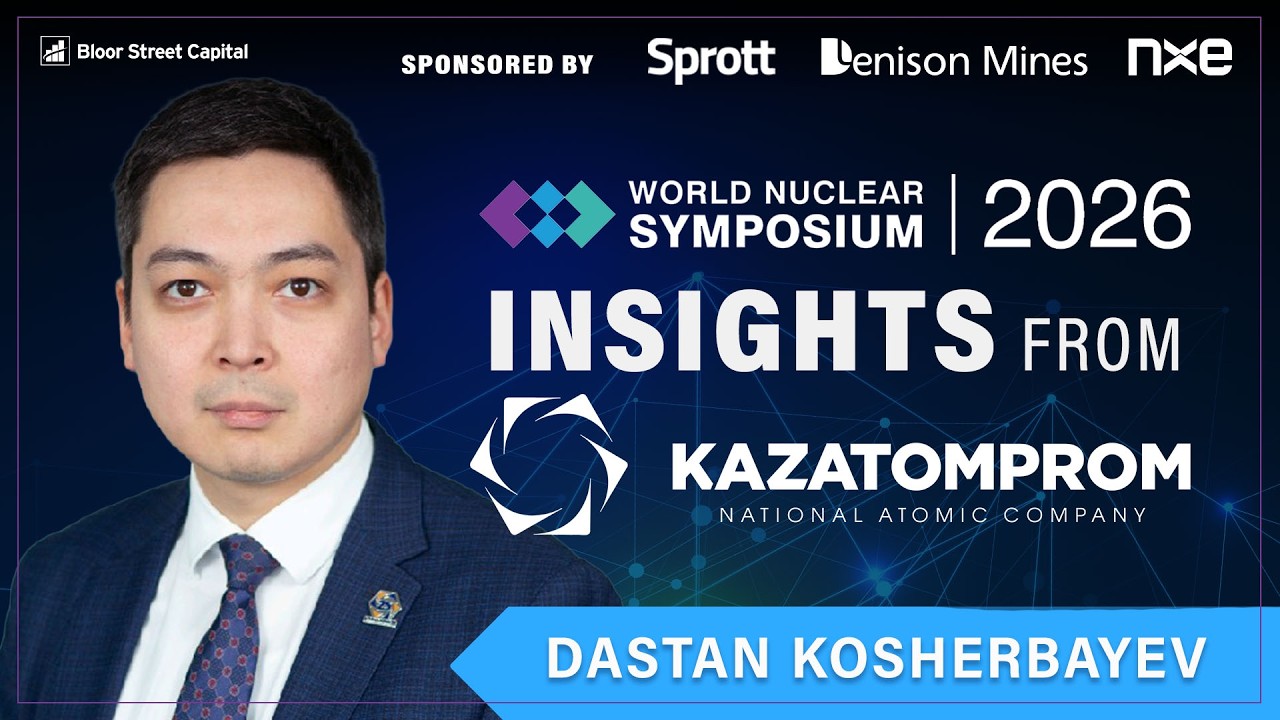
Kazatomprom: Uranium Production, Guidance & Sulphuric Acid Supply
- Top takeaway Argues that Kazatomprom's value-over-volume strategy is the right call and that no current uranium price would change the company's incentive to keep production flat
- Frames the current moment as the start of a 'nuclear renaissance' and says Kazatomprom is well positioned as the world moves from ambition to action on tripling nuclear capacity
- Downplays Middle East supply risk to sulfuric acid, citing reliance on local producers and a buffer because sulfuric acid is under 15% of production costs
- Attributes the June 21.4 million pound finished uranium inventory build (+20% YoY) to seasonal delivery timing rather than deliberate stockpiling
- Justifies the six-month halt to the third sulfuric acid plant as a precaution after fossilized remains of a prehistoric animal were found at the site
Kazatomprom reaffirms 2026 uranium guidance of 27,500–29,000 tons and says no price would tempt it to grow output — value over volume remains the playbook. Kazakhstan's third sulphuric-acid plant is delayed at least six months past its Q1 2027 target after prehistoric fossil remains were found at the site. Sulphuric acid — a critical input for ISR (in-situ recovery) uranium mining — accounts for under 15% of Kazatomprom's production costs, giving it margin buffer. June finished uranium inventory of 21.4 million pounds, up roughly 20% year over year, is framed as seasonal delivery timing rather than a deliberate build. Management describes a coming 'nuclear renaissance' as governments convert nuclear ambitions into action and positions Kazatomprom as a primary beneficiary.

Kazatomprom: The World's Largest Uranium Producer | Dastan Kosherbayev and Jimmy Connor
- Top takeaway His core argument: structurally exceptional uranium market fundamentals are being obscured by extraordinary policy uncertainty and geopolitical unraveling.
- He likens Western utilities to a 'frog in a boiling pan' - showing interest but failing to back it with contracts - while Eastern buyers procure with a decades-long horizon, and he expects 2026 to be the turning point for long-term contracting.
- He argues the West cannot be self-sufficient: the US needs roughly 50-60 million pounds of uranium a year but produced about 1 million pounds in 2024, so the Western Hemisphere must keep relying on external sourcing in the short term.
- He defends value over volume - each pound kept in the ground becomes more valuable, and Kazatomprom will reserve output for its own planned power plants while reviewing downstream nuclear fuel diversification.
- He reports no direct impact so far from the Middle East or the Russia-Ukraine conflict, calls the sulfuric acid situation for 2026 a 'green zone', and rejects rumors that Trans-Caspian route deliveries cost ten times more.
Kazatomprom's 2026 guidance of 71–75 million pounds looks attainable: sulfuric acid (its key input) is secured, with a third in-house plant due in early 2027. C1 cash cost (direct production cost per pound) guidance of $23.50–$25.00 and AISC (all-in sustaining cost) of $35.00–$36.50 reflect inflation and higher Kazakh mining taxes. The guest argues uranium's structurally strong fundamentals are being obscured by policy uncertainty: Eastern fuel buyers contract decades out while Western utilities hesitate. US reactors need roughly 50–60 million pounds of uranium a year against about 1 million pounds of 2024 domestic output, forcing reliance on external supply. An India contract comparable to Cameco's signals Eastern demand, while Middle East turmoil has lifted uranium prices without disrupting Kazatomprom's operations.
Specializations
Disclaimer: Dastan Kosherbayev has NOT endorsed this platform and is not affiliated with Pixys in any way.