Brian Martin
SVP, Business Development & Investor Relations | OceanaGold Corporation | Mid-tier gold producer strategy, M&A and capital markets
"Presenting OceanaGold's growth story: record free cash flow, disciplined capital returns, and the Ausgold acquisition on the path to about 650,000 oz of gold per year"
Biography
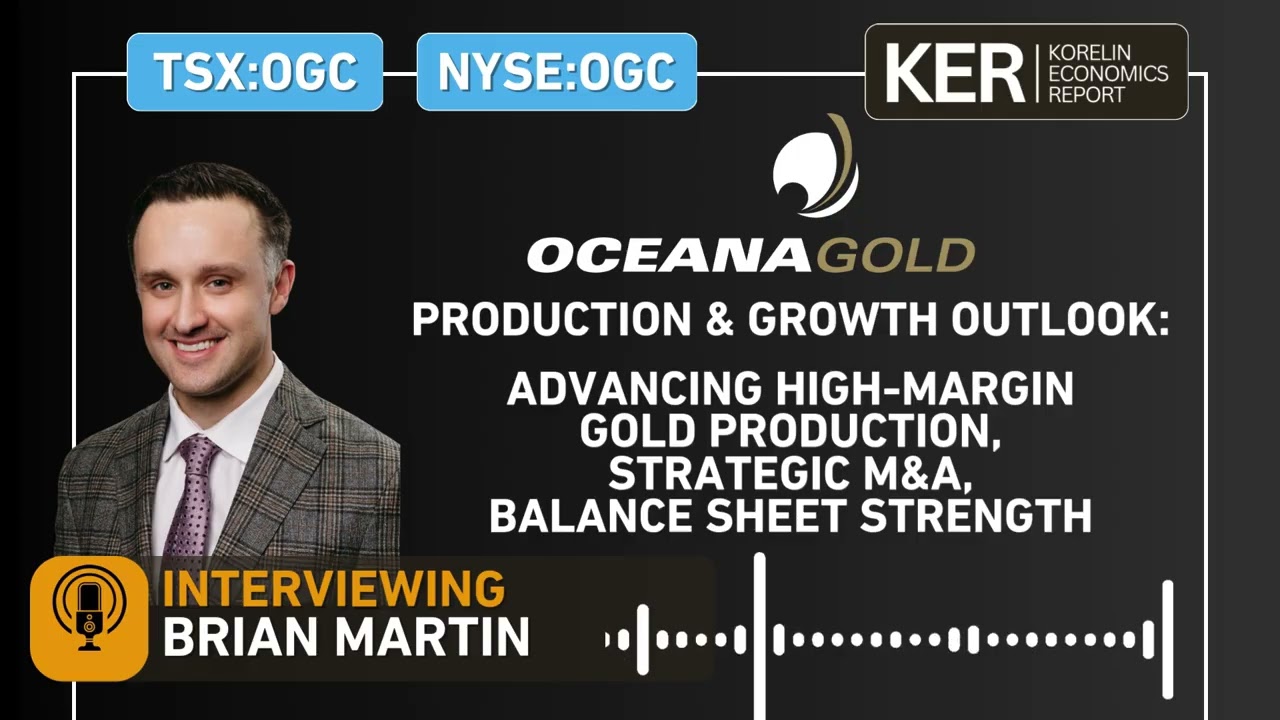
Brian Martin is Senior Vice President of Business Development and Investor Relations at OceanaGold Corporation (TSX: OGC; NYSE: OGC), a mid-tier gold and copper producer whose operating centers are the Haile Gold Mine in South Carolina, the Macraes and Waihi operations in New Zealand, and the Didipio Mine in the Philippines. For resource investors, he is the executive who presents OceanaGold's investment case directly: production outlooks, capital allocation, and acquisition strategy.
In this role he has been the company's principal voice to investors through a run of verifiable milestones: record 2025 free cash flow (FCF — the cash left after operating and capital spending) with US$477 million of cash and no debt at year-end 2025; a first quarter of 2026 that delivered US$255 million of FCF; the company's listing on the New York Stock Exchange on April 7, 2026; and the August 2026 agreement to acquire Ausgold Limited (ASX: AUC), owner of the Katanning Gold Project in Western Australia, in a transaction valuing Ausgold at roughly A$776 million (US$549 million). In a September 2026 interview with The KE Report, he walked investors through the acquisition rationale and OceanaGold's pathway toward roughly 650,000 ounces of annual gold production.
His commentary lays out how management runs the business: high-margin production from four operating centers, a debt-free balance sheet, and a capital allocation framework that funds sustaining investment and organic growth — including the Macraes Phase 4 life-of-mine extension and the underground Waihi North project in New Zealand — while returning cash through dividends and share buybacks. On M&A, the approach he describes favors assets that fit existing margins, sit in low-risk jurisdictions, and can be sequenced toward the 650,000-ounce goal rather than adding growth for its own sake.
Following Martin gives investors a direct view of how an intermediate producer frames cost control, project sequencing, and valuation against peers. Public detail on his earlier career is limited; his verifiable public record is tied to his OceanaGold role and his investor interviews, which are the best place to hear his current thinking on the company and the gold market.
Key Works
The KE Report interview in which Martin explains the Ausgold/Katanning acquisition, the capital allocation framework, and the path toward about 650,000 ounces per year.
The KE Report interview covering record Q3 2025 revenue and free cash flow, growth at the Haile Gold Mine, Waihi North progress, and the plan to list on the NYSE.
Specializations
Disclaimer: Brian Martin has NOT endorsed this platform and is not affiliated with Pixys in any way.