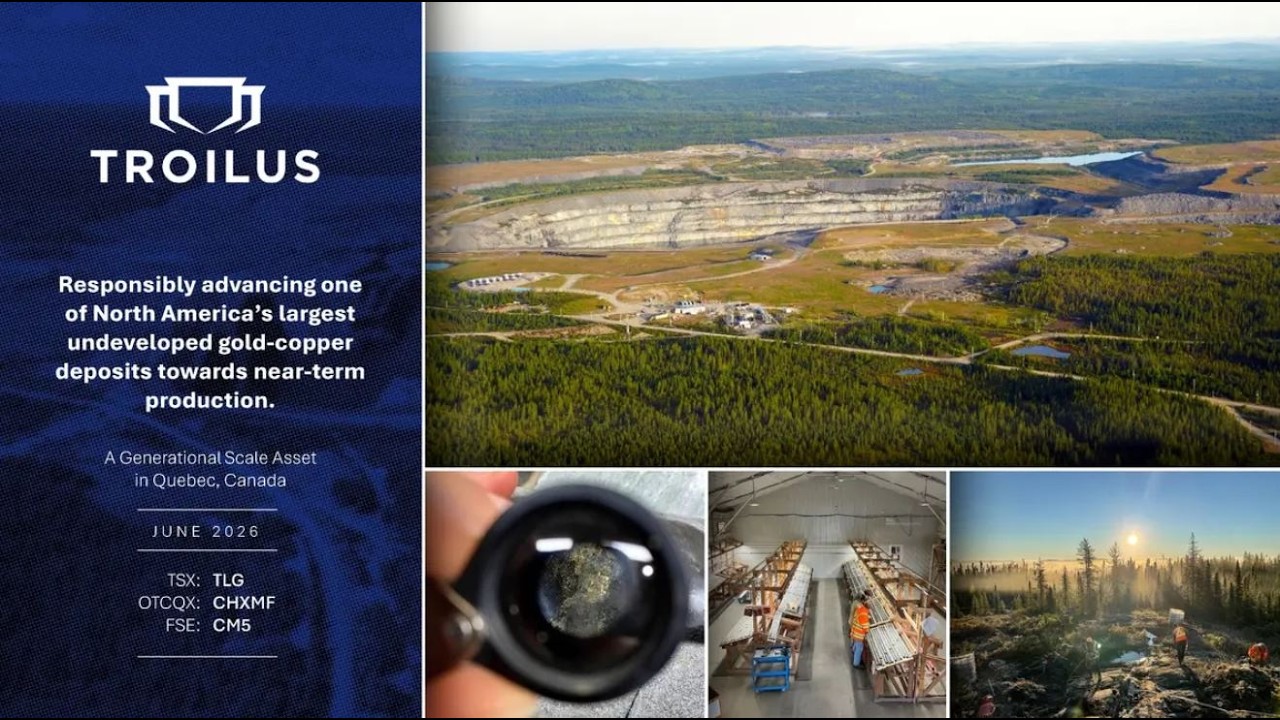
Troilus Mining: Hydro Power Secured, Fast-Track Permitting, and a $1.2 Billion Financing Taking Shape
Troilus Mining's CEO says basic engineering is done and detailed engineering is underway, the project has secured a 70 MW hydro allocation at 3.2 cents per kWh, and it is the first project named to Quebec's Filon fast-track permitting. With $1.2 billion in debt mandates heading to credit committee and a royalty or streaming deal nearly final, the remaining hurdles are the Cree IBA and the financing close.
Investor angle
The video works as a pre-construction catalyst checklist for Troilus Mining. Watch for: credit committee approval of the $1.2 billion debt package; final royalty or streaming terms (negotiations “almost complete,” with about $130 million in the bank); permits under the Filon fast-track; and the revised 43-101 in September, where the CEO promises larger reserves, higher grades and a lower strip ratio. Exploration adds optionality that is not yet in the mine plan: high-grade West Rim hits near surface about a kilometer outside the reserve pit, and in-pit drilling converting never-sampled hanging-wall zones from model zeros into ore — one section shows the strip ratio down about 25%. The 2-million-ton bulk sample, estimated at about $100 million of metal, doubles as required pre-development work and could pull first revenue to roughly 18 months out, into 2028–2029, ahead of commercial production. The CEO frames most of these items around the Denver Gold Show and Beaver Creek, and the host notes that developers typically re-rate as each milestone lands. Caveat: every claim is management's, and neither the financing terms nor the permits are closed yet.
Troilus Mining Corp (TSX: TLG) has spent eight years drilling out its copper-gold project in north-central Quebec — more than 400,000 meters of drilling for a 13-million-ounce-plus gold-equivalent resource that CEO Justin Reed calls one of the largest and fastest-growing in Canada. In this interview, he argues the project has now cleared most of the hurdles between study and construction, with power, permitting momentum and a $1.2 billion debt package all advancing at once.
## Engineering is in its final stage
Basic engineering is complete and detailed engineering — the last phase before construction — is underway, with more than 100,000 man-hours logged. Reed says 75 engineers from the company's owners team and BBA in Montreal are assembling a full execution plan. That work will replace the feasibility study's plus-or-minus 35% capital estimate with real procurement numbers.
The 2024 feasibility outlined a 22-year mine life processing 200,000 tons of rock a day, producing on average about 300,000 gold-equivalent ounces (gold plus other metals expressed in gold terms) per year, at just over $1 billion of capital cost. AISC (All-In Sustaining Cost — what it really costs to produce an ounce) sits around $1,200 an ounce, which Reed describes as in line with the industry average. About 30% of the gold exits in an on-site gravity circuit as doré (a semi-refined gold-silver alloy), with the rest shipped as a copper-gold-silver concentrate that is roughly 20% copper — a mix that qualifies Troilus as a critical-minerals producer and opens government support programs. A revised 43-101 (the formal technical report summarizing reserves and economics) is due in September, and Reed expects no major variances from the feasibility.
## Why the power deal matters most
Reed calls the 70-megawatt hydroelectric allocation from Hydro-Québec possibly the project's biggest milestone. The allocation — 100% hydro power at 3.2 cents per kilowatt-hour, with Troilus as the sole user of the line — removes the need for large diesel generators and, in his words, “checked one of the final boxes for our lenders.” He is direct about the dependency: no power, no mine. Quebec's economy and natural resources ministers attended the announcement, which he reads as a signal of government commitment to getting the mine built.
## Permitting: first into Quebec's Filon fast-track
Troilus submitted its ESIA (Environmental and Social Impact Assessment — the central permitting document) over a year ago, and federal and provincial reviews are progressing well. The new development: Troilus is the first company named to Quebec's Filon initiative, part of the province's critical and strategic minerals strategy. The program assigns one government contact — Reed calls it a “shepherd” — to move the file between departments instead of the roughly 15 that developers normally juggle. The aim is less red tape and a faster permit. His conclusion: “It's not a matter of if we're getting a permit, it's a matter of how soon.”
## Financing is the last piece
Troilus holds mandates for $1.2 billion in project debt from its MLAs (mandated lead arrangers — the banks that assemble project financings), with due diligence done and credit committee approval expected shortly. The company has about $130 million in the bank and is close to finalizing a royalty or streaming deal, with multiple offers in final negotiation. Reed says a fully financed package will be shown to the market “very shortly.” A big-board US listing sits on the mid-term agenda, without a committed date.
What remains before construction: finishing the IBA (Impact and Benefit Agreement — the formal partnership with local Indigenous communities) with the Cree, who already make up 35% of the workforce, and closing the financing. Site work has started regardless: about $100 million of pre-development spending this year, roughly 8 million tons of rock moved, and the camp expanded from 100 to 350 people ahead of a 1,000-person construction workforce. Reed expects everything ready early next year to open the gate on a two-year build. Because current advanced-exploration work counts toward that timeline — including a 2-million-ton bulk sample he estimates at about $100 million of contained metal — first revenue could arrive in roughly 18 months, into 2028–2029.
## Exploration: the deposit is improving
Reed claims the mine will be Eastern Canada's largest gold and copper producer and a top-10 Canadian gold producer, with about 700 permanent staff across a 22-plus-year mine life. Drilling is now pushing the numbers higher on two fronts:
- **The West Rim.** Preliminary drilling about a kilometer outside the reserve pit has hit high grades near surface in a previously unknown zone — including 18.5 meters of almost 7 g/t (grams of gold per tonne) and nearly 20 g/t over 6 meters. Reed floats a small satellite pit, stresses that it is not yet in any mine plan, and labels it future upside; winter drilling on the target will be intensive. - **Zeros to heroes.** Inside the Z87 pit, drilling is converting hanging-wall and inferred material that earlier operators never sampled — counted as zeros in the model — into ore. One section shows about 160 meters of roughly a gram at depth, and on that section the strip ratio (waste moved per ton of ore; the feasibility assumes 3:1) falls about 25%, which flows directly into lower mining costs. Hole 507 returned 164 meters of 0.9 g/t where the model expected nothing.
The September 43-101 should capture part of this: Reed promises bigger reserves, higher grades and a lower strip ratio.
## The investor takeaway
The near-term calendar is crowded: credit committee on the $1.2 billion debt, a royalty or streaming decision, permits under the Filon process, and the updated 43-101, all of which Reed expects to present around the Denver Gold Show and Beaver Creek in late September. The host adds that development-stage miners often see their market multiple improve as each milestone lands. Every claim here is management's, and the financing and permits remain close rather than closed — the final terms will be what matter.
Generated by Pixys from the source video below. Not investment advice.