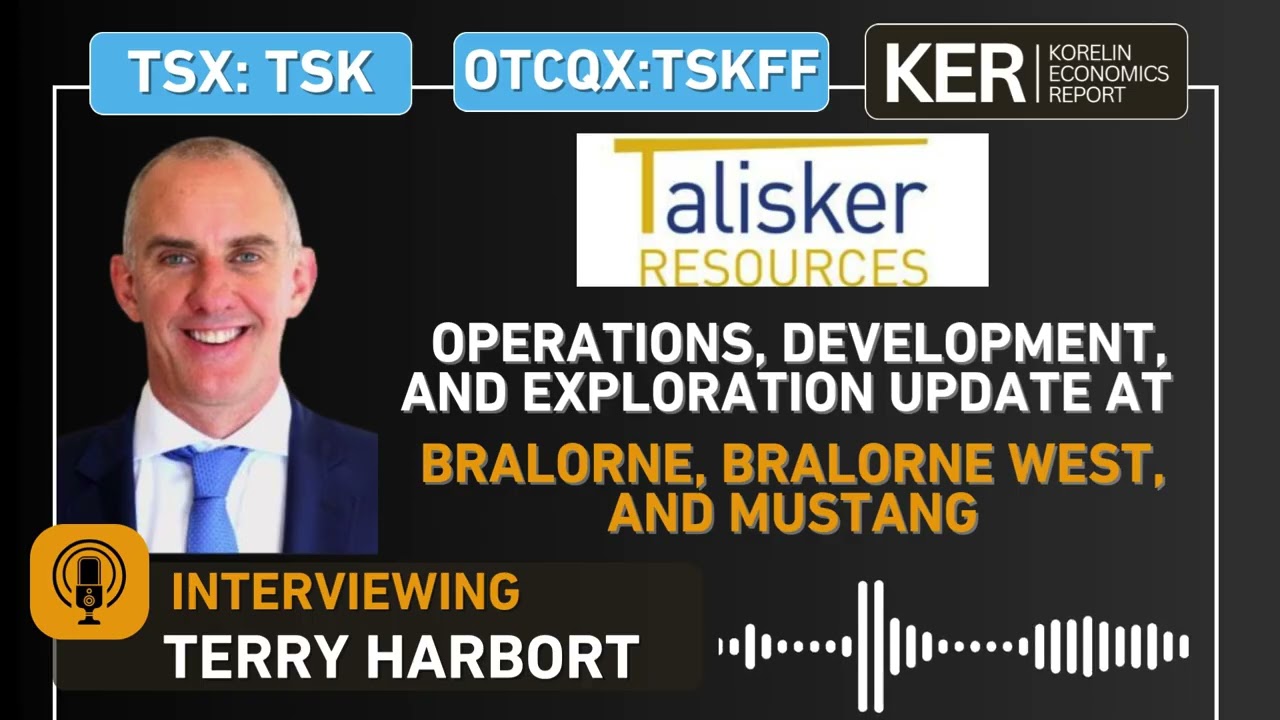
Talisker Resources Closes DSO Loop With First Taiwan Shipment, Readies PEA and Bralorne West Push
Talisker CEO Terry Harbert says the company has completed its first direct ship ore load to Taiwan via Ocean Partners, marking the close of its logistics chain as it ramps production from Bralorne, Bralorne West, and Mustang. Underground development hit 2,365 meters year-to-date, with an imminent PEA, pending drill results from Bralorne West, and a long-term plan to bring in its own milling facility.
Investor angle
Near-term catalysts to watch: the imminent PEA, a large batch of Bralorne West drill results expected in the next few weeks, ore-sorter commissioning on site, and the next roughly 10,000-ton DSO shipment out of Vancouver targeted for October or November. Bigger picture is the path from DSO cash flow to an owned milling facility and a 200,000-ounce-per-year district target across Mustang West, Mustang, Bralorne West, and Olympus.
Talisker Resources (TSX: TSK) has closed its first end-to-end direct ship ore (DSO) cycle to Taiwan, with CEO Terry Harbert framing the August 24 milestone as the final link in a logistics chain the company has been quietly filling for months.
"The pipeline's totally full," Harbert told host Shad Markowitz on The KE Report. "It was an important milestone for us." Material now flows from the Bralorne area underground, up to surface stockpiles, by truck to a crushing and sampling facility at Lillooet, then down to the Vancouver Wharf, where it accumulates to roughly 10,000–11,000 tons per bulk shipment. At Lillooet, Talisker issues a holding certificate, which Ocean Partners' banker signs off on to trigger the first 90% payment; a final 10% true-up arrives once the cargo is offloaded in Taiwan. The first vessel had already crossed and was due to arrive in Taiwan the week of the interview. A second stockpile is on its way to the wharf now, and Harbert said to expect another shipment in October or November, then a regular cadence "every couple of months."
## What's happening underground
Operations, Harbert said, are "very development heavy this year." The company has driven about 2,365 meters of underground development to date — roughly 1,000 meters of operating development on the veins and around 1,200 meters of capital development on the lower Mustang ramp. The ramp has stepped down from the 1060 elevation through the 1045, 1030, and 1015 levels, with the 1000 level next in line.
The headline moment: the first crosscut blast into the BK vein. "Happy to say it looked very good. A lot of visible gold. Very good-looking structure," Harbert said.
Bralorne West — the second mining area — is now connected. Instead of building its own portal, Talisker drove a straight-shot ramp across and will truck ore about 600 meters back out through the existing Mustang portal. "We've now got a drill rig underground," Harbert noted. "It's busily drilling. Some great results soon to come out." Ramp and ventilation work will tie into the Blackbird Raise, with the first crosscut into Bralorne West veins targeted for late this year and ore access early in Q1.
At Mustang itself, lateral development on roughly 3.5-meter cuts is done and the team has moved to stoping — the process of extracting ore between levels. Stopes will come from the 1120-to-1105 and 1105-to-1090 elevations this year, with deeper levels (1090 down through the new 1045, 1015, and 1000) sequenced for the second half of next year.
## Surface build-out
The activity isn't only underground. The camp is being expanded with a new 35-person and a 45-person accommodation block, an 85-person dry, and a larger kitchen and office facility to absorb growing technical services, sampling, and environmental teams. At the mine itself, earthworks and equipment deliveries are underway to house an ore sorter, with new 100-horsepower fans and hard-line ducting pushing ventilation the long distance from Mustang out to Bralorne West. A new transformer plus redundant diesel generation is being added for power resilience.
## Drilling and the PEA
Resource conversion drilling is focused on moving Bralorne West material into the M&I (Measured & Indicated — the higher-confidence resource categories that feed mine planning) categories ahead of mining in 2027 and 2028. "A big batch of results" is expected in the next few weeks. Production sampling on the lateral development has been the surprise highlight: ore shoots running 20 grams per ton across 70 to 150 meters, including one on the BK vein that Harbert put at about 79 meters of roughly 64–65 g/t. "It's what Bralorne was always known for in the old days," he said. "But we hadn't intersected ourselves."
The PEA (Preliminary Economic Assessment — an early-stage, scoping-level study of project economics) is "imminent," per Harbert. The company's mine plan and economics had been internal until now; the PEA is intended to give investors and funds an independent view. It is built on a resource update that Harbert said "effectively doubled" Talisker's resource. He pushed back on the need for a full feasibility study, arguing that with the mine already producing, "we're beyond that now. We know the ore body well, we're mining it, extracting gold." A pre-feasibility is more likely, contingent on drilling volumes, particularly if Talisker wants to access bankable debt capital.
## Ore sorter results
On September 17, Talisker released final ore-sorting test results. After extended testing at the University of Saskatchewan alongside manufacturer Tomra, the team chose XRT (X-ray transmission — a sensor that sorts rock by density, similar to a medical CT scan but for rocks) over a combined XRT-plus-laser setup to minimize capex (capital expenditure — upfront building cost). Recoveries came in at 85–87%, with the unrecovered gold deemed sub-economic. The system has been designed so a laser sorter can be added later as a scavenger once the company has its own milling facility.
## The bigger picture
Harbert laid out a district-scale ambition. Talisker holds about 24,000 hectares along 40 kilometers of strike on the mineralized structure that controls Bralorne. The plan is to develop four independent but connected operational centers — Mustang West, Mustang, Bralorne West, and Olympus — targeting 200,000 ounces of annual production for the district, "hopefully, if all goes well, we can move beyond that." The DSO route was chosen to get to revenue fast and to fund capex internally; the long-term answer is an owned-and-operated milling facility. "Ultimately, the economics are best if we have our own milling operation," Harbert said.
For investors watching Talisker into year-end and 2027, the catalysts line up: the imminent PEA, pending drill results from Bralorne West, ongoing production sampling, ore sorter commissioning, and the next DSO shipment out of Vancouver in October or November.
Generated by Pixys from the source video below. Not investment advice.