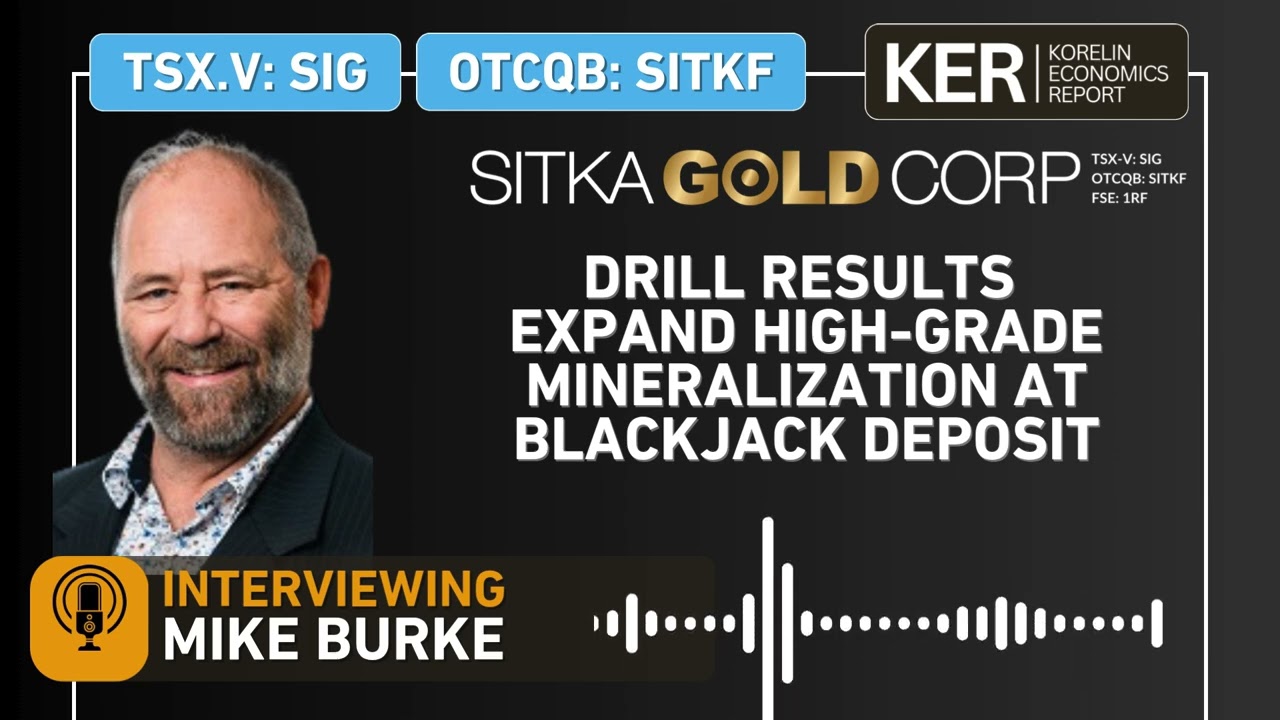
Sitka Gold's Blackjack drilling widens high-grade zones as RC Gold passes 5 million ounces
Six new Blackjack holes at Sitka Gold's RC Gold project mix shallow infill with deep step-outs, headlined by 94.5m of 1.62 g/t gold and about 197m of 1.06 g/t starting near 522m depth. Management says the project now tops 5 million ounces across three deposits and expects assay news every couple of weeks into late December.
Investor angle
Watch three markers from here. Resource growth: the current Blackjack estimate is built on about 18,000 metres of drilling and management says another 18,000 metres are already complete, so an increase is the stated expectation once assays are folded in. Deposit geometry: the deep program exists to define where an open pit would hand off to underground mining, a boundary that shapes any eventual mine plan and its economics. Cadence: Burke expects assay news roughly every two weeks into late December, including progress at Ross Gobble and first resource estimates for the Contact Pukoman and Bearpaw Breccia zones. His 10-million-ounce comparables (Fort Knox, Eagle) are management's framing of scale; the verifiable items are drill widths, resource updates and the open-pit-versus-underground transition.
Sitka Gold's newest drill results from the Blackjack deposit are doing two jobs at once: tightening the shallow resource and following the mineralized system to depth. Six holes released on June 23 headline the work, and Mike Burke, Sitka's director and vice president of corporate development, told The KE Report the holes were planned to expand the deposit even where they also act as infill.
## What the June 23 holes returned
Hole 125 delivered the headline intercept: 94.5 metres grading 1.62 g/t gold — grams of gold per tonne of rock — starting about 397 metres down the hole, including a 2.5-metre section near 12 g/t. The same hole then cut a much wider zone, roughly 197 metres at 1.06 g/t, beginning around 522 metres, with a 2-metre high-grade section near 10 g/t.
The shallower holes returned widths open-pit mining favors. Hole 126 cut 153 metres at 1.33 g/t from about 154 metres depth, and hole 123 returned over 100 metres at 1.36 g/t from around 138 metres. Burke argued that grade matters as much as width here: ounces mined early in a mine life carry better grades, and that helps pay back capital sooner.
## Infill versus expansion
Burke described the mix as deliberate. Some holes targeted gaps in the resource at shallower levels; the same holes kept drilling and hit deeper mineralization. Infill drilling — holes drilled between existing ones to raise confidence in what is already outlined — blends into step-out drilling that tests ground beyond the current resource. Here, expansion came first in the planning.
## High-grade pockets in a bulk-tonnage frame
The high-grade sections sit inside the deposit, hosted in quartz veins; hit a larger vein and grades jump. Burke cautioned against over-reading them. Drill spacing is still wide, this is a bulk-tonnage deposit, and individual veins will not be mined. Frequent larger veins, in his view, signal a robust mineralized system.
## What the deep holes are for
Oriented core drilling — core recovered so the structures in it can be measured — has let the team map the controls on mineralization and the deposit's plunge, Burke said, and better grades show up within that corridor at depth. His working thesis: the structures tighten with depth, carrying roughly the same amount of gold in a more confined area. He contrasted this with epithermal deposits, where a boiling zone can form discrete high-grade pockets, a style he said Blackjack does not follow.
The deep drilling has two stated purposes: outlining potential underground mineable mineralization, and feeding trade-off studies on where an open pit would give way to underground mining. Burke said the results could push that boundary down or pull it up — the data will decide.
## Visible gold as a steering tool
Visible gold appears in nearly every hole. Burke was careful about what it proves: charting visible-gold observations against assayed grade would not show a one-to-one match. It does reliably signal the hole is in the right mineralized veins, and the company uses it to adjust each next hole in near real time.
## Scale, and where management wants to take it
The discussion put the RC Gold project's combined indicated and inferred resource just over 5 million ounces — the host cited 5.12 million — across Blackjack, Geiger and Ross Gobble, with just over 2.3 million ounces of that at Blackjack itself: almost 1.3 million indicated and a little more than 1 million inferred. Indicated ounces carry enough drilling confidence to support mine planning; inferred ounces rest on sparser data.
Burke noted the current Blackjack estimate rests on about 18,000 metres of drilling, with another 18,000 metres completed since and the Saddle area still to be added once a few more holes land. Six rigs are now turning: three at Blackjack, one of them on the Saddle, and three at Ross Gobble. The company is drilling 60,000 metres this year — the meterage behind the 5 million ounces outlined to date — and expects the total to climb once this year's holes are folded in.
On comparables, Burke argued the project sits in the same rocks as large intrusion-related systems such as Fort Knox in Alaska and the Eagle mine in the Yukon, which he put near 10 million ounces each; he framed that as the target size for Sitka's ground. Two further zones with strong historical drilling, named in the discussion as Contact Pukoman and Bearpaw Breccia, could add initial resource estimates.
On news flow, he expects assay results roughly every couple of weeks into late December and said the program is fully funded, with drilling and assays already paid for. The 10-million-ounce comparables are management's framing of upside scale; the verifiable near-term markers are drill widths, resource updates and the open-pit-versus-underground boundary.
Generated by Pixys from the source video below. Not investment advice.