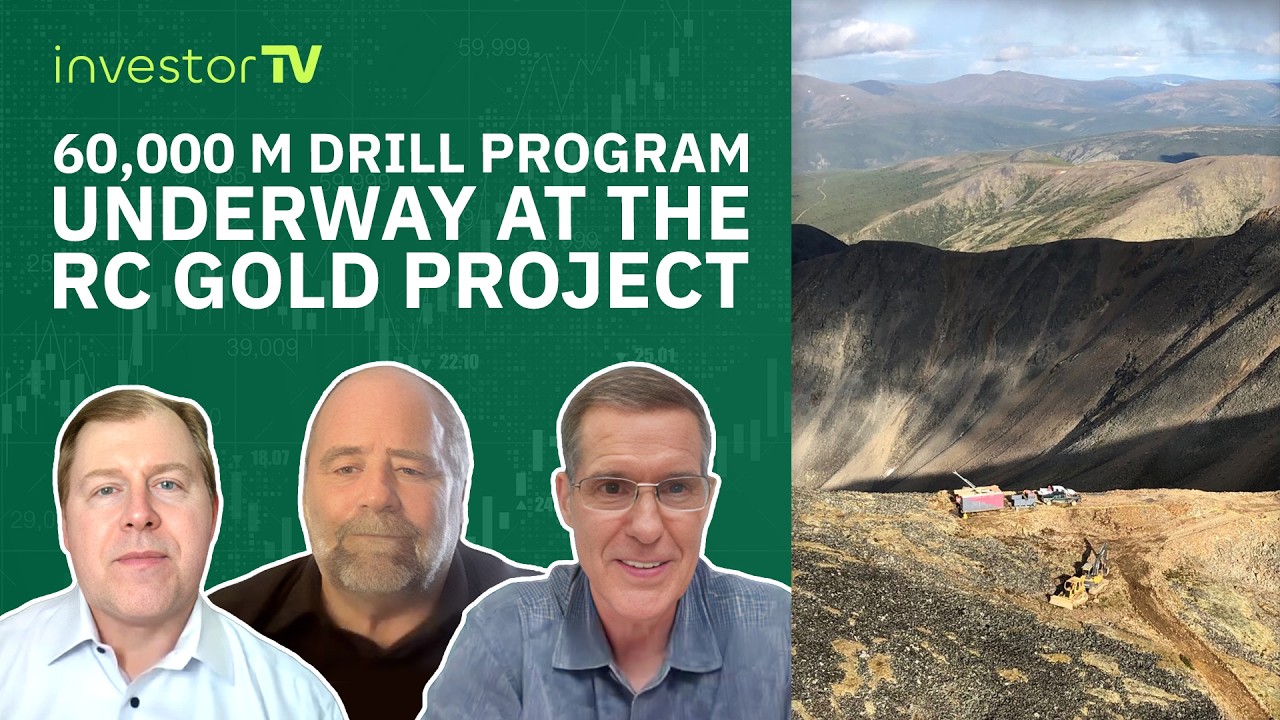
Sitka Gold Makes Its Case: 5+ Million Ounces, a Fully Funded 60,000-Metre Drill Year, and a Decade of Targets in Yukon
Sitka Gold director Mike Burke says the RC Gold project in Yukon already hosts more than 5 million ounces of gold, with a fully funded 60,000-metre drill program underway and economic studies targeted for early 2027. The show's analysts frame the stock as a three-to-five-year optionality play, worth about $375 million today against a claimed $1.2 billion-plus potential.
Investor angle
What investors can watch next: (1) Drill results — Burke promised batches roughly every two weeks into year-end, with 30,000 of the 60,000 metres aimed at expanding Rosgobel, which he says can double; (2) an updated mineral resource estimate and the start of economic studies in Q1 2027, the first formal test of mine economics on the 5-million-ounce base; (3) tungsten optionality — 51,000 inferred tonnes at 0.051% with 85% test-work recovery, and possible offtake agreements as non-dilutive financing; (4) the balance sheet — $40 million cash funds the program without new raises, on more than 400 million shares outstanding. Key caveats from the video itself: this is a pure explorer years from any mine decision, the per-ounce valuation math is the analysts' own, the assumed gold-price recovery is uncertain, and the description discloses the interview was produced on behalf of Sitka Gold, with Global One Media possibly compensated in cash or securities.
Sitka Gold's RC Gold project in central Yukon already hosts more than 5 million ounces of gold, and the company is drilling 60,000 metres this year — roughly as much as it has drilled on the property in its entire history. Director and VP of Corporate Development Mike Burke told investorTV the program is fully funded. "We've got $40 million in the bank," he said, describing the season as "bought and paid for."
A disclosure frames the conversation. The video description states the interview was disseminated on behalf of Sitka Gold and that producer Global One Media may receive compensation from the company in cash or securities. The hosts also promote their own research services on air. Readers should weigh the enthusiasm accordingly.
## Why the deposit type matters
RC Gold sits in the Tombstone gold belt, where gold forms inside granite intrusions — what geologists call reduced intrusion-related systems. Burke argued the style rewards explorers. The geology is predictable. The deposits are large bulk-tonnage bodies (broad, evenly mineralized rock suited to big open pits). Metallurgy is simple, recoveries are high, and much of the mineralization outcrops at surface.
The belt's first discovery was Fort Knox in Alaska in the 1990s. A regional fault offsets the trend 470 kilometres, which is why Yukon hosts its extension. Neighbors include Snowline Gold's Valley deposit, Banyan Gold, and Victoria Gold's Eagle mine. Burke positioned RC Gold as part of a maturing Yukon district rather than a lone project.
Access is a relative strength. The site is a two-hour drive from Dawson City via the Klondike Highway and a 35-kilometre access road, with jet service at a small international airport nearby. An 80-person operation, anchored by a 50-person all-weather camp, supports year-round work.
## Two deposits, three metals
The Clear Creek Intrusive Complex holds both named deposits, five kilometres apart. Blackjack, the first discovery, carries 1.3 million ounces in the indicated category (drilled tightly enough to support mine planning) at about 1 gram per tonne, plus 1 million inferred ounces (the least certain resource category) at 0.94 grams per tonne.
Rosgobel, first drilled in 2024, is the newer story. Its first two holes returned intersections above 100 gram-metres (grade times intercept length, a quick way to compare drill holes). The company followed with 12,000 metres in 43 holes in 2025 and outlined an inferred resource of 100 million tonnes grading 0.7 grams per tonne gold — 2.25 million ounces — plus 0.9 grams per tonne silver and 0.051% tungsten trioxide (the standard reporting form for tungsten). That equates to almost 3 million ounces of silver and 51,000 tonnes of tungsten.
The tungsten is a byproduct, not the thesis. Burke said the company reassayed stored drill reject material last winter, because standard gold assays only partially capture tungsten. He compared the grade to a tungsten-molybdenum deposit in New Brunswick grading about 0.06%. Early test work recovered 85% of the tungsten and over 90% of the gold. He also flagged a financing angle: tungsten offtake agreements (pre-agreed sales to a buyer) could fund part of a future mine build without new share issues.
Burke also sees a higher-grade starter pit at Rosgobel — a surface zone above 1 gram per tonne that could shorten early payback. At Blackjack, drilling below a realistic open-pit shell returned 45 metres at 5 grams per tonne in one hole and 20 metres at 5 grams in another; the second hole reached more than 1.1 kilometres deep. He said the company is testing whether that material could eventually support an underground mine.
## What comes next
About 18,000 of this year's 60,000 metres are complete, with 30,000 metres targeted at Rosgobel, which Burke said is open in every direction and "has the potential to double in size." Assay batches are due roughly every two weeks into year-end; the first results came out days before this interview. Management expects to move into economic studies (early engineering work that tests whether a deposit can support a mine) in the first quarter of 2027, alongside an updated mineral resource estimate.
Burke sketched the longer ambition: a mine producing 300,000 ounces a year over a 10-to-15-year life — what the industry calls a tier-one deposit. He said the company is "getting pretty close" to that scale, and that 10 million ounces plus "is not a target that's beyond our expectations." Only three of the property's 11 intrusions have been drilled, and each hosts a deposit, across a 477-square-kilometre land package. Asked how much drilling remains, Burke answered: "a decade."
## The analysts' framing
Don Durrett framed Sitka as an optionality play — a company whose value depends mostly on what it may still find. He argued the market pays about $75 per in-ground ounce today on 5 million ounces (closer to $50 if the resource reaches 8 million), versus the $150-plus per ounce he expects an advanced developer to command. On that math he called $1.2 billion a minimum value against roughly $375 million today, while cautioning that the payoff takes "3, 4, 5 years" of drilling.
Macro shaped the timing, not the thesis. Durrett called gold's 28% and silver's 52% drops from their highs a correction inside an ongoing bull market and expects higher highs. Host John Feneck pushed new highs into next year, citing a hawkish Federal Reserve under chair Kevin Warsh and what he said was a 70% probability of a September rate hike. Durrett added that a rerate could come simply from gold prices recovering.
Generated by Pixys from the source video below. Not investment advice.