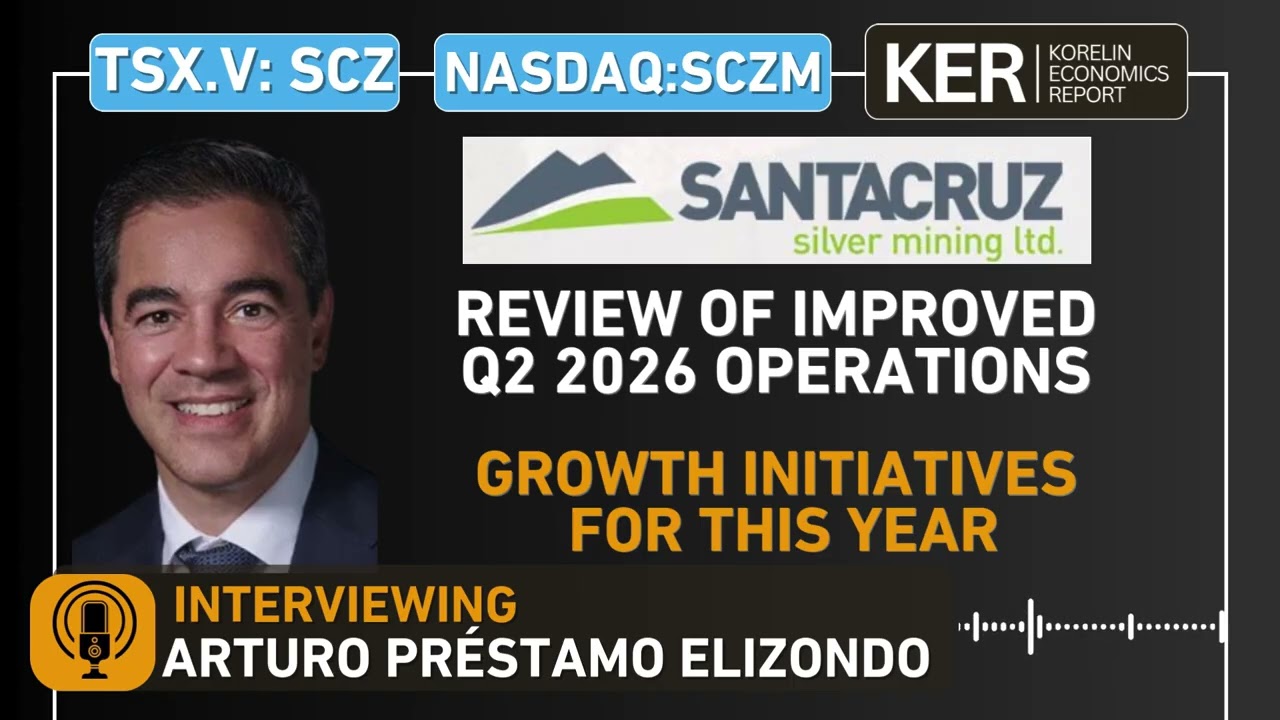
Santacruz Silver Targets Q4 Production Step-Up as Bolivar, Cimapan, and Soracaya Ramp
Santacruz Silver produced nearly 1.6 million ounces of silver in Q2 2026 on 22% more ore processed, with management pointing to Bolivar's full recovery, Cimapan's level 960 ramp, and year-end first ore from Soracaya as the next catalysts.
Investor angle
Watch Q4 production data for confirmation that Bolivar returns to full output and that Cimapan's level 960 ore lifts head grades, recoveries, and throughput simultaneously. Soracaya permitting (expected by early September) and any announcement on the M&A front are the next two binary catalysts.
Santacruz Silver Mining Ltd (TSXV: SCZ, NASDAQ: SCZM, Frankfurt: 1SZ) reported just under 1.6 million ounces of silver and a little over 23,000 tons of zinc for Q2 2026, with company president Arturo (last name not in the transcript) telling The KE Report that processing 22% more ore than Q1 was the main driver of the production jump.
Two assets did the heavy lifting. At Bolivar, the company is in the late stages of a recovery plan — the speaker said it should be in full production by Q4 — and the host pressed him on the importance of two high-grade silver veins, Bamba and Nanae, that anchor the orebody. Two additional high-grade areas have been identified and will start contributing before year-end, which the speaker framed as the reason Bolivar "is going to come back really strong."
Cimapan, the larger Mexican mine, is ramping throughput. The speaker put the current mill rate at around 80,000 tons per month versus roughly 74,000 tons historically — adding about 1,000 tons per month — and pointed to level 960 as the next quality step. Level 960 carries higher silver and copper content than the mine has historically produced, and is the payoff for "over a year and a half" of capex. By Q4, the speaker expects all three of Cimapan's key metrics — recoveries, head grade (the average metal content of the ore being processed), and throughput — to improve together.
On grades generally, the speaker pushed back against extrapolating the Q1-to-Q2 silver grade bump forward. Most of the increase came from putting more Bolivar tonnes through the mill; going forward, he expects silver grades to be roughly flat, with at most a slight rise as more Bamba and Nanae ore, and ore from the new high-grade zones, hits the mill.
The mix of metals matters for how investors model revenue. The speaker put current revenue at about 60% silver, 35% zinc, and the balance from lead and copper, and pointed to Soracaya — a silver-oriented development project — as the structural lever that should push the silver share higher over time.
The smaller asset, Cabello Blanco, contributed a little over 300,000 ounces of silver and 4,000 tons of zinc in Q2. The speaker called it the company's most profitable mine, with AISC (All-In Sustaining Cost — the full cost to produce an ounce and keep the mine running) below $20. A new vein, Esperanza, has begun contributing; the stated priority there is protecting margins rather than chasing volume.
San Lucas is the unusual part of the portfolio. Rather than a conventional mine, it sources ore from small miners in the Potosi and surrounding Bolivian districts and blends it with ore from Reserva, which was moved over from the Cabello Blanco complex. Q2 silver production there rose about 20% from Q1. The speaker described San Lucas as a margin business — its AISC moves with metal prices, so the relevant number is the spread between realised price and cost — and flagged a dedicated milling facility as the next step to unlock more throughput without crowding the company's other mills.
To fund San Lucas working capital, the company completed a fourth tranche of a 70-million-Boliviano promissory note on August 5. The speaker put the local-currency interest rate at around 10%, against Bolivian inflation of roughly 15%, making local borrowing a cheap way to hold working capital.
On the development pipeline, Soracaya already has a ramp down to two of the mine's key veins and underground equipment on site. Permitting is expected by late August or early September, with small-scale mining to start by year-end and what the speaker described as "some production" by mid-Q4. Given the silver-heavy ore, first Soracaya ounces should push the silver share of revenue higher.
On M&A, the speaker said the company has $75–80 million in treasury after roughly $30 million of tax payments earlier in the year and no debt apart from the Bolivian promissory notes. The acquisition profile is producing assets in the Americas with annual silver production above 3 million ounces, where the management team can add operational value. No specific targets were named.
The TSX uplisting — moving the listing from the TSX Venture Exchange to the main Toronto Stock Exchange, a step that typically broadens institutional and index access — is "almost there." The speaker attributed the delay to a QP (Qualified Person — the credentialed professional who signs off on mining technical reports under NI 43-101) being unable to travel for a site visit; that work is now complete, and listing is expected by month-end or early September.
On valuation, the host argued that even after the sector-wide re-rating and the subsequent halving in valuations, Santacruz still trades at a fraction of where its silver-equivalent output implies. The speaker agreed the company is undervalued, noted that the balance sheet is clean apart from the Bolivian working-capital notes, and framed the strategy as continuing to execute operationally so that, in his words, the valuation "comes out by gravity."
Generated by Pixys from the source video below. Not investment advice.