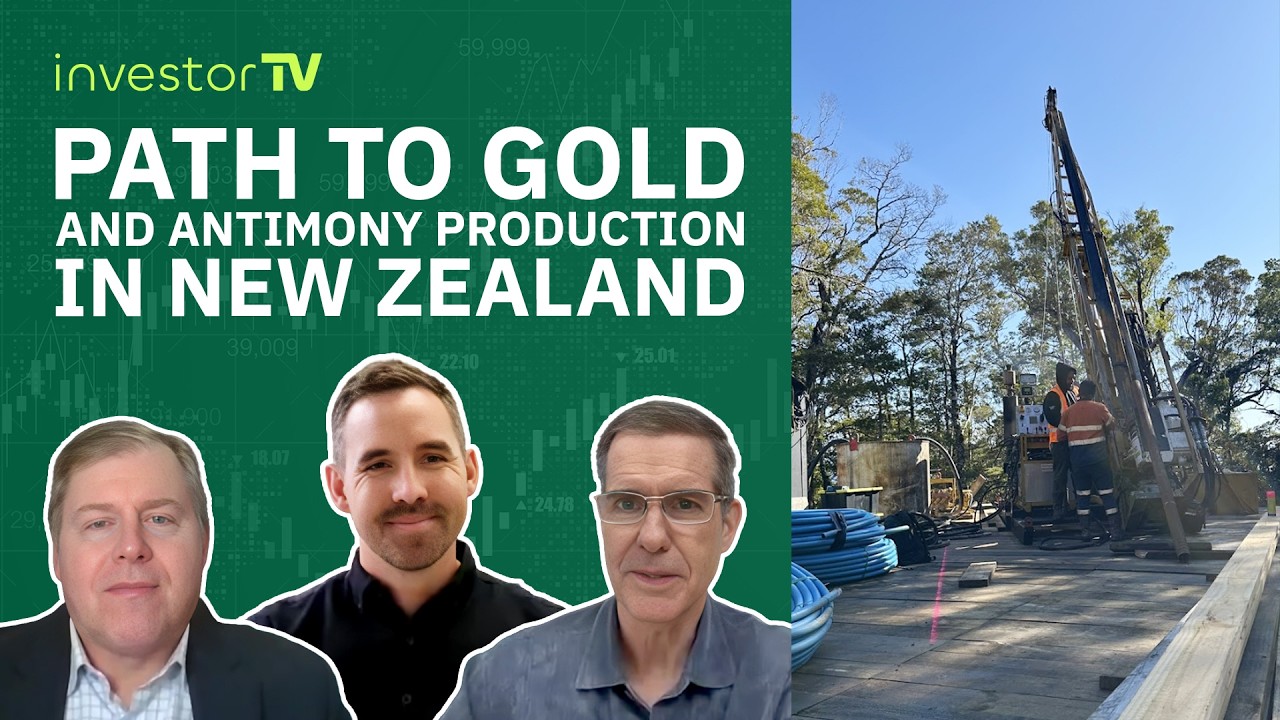
Rua Gold's Fast Track: PEA Due Within a Month on a Path to a Permitted Mine by April 2027
In an Investor TV interview recorded April 13, Rua Gold CEO Robert Eckford laid out a compressed timeline: a PEA within a month, a mine permit application by end of 2026, and a fully permitted starter mine by April 2027, backed by fresh institutional capital and high-grade gold-antimony mineralization in New Zealand's Reefton district.
Investor angle
For investors, the interview's core claim is execution speed: a roughly 500,000 oz NI 43-101 resource, a PEA within a month, a permit application by year-end, and targeted full permitting by April 2027 on a starter mine of about 200,000–250,000 oz with $90–110 million (US) capex and around 200 jobs. The catalyst path is unusually concrete, and the register is now institutional — Franklin, a Zurich-based gold fund, and Mercuria at C$5 million — after raises totaling roughly $60 million. Offtakes for the over-1% antimony material, with Mercuria and Asian strategics interested, offer a financing route that does not depend on equity dilution. Key caveats: near-term economics are unproven until the PEA, the starter resource is small, New Zealand's November 2026 election is a real though discounted political risk, and this is promotional media — the interview was disseminated on behalf of Rua Gold, one host holds shares and both promote conferences the company attends, and the grade comparisons and district targets quoted are management or analyst assertions, not independent estimates.
Rua Gold is running one of the more compressed timelines in junior mining. In an April 13 interview on Investor TV — which the video description discloses was disseminated on behalf of the company — CEO Robert Eckford told analysts Don Durrett and John Feneck that Rua plans to submit a mine permit application by the end of 2026 and to have a fully permitted starter mine ready for construction by April 2027. A Preliminary Economic Assessment (PEA — an early-stage study of whether a mine makes money) is due within the month, and Eckford expects it to show a positive NPV (net present value — the project's future cash flows discounted to today). A Pre-Feasibility Study (PFS — a more detailed follow-up) is targeted for October 31, 2026.
## The starter-mine plan
Eckford's strategy is deliberately small first. In February the company declared a NI 43-101 resource (the Canadian reporting standard for mineral estimates) of roughly half a million ounces in the Reefton district on New Zealand's South Island. Drilling now focuses on the top 200 meters of the deposit — he sizes that at roughly 200,000 to 250,000 ounces — which is the basis of the mine being designed. The pitch: the starter deposit alone pays for the processing plant and carries the company into cashflow, with every ounce found after that, in his words, "all gravy."
The pace rests on New Zealand's fast-track permitting, introduced in late 2024. Eckford pointed to neighbor Oceana Gold, which he said was fully permitted at the end of 2025 and moved into construction within 114 business days. In parallel, Rua is drilling another 20,000 meters; results announced two weeks before the interview showed mineralization at least 500 meters deep and still open, and the company aims to grow the Old Creek area toward half a million ounces by the time the PFS lands. Because the mine is underground, Eckford said going deeper does not change the surface footprint — or the permit.
## The antimony angle
Reefton's mineralization is gold-antimony style. Eckford said the material averages over 1% antimony — grades he compared with roughly 0.05% at Perpetua's Utah project, about 20 times higher. Early-1900s miners left antimony-bearing ore untouched because it ruined gold recovery and had little market, which he said is why some of the best grades sit at surface. Antimony now appears on critical-minerals lists, and Eckford called the deposit New Zealand's biggest. He noted New Zealand has signed the US-led Minerals Security Partnership, and that shareholder Mercuria, a metals trader, along with strategics from Korea and Japan, is already looking at antimony offtake (agreements to buy future production).
## A refreshed register
Between October and the interview, Rua raised $33 million at $1.10 a share, then completed a raise announced around C$25 million whose book, Eckford said, reached C$70 million and closed at roughly C$30 million, with institutional anchors including Franklin of the Bay Area, a Zurich-based gold fund, and Mercuria at C$5 million. He expects $15–20 million to remain in the treasury by early 2027 after funding drilling, mine and environmental studies, and a planned 5,000-meter program on an undrilled epithermal (hot-fluid style) gold system in the North Island. On the eventual financing, he pointed to offtake-backed support and project debt as options, so the company need not rely on equity dilution alone.
## District scale and political risk
The district is the long-term case. Eckford said Reefton historically produced about 2 million ounces at 20 grams per tonne (g/t), spans nine historic mines, and that Rua controls about 95% of the tenements (mineral land holdings) — seven of those mines never reworked. Durrett sized the district at roughly 300,000 acres, and Eckford highlighted private neighbor Endura, which holds 800,000 ounces at 23 g/t with mineralization running 700 to 1,500 meters deep; nothing in the district has been mined below 500 meters, which frames everything below Rua's starter deposit as open-ended upside. On politics, Eckford said the mine sits outside conservation land with a footprint under one hectare, the plant and tailings are being permitted oversized for later expansion, and even a change of government would more likely slow permitting than stop it — Endura won approval under the previous, less mining-friendly government. He put the chance of a government switch at November's election below 50%.
## What the analysts took away
Both hosts were constructive. Durrett, who disclosed on air that he owns shares and plans to add before the PEA, argued the PEA carries limited surprise risk with gold near $4,500 an ounce and capex (the capital cost of building the mine) of roughly $90–110 million (US), and credited the team with eight mine builds and $11 billion in mine sales. He called New Zealand politics the story's only red flag. Feneck framed the PEA as the near-term catalyst and the October 2026 PFS as the next proof point. Both hosts also run paid conferences Rua plans to attend, so their enthusiasm is not neutral.
## Disclosure
The video description states the interview was disseminated on behalf of Rua Gold and that producer Global One Media may be compensated by featured companies, potentially in securities. Durrett disclosed his shareholding during the interview.
Generated by Pixys from the source video below. Not investment advice.