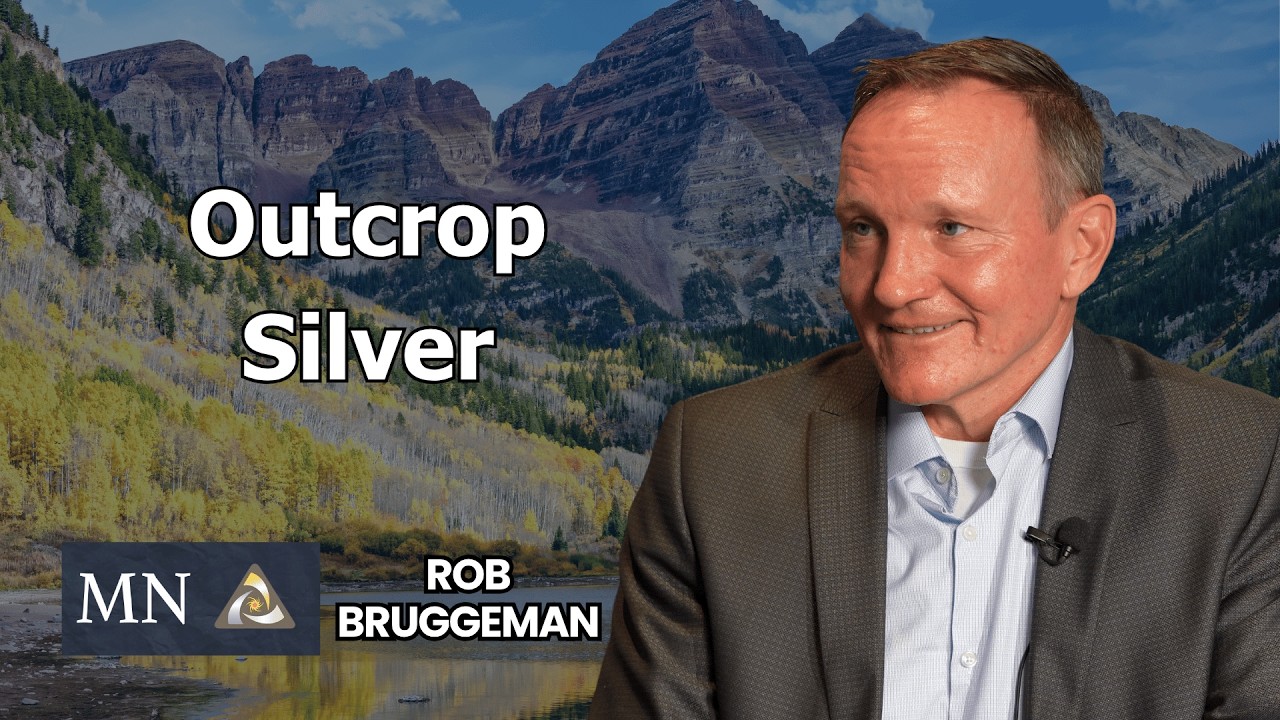
Outcrop Silver Charts a Staged Path to 2027 Pilot Production as Colombia Turns Pro-Mining
Outcrop Silver & Gold (OCG) says its pilot plant is already in permitting, targeting build, commissioning, and first cash flow in 2027. CEO Rob Bruggeman outlines a staged path: PEA around end of Q1 2027, PFS by mid-2027, and full production in three to four years, helped by Colombia's new pro-mining government.
Investor angle
The investment case Bruggeman presents is a dated catalyst path rather than a distant promise: the pilot plant is in permitting now and targets build and commissioning in 2027 with cash flow from next year onwards, the PEA lands around end of Q1 2027, and a PFS follows by mid-2027. He argues the staged design de-risks execution — the pilot supplies real cost and production data before major capital, staged capital stays low, and permitting advances by annually amending an existing operations plan rather than starting a new permit. He does not expect a definitive feasibility study to be needed. Near-term markers: the PEA consultant announcement and pilot plant details within weeks to months, then PEA completion around end of Q1 2027. Longer term he targets a total resource above 100 million ounces within 3-4 years of drilling, a 15-20 year mine life (potentially 25-30), and a re-rating from roughly $2 per in-situ ounce to a cash-flow-based valuation. Exploration upside sits in 17 kilometers of strike open at both ends, possible parallel systems, and previously stalled gold projects that the policy shift could revive as spin-out or option candidates. All of these are the speaker's claims and targets — study results, permits, timelines, and economics remain unproven until delivered.
Outcrop Silver & Gold (OCG) plans to run a pilot plant next year and start booking cash flow in 2027, years before any full-scale mine. Speaking to Mining Network at the Precious Metals Summit, President and CEO Rob Bruggeman laid out a staged development plan built on the company's recently updated mineral resource estimate, a high-grade deposit that sits close to surface, and a new pro-mining government in Colombia.
## The plan: start small, then ramp
Bruggeman's answer to the question he says every investor asks — when does cash flow arrive — is to develop in stages rather than build everything at once.
- **Pilot plant (2027):** The pilot plant is already in permitting, and 2027 is for execution — building, commissioning, and running it. He expects cash flow from next year onwards, and said pilot-level production by this time next year is the plan, not an overreach. - **PEA (around end of Q1 2027):** The company is selecting a consultant now and will give the market more details within weeks. The PEA (Preliminary Economic Assessment — an early, low-precision study of whether a project can be mined at a profit) is separate from the pilot plant. It will frame the mid-size and full-scale operations: size, ramp-up, which veins to target, and the costs and economics. It will also guide where drilling should upgrade inferred resources (the lowest-confidence resource category) to indicated (solid enough to plan a mine around). - **PFS (mid-2027):** Next comes a PFS (Preliminary Feasibility Study — a tighter version of the PEA) around mid-2027, folding in the additional drilling completed by then and anchoring the permits for the larger operation. - **Full production (3-4 years):** Bruggeman sees resource growth past 100 million ounces — likely 3-4 years of drilling — and full production arriving in the same window.
## Why he says a definitive study is unnecessary
Bruggeman does not expect to need a DFS (Definitive Feasibility Study — the final, bank-grade study). A feasibility study exists for two reasons, in his telling: detailed engineering for complicated operations, and cost certainty for lenders financing large capital — numbers good to about plus or minus 10 percent rather than the 25 percent of earlier studies. Outcrop's staged capital should stay relatively low, and a running pilot plant supplies real production and cost data instead of estimates. In his view, the PFS will be accurate enough to finance the ramp.
## Permitting by amendment
The permitting plan uses Colombia's framework for staged growth. The pilot plant's technical plan of operations needs federal approval and is in that process now. After that, growth comes from annually amending the existing operations plan — stepping from pilot-scale output up to the next level on the same permits — rather than permitting a new project. Bruggeman said this evolution-style permitting has traditionally worked well in Colombia, and that the company's work in the municipality has earned social support strong enough to carry the plan even without a friendly federal government.
## Colombia's policy shift
A large share of the interview covered Colombia's new federal government, which Bruggeman called pro-mining. He cited the energy and mines minister arguing that mining must again be seen as a positive economic driver, and listed early changes: royalties paid to the government are deductible as costs again, and areas previously closed to exploration have reopened. He endorsed a use-it-or-lose-it approach under which titles can be taken away if holders do not work them, and noted rumors of a program similar to Argentina's RIGI, a large-scale investment incentive credited with drawing foreign capital into Argentina. The government wants new mines operating within four years. Measures Bruggeman would like to see next — 25-30 year stability agreements and Canadian-style accelerated depreciation of capital — remain hopes, not policy.
## Valuation and upside
Bruggeman said Outcrop trades at roughly $2 US per ounce in the ground — an in-situ valuation (a per-ounce figure for metal still underground) he called crude because it ignores grade, jurisdiction, and permitting ability. His first priority is moving the market to value the company on cash flow, which he expects to be significantly higher; added ounces become worth more once that shift happens.
Growth centers on the Santa Ana project, which he described as spanning 17 kilometers of strike length (the along-surface extent of the mineralized system), open at both ends, with indications of parallel systems. He also pointed to gold-dominant projects in Colombia left idle over licensing hurdles and informal mining; with the policy shift, and grades he described as 'phenomenal', he sees optionality to spin them out, option them, or one day create an Outcrop Gold.
## What to watch
- Pilot plant details and the PEA consultant, promised within weeks to months - PEA completion around the end of Q1 2027 - The pilot plant permit, then its 2027 build and commissioning - The PFS by mid-2027, followed by permit amendments for the larger operation - Resource growth toward 100 million ounces
Bruggeman closed by saying the team will grow with the shift from exploration to development — adding operations staff and board members while leaning on consultants, since a high-grade deposit means a small plant and a smaller build to manage.
Generated by Pixys from the source video below. Not investment advice.