Montage Gold's CEO on the 32X Run: Why Infrastructure Beat Grade, and What the $8 Billion Valuation Misses
Montage Gold CEO Martino De Ciccio argues the company's 32X share price run came from picking a buildable asset with the right backers, keeping the capital structure tight, and letting infrastructure — not grade — drive project economics. He says the market is pricing Koné's production but not the growth from Didievi, Wendé and Mauritania.
Investor angle
De Ciccio's own framework for valuing Montage: a DCF on Koné alone leaves out the optionality the market isn't pricing. Koné's resource grew from 5 to 8 million ounces at ~85% higher grades, supporting a target of 350,000–400,000 oz/year for at least a decade — yet Montage trades at high double-digit free cash flow multiples versus 5–10x for producers, which he says implies a re-rate just from starting production. The unticed upside he points to: Didievi (1 Moz at 2.5 g/t published, ~100,000 m drilled since, fast-tracked toward construction for 8% dilution), Wendé (70,000 m of drilling, maiden resource next year, zero shares issued), and a Mauritania land package drilling 15,000 m in Q4. His core lesson for screening developers: grade is not king — strip ratio, metallurgy, and especially existing infrastructure (Koné has a sealed highway and high-voltage power line 20 km from site plus port access) decide whether a deposit becomes a profitable mine.
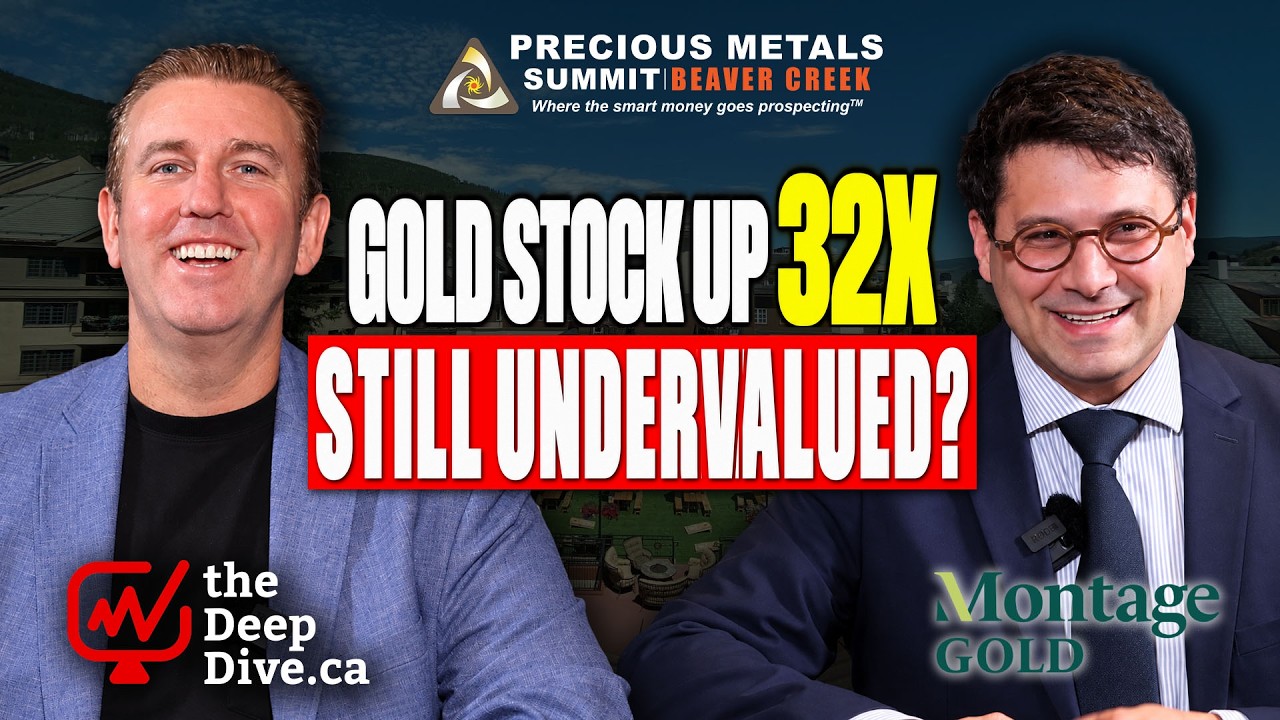
Interviewed by The Deep Dive at the Beaver Creek Precious Metals Summit, Montage Gold CEO Martino De Ciccio made the case that Montage's roughly 32X share price gain since he first stepped in is less a story about a lucky gold bet and more a story about disciplined asset selection, capital structure, and sequencing.
## How Montage came together
De Ciccio says the starting point was securing the right backers — the Lundin family, who wanted to build an African gold business. Scanning Africa in late 2023, with the market still not turned and many projects available, the team found Montage: an asset he describes as under the radar, with potential for at least 5 to 10 million ounces, a path to around 400,000 ounces per year, and the lowest-cost profile in a country they knew well.
They jumped in during February 2024. According to De Ciccio, the company then secured permits, secured funding, built senior ability within the team, re-engineered the existing study, and launched construction — all within about six months of taking over. At the time of recording, he said Montage was in the final stretch to producing gold. (The video description notes Montage achieved its first gold pour at Koné on September 26, 2026, after the interview was recorded.)
## Protecting the capital structure
De Ciccio attributes much of the share price performance not just to asset selection but to protecting the capital structure. He says Montage funded Koné with over 90% leverage on the business, keeping the equity cap table tight. That, he argues, means every asset added to the portfolio since — at very low dilution — benefits existing shareholders. He cites Didievi (referred to as "DGV" in the interview) as having cost only about 8% dilution, and Wendé as having been acquired without issuing a single share, simply through the regular granting process.
## Grade is not everything
A recurring theme in the interview: high grades alone don't make a mine. De Ciccio, who says he has been in the space for 20 years, notes he spent the first 15 being told "grade is king," only to repeatedly examine good-grade deposits whose economics didn't work. What matters, he argues, is the full equation: strip ratio, metallurgy, infrastructure, and more.
Koné is his example. He describes it as low grade but low strip, with port access, a sealed highway 20 kilometers from site, and a high-voltage power line also 20 kilometers away. In his framing, having power, water, and people nearby means a project can get off the ground far faster than one requiring new infrastructure from scratch. He points to the same pattern at North Isle, where he was a long-time director — a company that went from a $5 million market cap at 2 to 5 cents to roughly $1.5 billion, with characteristics he compares to Koné: low grade, low strip, and byproducts that change the economics.
## The valuation debate: what the market is and isn't pricing
The host raised the obvious question — Montage was valued around $8 billion while still pre-production. De Ciccio's response: don't read the share price chart in isolation, because the share price has been relatively flat over the last two years while the market cap grew. On his preferred lens — consensus free cash flow multiples for next year and beyond — he says Montage trades at high double digits while established producers sit in the 5 to 10x range. That gap, he argues, means "there's still a re-rate coming just by getting Koné into production" — a claim from the speaker, not a forecast.
What the market is not yet pricing, in his view, is portfolio growth:
- **Koné has gotten bigger and better.** The resource grew from 5 to 8 million ounces, with newly added ounces at roughly 85% higher average grades. He says the company is targeting production profiles of 350,000 to 400,000 ounces per year for at least 10 years, with a new mine plan due in late Q1 next year. - **Didievi is growing fast.** The last published figure was 1 million ounces at 2.5 g/t from June of the prior year; since then about 100,000 meters of drilling has gone in, and the company aims to fast-track the asset toward construction. - **Wendé already has work behind it.** Held for only six months, it has seen about 70,000 meters of prior drilling, with a maiden resource expected next year. - **Mauritania is next.** The company has secured a similar land package there and is starting drilling in Q4 of this year with 15,000 meters.
## The optionality argument
De Ciccio's advice for pricing a stock like Montage: run a DCF on Koné, add the upside you believe, calculate a potential share price — but then value the remaining optionality. That optionality, in his telling, is an entrepreneurial management team with a build and exploration team that host-country governments regard well, which is why Montage keeps getting more permits in Côte d'Ivoire and attracted new ground in Mauritania. He says the company would prefer to source its next project organically rather than chase acquisitions, given how much is already on its plate.
## The takeaway for investors
The investment case De Ciccio lays out rests on three legs: a funded, near-production flagship (Koné) that should re-rate on free cash flow multiples alone; a growth pipeline (Didievi, Wendé, Mauritania) acquired with minimal dilution that he says the market is not pricing; and a management track record of converting overlooked assets into value. The counterweights he acknowledges implicitly are the rich absolute valuation ($8 billion pre-production), the stretched free cash flow multiple versus producers, and the fact that the growth thesis now depends on executing across multiple assets at once. As always, these are the speaker's claims, not recommendations.
Generated by Pixys from the source video below. Not investment advice.