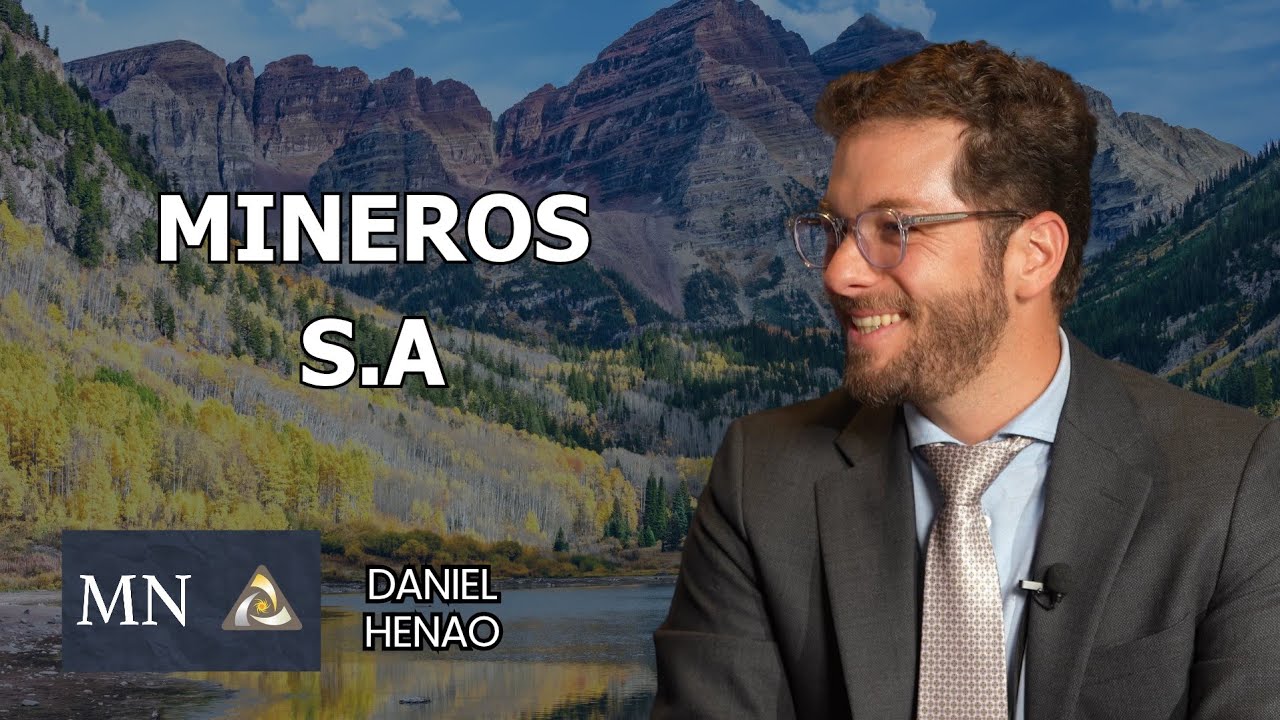
Mineros CEO Maps a Processing-Led Path to 500,000 Ounces by 2030
CEO Daniel Henao says Mineros S.A. can more than double output to roughly 500,000 ounces by 2030, starting with a Nicaraguan processing expansion and the Porvenir project, then growth in Colombia and Chile. He says the company is beating raised guidance while paying dividends and buying back shares.
Investor angle
The near-term story at Mineros is execution, not discovery. Within about two years, Henao sees the company moving from a 220,000-240,000-ounce guidance base toward a roughly 300,000-ounce Nicaraguan platform: the $25 million expansion to 2,500 tpd is underway, an owned idle mill could lift throughput to about 3,500 tpd (permits already run to 4,000 tpd) as early as next year, and Porvenir adds around 70,000 gold-equivalent ounces if a construction decision follows the last permits. Watch list: full-year Nicaragua output versus the raised 150,000-plus target, the second-expansion decision, Porvenir's forestry and water permits, Colombia's growth plan for the Nechi operation, and the Chilean PEA due early next year. The $10 million paid for the 23-million-ounce Tolima project, with $60 million contingent on permitting, is a small outlay for a large resource — but it stays dormant until community consent arrives. Per Henao, dividends and buybacks continue while growth is funded.
Mineros S.A. is a 50-year-old gold producer whose two cornerstone assets — one in Nicaragua, one in Colombia — have been in production for over a century. Speaking with Mining Network at the Precious Metals Summit, President and CEO Daniel Henao described the company as a turnaround in progress: profitable through every cycle he could point to, paying dividends for decades, but historically held back by operational bottlenecks that the current owners are clearing. The headline of the interview is a production target of about 500,000 ounces by 2030, which Henao called more than double current output; the host framed today's guidance at 220,000 to 240,000 ounces with strong cash flow behind it.
## Nicaragua: attacking the processing bottleneck
Nicaragua is the larger platform, and its constraint was never geology. "Gold is not the issue in Nicaragua. It's really processing," Henao said. Feed from two producing underground mines, plus ore bought from artisanal miners, runs through the company's Hemco plant, which for years capped what the business could produce.
Mineros is deploying about $25 million to lift plant throughput by 40%, from 1,800 to 2,500 tons per day (tpd — the volume of ore a plant can treat daily). Henao expects the expansion, combined with improved recoveries, to add roughly 30,000 to 40,000 ounces. He said the platform produced about 75,000 ounces in the first half of the year, that silver revenue rose 500% versus the prior-year half, and that management is working to beat a raised full-year target above 150,000 ounces.
A second step could follow quickly. The company already owns an idle 1,000-tpd mill it bought a few years ago, and permits extend to 4,000 tpd. Installing it — taking capacity to roughly 3,500 tpd — "could very likely be the program for next year," Henao said.
## The Bonanza partnership: a royalty that doubles as an exploration map
Much of Hemco's remaining ore comes from artisanal miners working under the Bonanza Mining Partnership, which Henao described as a royalty-like instrument: Mineros buys the mineral at about 45% of spot. He argued the model strengthens the social license — the community acceptance a mine needs to operate — and produces a less obvious benefit. Because Mineros tracks where each purchase originates, artisanal deliveries act as a steady stream of exploration data from the company's own concessions. That helped justify the largest drilling program in the property's history, about 85 kilometers, run with owned rigs at roughly $100 per meter — about a quarter of what peers pay, per Henao. The district has produced about 8 million ounces historically, and he argued its real potential is still poorly understood.
## Porvenir: a second engine backed by a pre-feasibility study
Immediately southwest of the producing mines sits Porvenir. An updated pre-feasibility study (PFS — an engineering and economics study that tests whether a project can be built profitably) shows a 38% internal rate of return (IRR — the annualized return a project is expected to generate) on a $200 million investment, at a gold price assumption the discussion placed at or below current market prices.
Permitting is far along: processing, mining and tailings permits are in hand, with forestry and water-disposal permits still outstanding. Site preparation has started, and Henao said a construction decision could come as soon as the remaining permits arrive. Phase one is framed at roughly 70,000 gold-equivalent ounces per year over an initial nine years, with the plant designed to double from 2,000 to 4,000 tpd as satellite deposits are drilled.
## Colombia: more ounces from an old mine, plus a large acquisition
The Colombian operation, built around the Nechi complex, has recently produced 80,000 to 90,000 ounces per year against about 2.2 million ounces of resources. Henao called that imbalance illogical and said a growth strategy — additional permits, added infrastructure, possibly around 40% more production — will be presented to the market soon, in what he described as an increasingly supportive political environment.
Then there is Tolima, the former AngloGold Ashanti project Mineros acquired. Henao sized it at 23 million ounces in a porphyry-style system (porphyries are large mineralized bodies typically suited to large-scale mining), including 5 million indicated ounces (resources estimated with enough confidence to support mine planning), open at depth and along strike in both directions. The terms were modest: $10 million paid up front and a $60 million contingent payment due only if the project is permitted. The barrier, he stressed, is social rather than technical. His stated approach is to plan a mine well below a million ounces per year and to build community consent through mechanisms such as paying income tax in kind via infrastructure — the company is building a school for 2,000 children near its Colombian mines.
## Chile: the earlier-stage leg
Mineros bought a Chilean project from Pan American Silver late last year, starting from 2.5 million ounces in a district Henao said is surrounded by producing mines. A preliminary economic assessment (PEA — an early, lower-confidence economic study) is planned for early next year, with a ballpark of 100,000 to 150,000 ounces, starting with oxide mineralization in an approach he compared to neighboring projects.
## What an investor should weigh
Henao's roadmap adds up to roughly 200,000 ounces from the Hemco system plus 70,000 or more from Porvenir — approaching 300,000 ounces in Nicaragua alone — before counting Colombian growth, the Chilean PEA and Tolima. Alongside growth, he pointed to dividends, buybacks, a bullion policy in development, inclusion in major indexes, and a share price he said has moved from about 50-60 cents to $10.
The caveats sit in the timeline. Every leg beyond the current expansion depends on permits, construction decisions and, in Tolima's case, community consent that previously stopped a major miner. The verifiable claims are the near-term ones: full-year Nicaragua output against a raised target, the second-expansion decision, Porvenir's remaining permits, Colombia's growth plan, and the Chilean PEA.
Generated by Pixys from the source video below. Not investment advice.