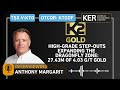
K2 Gold Step-Out Hits 27m of 4 g/t at Dragonfly, Hints at Parallel Structures on the Eastside Trend
K2 Gold's second drill release from the Mojave Project returned 27.4m of 4.08 g/t gold plus a 3m intercept at 17.5 g/t at the Dragonfly Zone — a 40m step-out that CEO Anthony Marguerite says points to multiple parallel stacked structures rather than a single ore shoot.
Investor angle
Watch the next batch of Dragonfly assays for continued confirmation of parallel stacked structures at depth — that is the framing that materially expands the resource potential. The Newmont target assays, roughly 3 km south of Dragonfly, will be the next test of regional scale on the Eastside Gold Trend.
K2 Gold's second drill release from its Mojave Project in California returned a 27.4-metre intercept grading 4.08 grams per tonne gold at the Dragonfly Zone, alongside a 3-metre hit of 17.5 g/t in the same hole — step-outs that the company says are reshaping how it thinks about the ore body.
The four holes released are positioned 40 metres from any previous drilling, making them "legitimate step-outs" that extend the known system rather than infill it, according to CEO Anthony Marguerite. Speaking on The KE Report, Marguerite said the geometry is coming into focus and could widen at depth.
The headline number — 27.4m of 4.08 g/t Au — is the long, well-mineralized intercept that gives the system its bulk. The shorter, higher-grade 3m at 17.5 g/t sits inside one of those broader intervals and is what the team is watching for structural clues. Marguerite said the 3m at 17.5 g/t could be the down-dip projection of surface mineralization the company reported in its earlier release at the tail end of August, where three Dragonfly holes hit gold running up to 0.9 g/t right at surface.
That surface-to-depth tie matters because it gives the team a single mineralized structure they can follow. The arsenic signature in the assays is, in Marguerite's words, "a strong geochemical tie" linking what the drills are seeing at depth to what was logged near surface.
The bigger thesis is structural. K2 Gold is no longer describing Dragonfly as one structure it is chasing — it is now framing it as multiple parallel stacked structures. Each new step-out continues to "prove that thesis," Marguerite said. That framing matters for tonnage: stacked parallel structures typically host more ounces per vertical metre than a single narrow shoot.
K2 characterizes the system as structurally controlled, sediment-hosted gold in an oxide environment. Oxide mineralization is the near-surface, weathered zone where gold is recoverable through standard milling or heap-leach circuits (a process that percolates cyanide solution through crushed ore to dissolve gold) without the higher processing costs of sulphide ore. Against that backdrop, oxide producers typically run at average head grades of 0.6 to 0.8 g/t, Marguerite noted. Hitting "multiple gram per tonne" material in an oxide setting is, in his view, what makes Mojave stand out.
The Dragonfly results sit inside the broader Eastside Gold Trend, which is itself only a slice of the Mojave Project. K2 is in the middle of a 14,000-metre first-phase drill program on that trend. As of the interview, the company had released results from seven holes, with about another 15 in the lab, and was not yet halfway through the program. Drill results are expected to come out on a roughly two-week cadence, "pad by pad," with most pads producing four holes.
The drill rig has already moved. Roughly 3 kilometres south of Dragonfly, the company is now turning the bit at the Newmont target area. No assays are back from Newmont yet, but Marguerite said the team is "happy with what we're seeing along the way" in the core and that every released hole so far has produced "decent intercepts."
For investors watching for scale, three signals from this release matter:
1. **Step-out distance and tenor**: the 27.4m of 4.08 g/t sits 40m from prior drilling, so the system is being grown, not just infilled, and at a grade that is well above what oxide peers typically mine. 2. **Stacked structures**: framing Dragonfly as multiple parallel sheets rather than a single structure raises the ceiling on what the trend could host if more stacks are confirmed by drilling. 3. **Drill cadence**: results roughly every two weeks, with about 15 holes still in the lab and a rig turning, means the news flow is the next several months of the story, not a one-off.
K2 Gold is listed on the TSX Venture Exchange under the symbol KTO, on the OTCQB under KTGF, and on the Frankfurt exchange under 3K. The interview was published September 10, 2026.
Generated by Pixys from the source video below. Not investment advice.