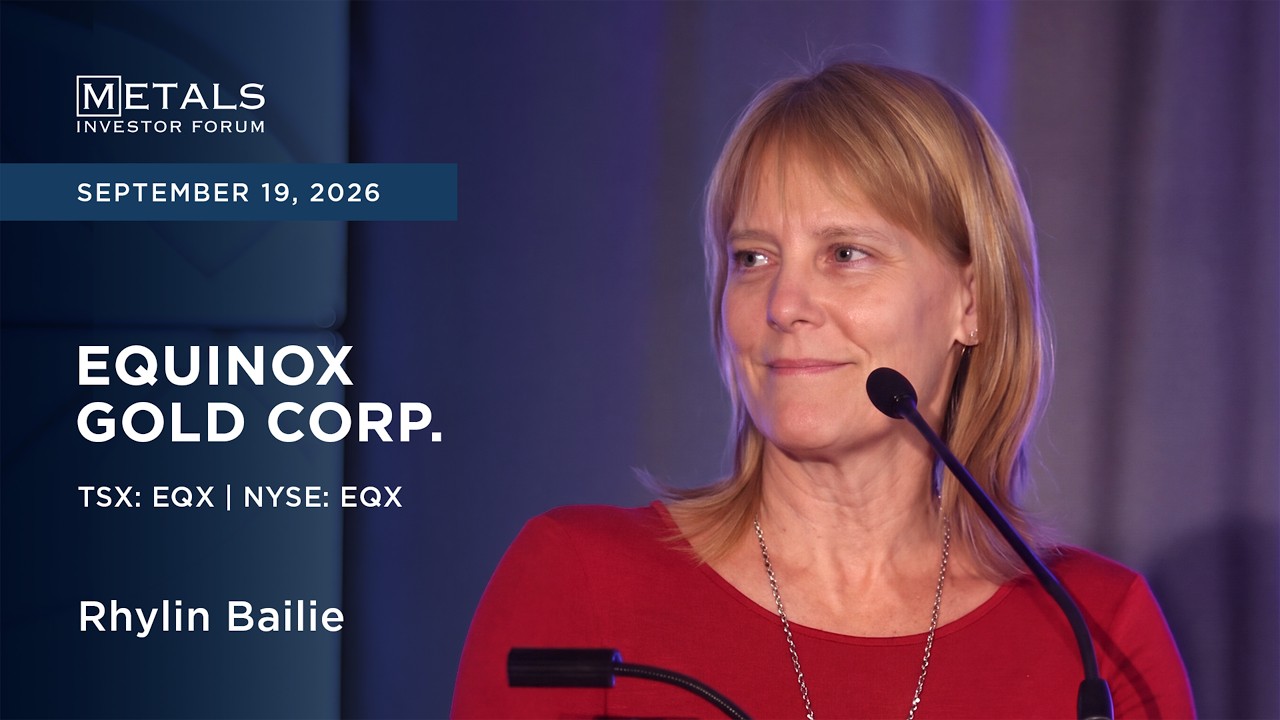
Equinox Gold Orla Merger Pushes Production Past 1.1 Million Ounces, With Growth Path to 1.9 Million
Equinox Gold's Rhylin Bailie laid out how the July 2026 Orla Mining merger vaults the company past 1.1 million ounces annually, with growth projects pushing toward 1.9 million ounces within five years, while management frames current valuation as below peer averages.
Investor angle
The two highest-conviction catalysts in this presentation are the upcoming Los Filos technical report update (the existing technical report reflects $1,450 gold economics vs. a new report at higher prices) and the U.S. growth ramp from Mesquite's 75,000 ounces today to 400,000+ ounces per year once Railroad (2028) and Castle Mountain (post-2027) reach production. Combined with a debt-free balance sheet, initiated dividend, and management's stated valuation targets (0.9x → 1.4x NAV, $17,000 → $30,000+ EV/oz), the setup is a clear "catch-up to peers" thesis. The main risk to verify is unit economics — Bailie did not address AISC (All-In Sustaining Cost) at the asset level in this presentation.
Equinox Gold's Rhylin Bailie used the Metals Investor Forum in Vancouver to walk investors through what the July 2026 merger with Orla Mining means for the production base — and what the next several years of growth projects could deliver on top of it.
The Orla deal closed in July 2026 and brought a third Canadian mine into the portfolio (Musselwhite), pushing Equinox Gold past the 1.1 million ounce mark on an annualized basis. The company is now the second-largest Canadian gold producer behind Agnico Eagle, with capacity for roughly 685,000 ounces per year from its three cornerstone Canadian mines.
## The Canadian Cornerstone
Greenstone is the centerpiece. Bailie said the mine is on track to produce around 260,000 ounces this year, with a long-term profile of more than 320,000 ounces per year for the next 10 years on a 14-year reserve life. She flagged "a very large underground deposit that isn't factored into the current mine life" and a large land package with exploration upside, suggesting Greenstone could operate for decades.
Musselwhite, the new mine from the Orla transaction, has produced more than 6 million ounces over 28 years. Bailie said growth potential at the asset is something she doesn't think "the market truly appreciates."
Valentine in Newfoundland poured first gold in September 2025 and is still ramping. Guidance for 2026 is 145,000 ounces; with the phase two expansion underway, the mine should produce closer to 225,000 ounces annually out to 2036, with further exploration upside.
## U.S. Growth: From 75,000 to 400,000+ Ounces
The U.S. portfolio is where the next leg of growth lives. Mesquite is currently the only producing asset at around 75,000 ounces this year. Two growth projects sit behind it:
- **Railroad**, in Nevada, where construction started in August 2026, is expected to add more than 100,000 ounces per year when it reaches production in 2028. - **Castle Mountain**, in California, where construction is slated to begin in the second half of next year, should add more than 200,000 ounces per year.
Combined, U.S. production is targeted to grow from 75,000 ounces today to more than 400,000 ounces per year. Stacked on top of the Canadian mines, Bailie said Equinox is "looking at nearly 1.2 million ounces of gold per year coming from just Canada and the USA."
## Mexico: The Los Filos Catalyst
In Mexico, Camino Rojo is producing around 115,000 ounces per year with expansion potential to 200,000+ ounces from an underground deposit. Los Filos, which Bailie called "the real gem in this group," is currently an open-pit heap leach operation. The company is working on an expansion that would add a carbon-in-leach (CIL) plant to process higher-grade underground ore. With more than 13 million ounces of M&I resources and reserves, the deposit supports at least a 15-year mine life at expanded production of close to 300,000 ounces per year.
The catalyst, Bailie argued, is the updated technical report. The current report dates to 2022, when gold was at $1,450. With gold prices significantly higher, the company is preparing a new mine plan that "could significantly increase annual production." She said analysts are giving Los Filos "almost zero value" today, framing the report's release as the next major re-rating event.
## Nicaragua
The Nicaragua complex came in through the Caliber Mining merger and produces around 235,000 ounces per year. Bailie described it as "a great little cash flow engine."
## The Capital Structure Reset
Bailie spent time on the balance sheet reset. The company sold all of its Brazil mines in January 2026 and used the proceeds to pay off more than $1 billion in debt. Equinox Gold is now focused entirely on North America, with 75% of net asset value (NAV) and 70% of production coming from Canada and the U.S.
Shareholder returns began this year: a share buyback program is underway, the first dividend was paid in March 2026, and the dividend was raised 50% in August. Annualized, the dividend currently equates to roughly 0.9 cents per share.
## The Valuation Argument
The thesis Bailie laid out is a valuation catch-up story. She said Equinox has nearly doubled production — from 620,000 ounces in 2024 to more than 1.1 million ounces today, with a path to 1.9 million ounces in roughly five years — but the stock hasn't reflected it because there has been "so much change" that "the market hasn't really kept up."
Her targets:
- NAV multiple: from the current ~0.9x to 1.4x - EV per ounce of production: from ~$17,000 to more than $30,000
She argued the company has the metrics to deliver: long-life mines in tier-one jurisdictions, an unmatched organic growth profile (800,000 ounces of growth from projects already in hand), a debt-free balance sheet with self-funding flexibility, and an integrated team across the recent mergers.
## Pixys 12 Criteria Lens
Through the Pixys 12 criteria lens, the presentation speaks most directly to **geographic quality**, **production growth**, **balance sheet**, and **capital return**. Jurisdictional mix is now North America-only, with Canada and the U.S. carrying the bulk of value. Growth is unusually visible — most of the next 800,000 ounces is already in the permitting or construction pipeline, not greenfield exploration. Debt has been retired. A dividend and buyback have been initiated.
The areas the video does not address in depth: cost structure (AISC — All-In Sustaining Cost, what it really costs to produce an ounce), reserve quality by asset, exploration budgets, and permitting timelines for the Los Filos expansion. Those remain open questions for due diligence.
Generated by Pixys from the source video below. Not investment advice.