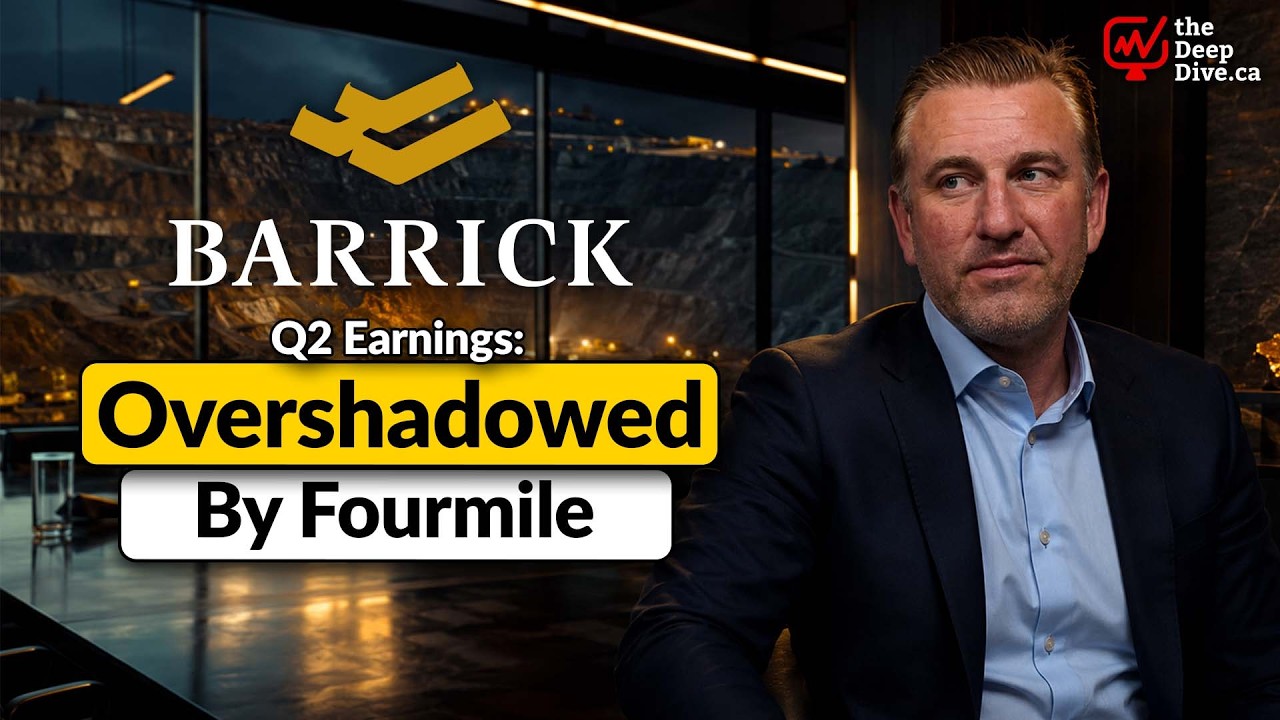
Barrick's Q2 2026: Operations Beat, But Cash Conversion Is the Story
Barrick's Q2 2026 beat operationally — gold production above guidance, costs inside — but attributable free cash flow collapsed to $141 million against $1.5 billion in shareholder returns, while the market fixated on the contested Newmont Nevada deal and pushed the stock down.
Investor angle
The Q2 2026 print sets up a clear test for the Pixys 12 criteria on cash conversion and capital allocation discipline: Barrick beat on ounces but funded $1.5 billion in shareholder returns out of $141 million of free cash flow, and the Lumwana CapEx 'cut' is a project deferral, not thrift. The Nevada deal adds valuation opacity because the key asset (Four Mile) sits behind a conceptual PEA with no technical report. Watch the second-half free-cash-flow trajectory and the Four Mile technical disclosure before treating the recent share-price weakness as a buying opportunity.
Barrick Mining (B) put up its strongest operational quarter in years in Q2 2026, yet the share price moved on everything except operations. The host of The Deep Dive argues the quarter was a financial miss even as the mine performance landed above guidance, and that the real driver of the stock's slide was a contested corporate reorganization, not the gold and copper numbers.
## The operational beat
Gold production hit 796,000 ounces, up 11% from Q1's 719,000 and above Barrick's own guide of 730,000 to 770,000. The host credits Loulo-Gounkoto for ramping ahead of schedule, Pueblo Viejo for recovering faster than expected from a Q1 shutdown, Cortez for setting a record on underground tons, and Gold Rush for continuing to climb. Copper production came in at 56,000 tons, up 14% sequentially.
Costs went the wrong way, as they did across the sector. Total cash costs were $1,426 an ounce, up 7%, and all-in sustaining costs (AISC — what it really costs to produce an ounce) were $1,866, up 9%. The host flags that $1,866 is the highest in the senior group — above Agnico Eagle at $1,459, Newmont at $1,621, and Kinross at $1,821. Against guidance, however, Barrick is fine: six-month cash costs are averaging about $1,379 against a $1,330 to $1,470 range, and AISC is around $1,791 against $1,760 to $1,950, both under the midpoint.
Copper is the less comfortable line. C1 cash costs are running $2.52 a pound against a $2.20 to $2.45 guide, and copper AISC is $3.82 against $3.45 to $3.75 — both above the top end. The host notes how carefully management framed it: "We manage costs well, and our gold costs are relatively low."
## The financial miss
Revenue was $5.3 billion, up a touch from Q1's $5.2 billion — boring on its own until you remember every other senior fell sequentially. Net earnings were $1.2 billion, or $0.73 a share, down from $1.6 billion and $0.96. Adjusted earnings were $1.4 billion, or $0.82, against $1.7 billion and $0.98 the prior quarter. Adjusted EBITDA totaled $2.6 billion against $2.8 billion, with margins slipping from 66% to 60%. Realized pricing of $4,417 an ounce was down 8% from $4,823 in Q1.
The number that mattered was attributable free cash flow: $141 million, down from $1.2 billion in Q1 — an 88% collapse in a single quarter, and down 33% year-over-year on a gold price that is 34% higher.
Management offered two explanations. First, Q2 is typically the seasonal low for free cash flow because of the timing of annual tax and interest payments. Second, the quarter absorbed a one-time $400 million payment to the government of Mali — royalties, penalties, and interest — after Mali applied its 2023 mining code retroactively to 2024 and 2025 as a condition to get the site operational again. The host flags the phrasing carefully: the payment happens one time per year going forward, not as a true non-recurring item.
Against that $141 million of free cash flow, Barrick returned $1.5 billion to shareholders — a $1.2 billion buyback plus $288 million in dividends. That is roughly 10.5 times the cash the business generated in the quarter, and the funding came out of the balance sheet. Cash dropped from $7.1 billion to roughly $6 billion, and the net cash position fell from $2.4 billion to $1.25 billion. Under new leadership since October 2025, Barrick has returned $3 billion in dividends and buybacks across three quarters — more than double the prior five corresponding periods.
## Growth and CapEx
The growth news is constructive. Lumwana's mill expansion is on budget with first copper targeted for the end of Q1 2028. Four Mile has 20 rigs turning and starts decline development this quarter. Pueblo Viejo's resettlement is at 95% acceptance. CapEx guidance came down from $4.2 billion to roughly $4 billion — but the host is unmoved: Barrick decided not to start building the Lumwana plant this year and cut the project's 2026 spend from $650 million to $475 million. A guidance cut driven by a project under review, he argues, is not the same thing as capital discipline.
Two softer items for the back half: Veladero was down two weeks on weather, and Porgera shut its plant entirely when the Whale Creek dam dried up. The host says guidance still looks achievable but "certainly not conservative."
## The deal that moved the stock
The share-price action came from the second release of the week — the end of the Barrick–Newmont Nevada war. Barrick vends a 38.5% stake in Four Mile into the joint venture; Newmont vends in its Mike and Fiberline assets, roughly 6.4 million ounces; Newmont pays Barrick $2 billion in cash within 30 days; every dispute is resolved; and Newmont consents to Barrick's North American IPO. Barrick values the whole package at around $4 billion.
The host highlights a moment from the call: CIBC analyst Anita Sahni pointed out that nobody can actually value Four Mile, because Barrick published a conceptual PEA and never filed a technical report behind it.
## The valuation split
On a roughly $67 billion enterprise value, Barrick trades 6.3 times EBITDA and 10.8 times street earnings — a 3% discount to Newmont, Agnico, and Kinross on EBITDA and a 14% discount on earnings, the second-cheapest senior in the group on both metrics. Free cash flow is the problem: 24.6 times FCF against a peer average of 14, a 74% premium. Agnico, the operational pass, screens at 22 times.
The host frames the bear case in a single line from JP Invest: $141 million of attributable free cash flow on $5.3 billion of revenue. The bull case from Neil Ringdahl: Barrick is undervalued now, most of the assets are good, and a company this cheap with assets this good does not stay independent forever. Both, the host argues, are describing the same company. The quarter says the operations are finally working; the share price says nobody trusts what is being built on top of them.
Generated by Pixys from the source video below. Not investment advice.