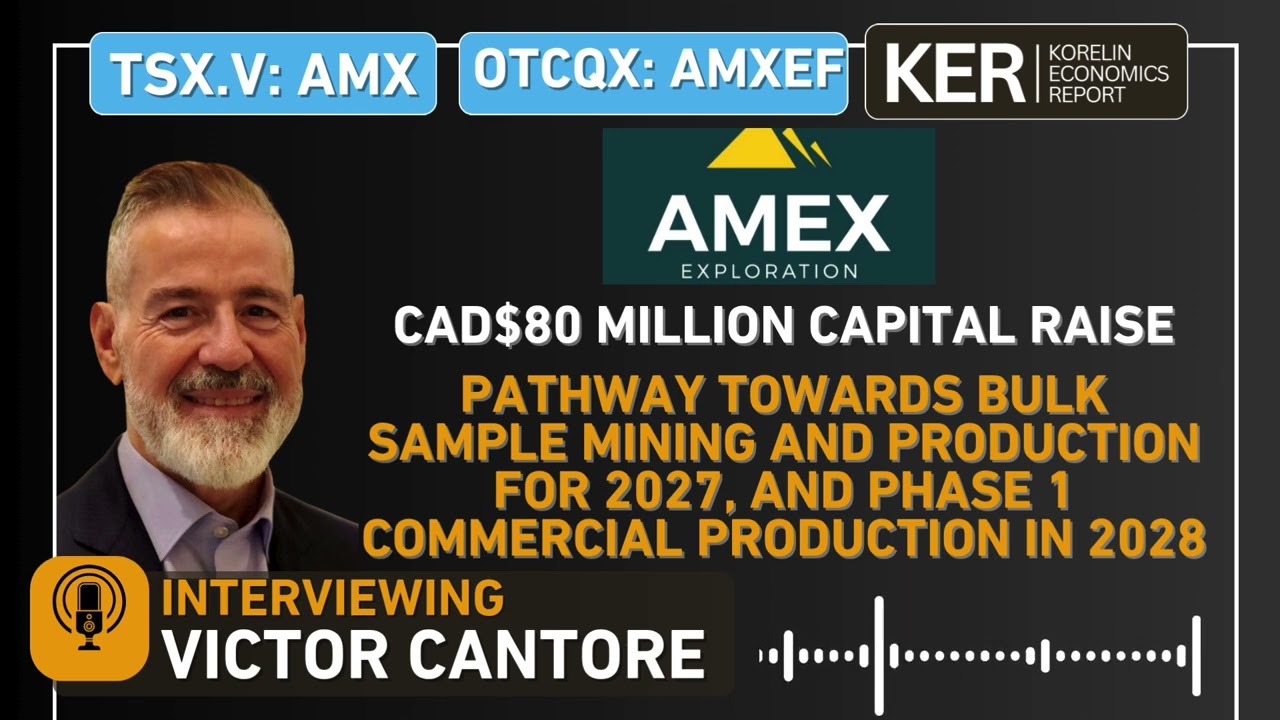
Amex Exploration: C$80M raise clears the path to first Perron gold in late 2027
CEO Victor Cantore says the completed C$80 million private placement, with Eldorado Gold maintaining its 27% stake, removes the last funding hurdle for a roughly C$50 million bulk sample at the Perron project in Quebec. He expects 23,000 to 28,000 ounces from it starting in the second half of 2027, funding a self-financed path to commercial production by mid-2028.
Investor angle
Amex's bulk sample is unusual: it is not a pilot pit at the edge of the property but the literal front end of the planned mine — same portal, same decline, same ramp, extended deeper for commercial production. If Cantore's numbers hold, the company generates roughly C$125 million of revenue from a permitted 40,000-tonne sample against about C$50 million of spending, most of which counts toward Phase 1 capital anyway. That structure pulls revenue forward to late 2027, funds Phase 1 and the Phase 2 mill from cash flow, and underwrites a roughly 100,000-metre drill program without new dilution. The valuation case is entirely management's: near-$500 million a year in pre-tax free cash flow at $3,500 gold versus a roughly $600 million market cap, with 147,000 ounces a year at about $910 AISC and commercial production in mid-2028 as the claims to verify against the feasibility study. Execution risk is the remaining variable, and Cantore's promised weekly-to-biweekly milestone news flow should reveal quickly whether the plan is tracking.
Amex Exploration closed the one piece its plan was missing: money. On June 18 the company completed an oversubscribed private placement (a direct share sale to investors) for C$80 million — four times its original C$20 million target — and its largest backer, Eldorado Gold, maintained its 27% stake. CEO Victor Cantore told The KE Report that financing was the last open question ahead of a bulk sample at the Perron Gold Project in Quebec, with key permits already in hand and first production from the sample targeted for the second half of 2027. According to the episode description, the company will also change its name to Amex Gold Mining Inc. in early July to reflect the shift from explorer to developer and producer.
## The bulk sample is the mine's front end, not a side project
A bulk sample is a limited test-mining campaign: the company mines real ore, processes it, and checks actual grades and recoveries against the assumptions in its feasibility study (the detailed engineering and economics document behind a mine decision). At Perron, Cantore described a permitted 40,000-tonne sample expected to yield 23,000 to 28,000 ounces of gold, with ore trucked to a nearby plant under a toll milling arrangement — paying someone else's mill to process it instead of building one.
He put the capital cost at roughly C$50 million and said about two-thirds of it — the portal, decline, and ramp — counts toward Phase 1 mine capital anyway, leaving about C$30 million of net new spending against the C$194 million Phase 1 capital budget he cited. The sample's revenue, which he estimated at about C$125 million, more than covers the outlay. He also stressed that none of the infrastructure is throwaway: the bulk sample uses the same portal, decline, and ramp planned for commercial production, and extending the ramp deeper is the only change once full production permitting is secured.
## The economics Cantore cites
All figures in this section come from Cantore, quoting the company's feasibility study. Phase 1 targets commercial production — defined as mining 660 tonnes per day for three consecutive months within a planned rate of about 1,100 tonnes per day — in mid-2028. The study outlines five years at about 147,000 ounces per year, an AISC (All-In Sustaining Cost — what it really costs to produce an ounce, including sustaining spending) of around $910, and fully diluted grades just over 12 grams per tonne in the categories the mine plan targets.
At $3,500 gold, he said the study implies almost $2.5 billion of pre-tax free cash flow over those five years — about $500 million a year — an IRR (internal rate of return, the project's annualized return) of 114%, and a post-tax NPV (net present value — future cash flows discounted into today's dollars) of $1.1 billion, against a market capitalization he put near $600 million. On that arithmetic he argued the project is effectively paid for before commercial production even starts: about $220 million arrives during the build from bulk-sample revenue and early production, which he said compresses payback to roughly half a year.
These are management's figures, presented at a specific gold price, and the interview offers no independent check on them. They are worth testing against the study itself.
## A self-financed two-phase plan
Phase 1 is toll milling for the first years of production. Phase 2 is a larger operation with a processing plant built on site. Cantore's central claim is that the first year of Phase 1 output should generate enough free cash flow to fund the entire Phase 2 build-out, so the company does not need to return to the market, and that the same revenues could support tens of millions of dollars of exploration per year without dilution. He named the remaining risk himself: "You still have the execution risk. You've got to go do it."
## Exploration keeps running on both sides of the border
The financing also underwrites a large drill program: close to 100,000 metres planned for 2026, with three drills on the Quebec side and two in Ontario, and more drills awaiting permits. Cantore said the land package has grown from 45.6 to 570 square kilometres along the Abitibi Greenstone Belt, with roughly 70 kilometres of strike, and that the Ontario ground is a potential mirror image of the Quebec side across a pluton (a mass of igneous rock that can push mineralization to either side of it). His argument: other deformation zones in the Abitibi host 10 to 20 million ounces, so the trend he is drilling should hold more than the 2.3 million ounces outlined to date, and every zone remains open in at least one direction.
## What to watch next
Cantore promised milestone updates every one to two weeks: the selected mining contractor and contract, the portal blast, and the power connection — about $8 million to reach hydroelectricity at roughly 5.5 Canadian cents per kilowatt-hour for 4 megawatts. Host Shad Markowitz placed the company on the second leg of the Lassonde curve (the stage pattern in which junior mining valuations re-rate as a project moves from discovery toward production), and Cantore closed with his valuation case: a company generating nearly $500 million a year in pre-tax free cash flow should not trade at $600 million, and he believes it should trade at two to three times that before counting exploration upside. That case rests on his own numbers, but the promised cadence of milestones should show quickly whether the plan is tracking.
Generated by Pixys from the source video below. Not investment advice.